How to Develop a Successful Nonprofit Fundraising Strategy




It’s the end of the quarter. You’re scrambling to hit a revenue goal, your biggest corporate sponsor hasn’t renewed, and your team is burned out from launching three separate “urgent” campaigns in the last two months. You feel stuck in a constant cycle of putting out fires, with no time to think about next year, let alone three years from now.
This reactive loop is a direct symptom of operating without a clear fundraising strategy. Your nonprofit fundraising strategy serves as your organization’s blueprint for recruiting new supporters, engaging existing ones, and expanding your influence—all with the goal of funding your mission more efficiently and predictably.
That’s why developing a strategic fundraising plan is necessary. It’s the key to breaking the cycle. Whether you’re looking to refine your existing approach or design a new plan from scratch, this guide will steer you through the process of building a fundraising strategy.
Keep in mind that successfully executing a powerful fundraising strategy requires a strong partnership between your organization’s marketing and fundraising staff. Commit to eliminating departmental silos so that everyone is on the same page and all team members contribute their unique skills to help you succeed. With that, let’s get started.

Nonprofit fundraising strategy: FAQs
What is a fundraising strategy?
A fundraising strategy is the plan or roadmap your nonprofit uses to organize its fundraising efforts throughout the year. It provides a cohesive structure and blueprint to maintain fundraising momentum, with clearly defined campaigns, team roles, deadlines, and benchmarks to hit.
Despite the critical benefits of a fundraising strategy, almost half of nonprofits lack a guiding plan to empower growth and future success. As we’ll discuss in the next section, this is a critical oversight that nonprofits must consider when building their fundraising calendars.
Why is a nonprofit fundraising strategy so important?
You likely understand the general benefits of planning, but why is creating a fundraising plan so crucial for your nonprofit? A well-developed fundraising strategy will accomplish the following:
- It will provide your team with a guiding blueprint for making informed decisions. Whenever there’s uncertainty in your decision-making process, your team members can turn to your fundraising strategy for clarification and guidance.
- It will help you build upon past successes. Your fundraising strategy will consider your past successes and opportunities to help your organization grow year after year.
- It will provide accountability. A fundraising strategy helps keep you on track by offering deadlines and benchmarks to hit throughout the year.
Ultimately, a well-rounded fundraising strategy will help your organization raise more and fuel long-term support. But what does a fundraising strategy look like in practice?
What are the 6 key elements of a fundraising strategy?
Although every nonprofit is unique, and its fundraising plan will be as well, there are several key elements that most nonprofits should include in their fundraising strategies to achieve their goals. That’s because all nonprofits share similar goals, including connecting with more donors, enhancing their donor retention rates, and forming strategic, sustainable partnerships with other organizations.
Therefore, your fundraising strategy should address six vital components. We’ll introduce these elements here and then provide actionable steps for incorporating each of them into your fundraising strategy.

1. Donor stewardship
Donor stewardship is the process of cultivating strong relationships with supporters after they make a donation to your cause. When you build deeper relationships with them, you can turn one-time donors into ongoing—sometimes lifetime—supporters of your mission. Donor stewardship also helps boost your donor retention rate, enabling you to earn more over time.
2. Major gifts
Your fundraising strategy should focus heavily on cultivating major gifts. Why? Studies show that 88% of total dollars raised come from only 12% of donors; these are your major donors. When you create a tailored plan to build relationships with them, you’ll earn more support for your mission.
3. Marketing
Your marketing plan describes how you will connect with your target audience and inform them of engagement opportunities. This involves recruiting new supporters and maintaining contact with existing donors. Pursuing a multi-channel marketing strategy—communicating via social media, email, direct mail, and other communication channels—will allow you to expand your reach and promote your cause to the broadest possible audience.
4. Online fundraising
No nonprofit fundraising plan is complete without an online fundraising strategy. According to Double the Donation’s fundraising statistics, 63% of donors in the U.S. and Canada prefer to donate online using a credit or debit card. Your fundraising strategy should address how you will connect with supporters online, which requires defining a digital marketing strategy, outlining your virtual event plans, and planning to send personalized online communications.
5. Events
Fundraising events engage supporters in person or online, offering a unique and exciting experience. Events such as 5Ks, Giving Day challenges, auctions, peer-to-peer fundraisers, and galas should play a significant role in your fundraising strategy.

6. Strategic partnerships
Partnerships between nonprofits and for-profit organizations are more common and impactful than ever before. Businesses are seeking more opportunities to expand their corporate philanthropy programs, thereby bolstering their own reputations while giving back to the community. Nonprofits benefit from a variety of corporate philanthropy programs, including event sponsorships, in-kind donations, and corporate matching gifts. Corporate partnerships are an effective yet often underutilized source of support for nonprofits.
So, how can you build a fundraising strategy that incorporates these six critical elements? Read on for a step-by-step guide to establishing a strong fundraising strategy.
10 steps to build your fundraising strategy
1. Evaluate your current fundraising strategy
Assess your current fundraising strategy, if you have one. If you don’t have a formal strategy, evaluate the strengths and weaknesses of your individual fundraising efforts and campaigns.
For example, you might find that your annual fundraising 5K is well-attended, but you have a hard time maintaining supporters’ attention in the aftermath. Or, you might determine that your email newsletter receives a lot of engagement, but you’re struggling to grow your social media following. Note these specifics and address them in your new fundraising strategy.
Also, review your fundraising metrics and data from previous campaigns. This information can give you a clearer picture of how your fundraising efforts have grown or changed over the years. Plus, you can identify trends or patterns that illustrate where you’re most successful and where there’s room for improvement.
2. Set goals
Set goals that are achievable given your current capacity. Consider your staff size and the time they have to devote to fundraising pursuits, your current budget, and your past fundraising campaign totals.
However, you should also set goals that are ambitious enough that they give your team something to strive for. You should always keep your focus on growing your organization, so make sure your goals are consistently higher than your past fundraising results.
3. Assess your software solutions
A modern fundraising strategy relies on powerful software solutions that consolidate fundraising into a centralized online system.
Assess your current fundraising toolkit and consider how your solutions work together to support your fundraising efforts. Are there any solutions or apps you’re missing or that you’d like to replace with a different system or provider?
Ensure you have access to these useful tools:
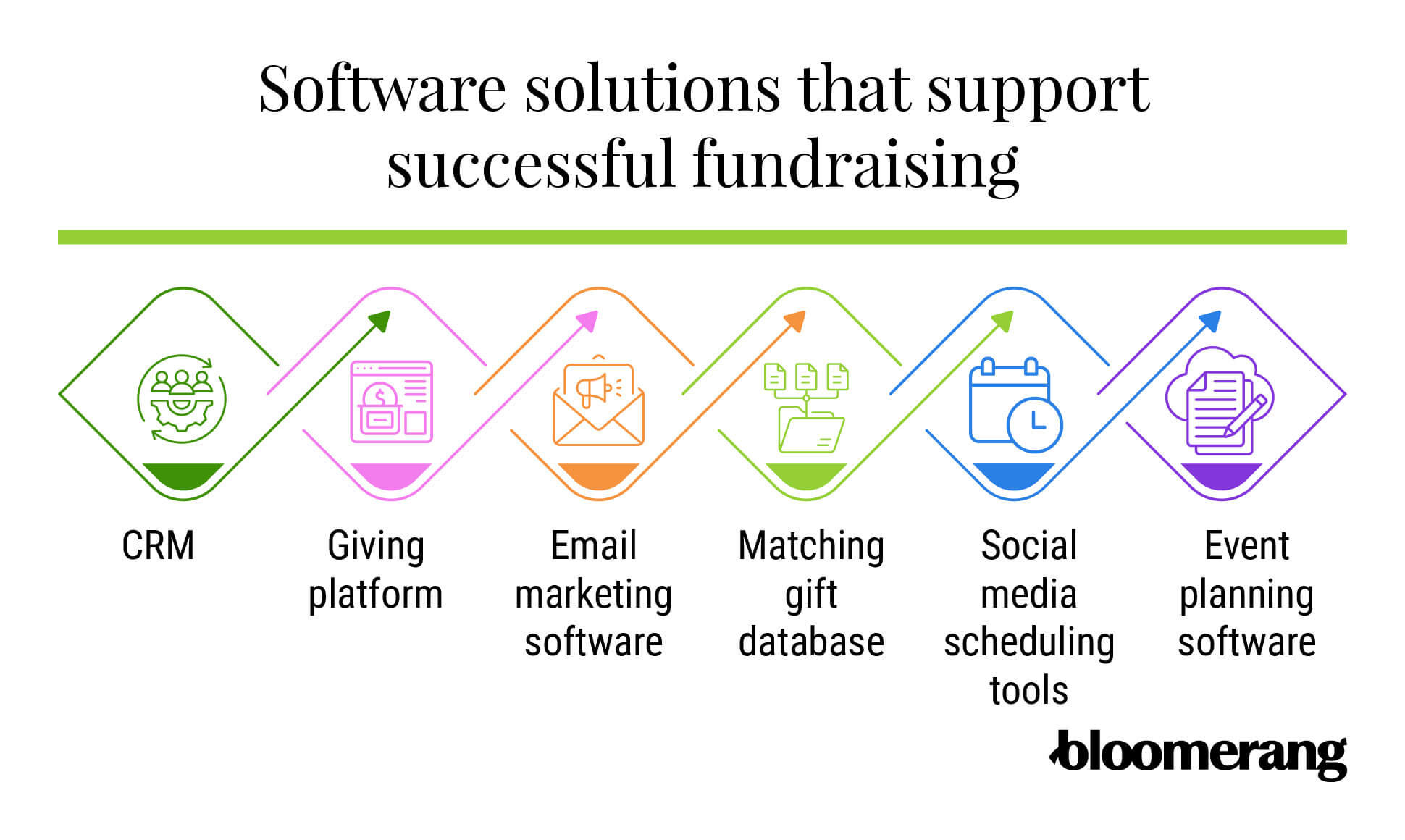
- CRM. Your nonprofit CRM helps you store and manage donor information within robust donor profiles. Powerful platforms like Bloomerang also allow you to create donor segments for more targeted research and communications, view donor engagement and generosity metrics per supporter, and track fundraising campaign progress.
- Giving platform. A giving platform or fundraising tool enables your nonprofit to create a branded online giving form and accept digital donations from supporters at any time, from anywhere. Solutions like Bloomerang Fundraising take this functionality a step further, with peer-to-peer fundraising, text-to-give, and auction planning built right into the core giving platform.
- Email marketing software. Use email marketing software to personalize donor outreach, thank donors for their contributions, and build relationships by offering donors more ways to get involved. Plus, you gain access to a variety of email metrics, such as open rates and click-through rates, that let you know how effectively your emails engage recipients.
- Matching gift database. A matching gift database helps you identify donors who are eligible for corporate matching gifts. In corporate matching gift programs, businesses match donations that their employees make to nonprofits and other charitable organizations. With a matching gift tool, you can follow up with match-eligible donors to remind them to apply for a match. And, you can even embed a matching gift search tool into your online donation form so donors can research their eligibility and apply for a match on the spot.
- Social media scheduling tools. Social media scheduling platforms help you generate an active social media presence. You can schedule posts in advance on platforms like Facebook, Twitter, and Instagram to ensure that you’re consistently appearing on followers’ feeds. Tools like Hootsuite and HubSpot are popular platforms that also integrate with a variety of social media platforms, project management tools, and CRMs.
- Event planning software. Planning fundraising events requires coordinating many moving parts, including the event schedule, volunteers, food, prizes, special guests, and more. Event planning software helps keep all event planning necessities under one roof so that your team stays on the same page throughout the process.
Remember: When it comes to fundraising, you will have to spend a little upfront in order to see fundraising success. If you’re lacking any of these crucial fundraising tools, it’s worth it to investigate your options and invest in a solution that can take your fundraising to a higher level. The investment will pay for itself when you start seeing steady fundraising growth.
Also, your fundraising solutions should integrate with one another. When your solutions are aligned, you can create a streamlined data entry process and seamlessly leverage data across platforms. This means you can pull the information from your CRM to construct email marketing campaigns, or use donor data to create an event invite list.
4. Determine your core fundraising initiatives
Your fundraising strategy should describe the core fundraising campaigns that you intend to host throughout the year and relevant details for each initiative, including:
- Type of fundraising campaign. Peer-to-peer fundraisers, auctions, galas, walk-a-thons, email marketing campaigns, giving days, bake sales — there are a plethora of initiatives you might pursue. Choose fundraising initiatives that have proven successful in the past or that you think your audience members will be most interested in. To predict popular fundraising events, use your past event data and information from your supporter profiles.
- Expected revenue from each initiative. Set a fundraising goal for every campaign based on your organization’s overall fundraising objectives for the year and your past success rates for each type of campaign. You may also set side objectives, such as a goal number of attendees.
- Approximately when each event will be hosted. Your fundraising plan should include an event calendar so that you have ample time to prepare for each event. Even if it’s just a rough timeline, having an idea of when you’ll host each fundraising initiative will ensure that your events are properly spaced out.
- Individuals involved in each campaign. Determine which staff members will lead each fundraising initiative, whether you need to form a committee for certain events, and whether the initiative will require volunteer or board member support.
Iron out the specifics so that every staff member is aware of their responsibilities in supporting your fundraising campaign. For example, let’s say you decide to host a shoe drive fundraiser. On top of listing the details above in your fundraising strategy, you may also want to outline which shoe fundraising provider you’ll work with (such as Funds2Orgs), where you’ll place collection bins or drop-off points, how you’ll market the fundraiser, and who will be in charge of each aspect of the event.
5. Conduct prospect research
Prospect research is the process of identifying prospective major or mid-tier donors that exhibit both a willingness to give to your cause and the capacity to do so.
Prospect research is especially helpful if your organization is planning any major fundraising campaigns as part of your fundraising plan, such as a capital campaign. You can identify the major donor prospects that will potentially contribute large amounts to your efforts.
Conducting prospect research involves using your CRM and external databases to identify prospects that exhibit philanthropic and wealth indicators. Let’s take a closer look at each of these types of indicators:

- Philanthropic indicators include past charitable giving to your nonprofit or similar organizations, political giving, and involvement as a volunteer or board member. These indicators measure the prospect’s propensity to give to your organization.
- Wealth indicators include real estate ownership, SEC holdings, and the size of past charitable gifts. These indicators show the capacity your prospects have to donate at a major gift level.
While you can take the DIY approach and look up public records for each prospect individually, it’s typically more efficient to use a dedicated prospect research database. These tools help conduct the heavy lifting when it comes to identifying prospects that exhibit wealth and philanthropic indicators. Plus, tools that integrate with your CRM can pull data right from your donor profiles, analyze trends and patterns, and pinpoint donors who are ready to give more.

6. Make giving easy
Your fundraising strategy should facilitate convenient, simple giving opportunities on an ongoing basis so that donors can contribute whenever they feel inspired.
Make giving easy with the help of a virtual fundraising platform. These solutions can support both ongoing fundraising and specific fundraising campaigns, such as peer-to-peer fundraisers. They allow you to create mobile-responsive online donation forms, manage peer-to-peer campaigns, track donors’ giving histories, and gather event donations.
Implement these additional strategies to make donating as easy as possible:
- Audit your website. Assess your current website user experience and how quickly visitors can access your donation page. Make sure you include a variety of calls to action on your website homepage that connect visitors to your online giving form.
- Streamline your giving page. Only ask for necessary information and eliminate any unneeded form fields, like those that ask for donors’ middle names.
- Include links to your donation form throughout your other marketing platforms. Link to your online giving page in your social media and email campaigns to keep giving front-of-mind for supporters and to make it easy for them to navigate directly to your donation page.
Making your online giving process simple and easy to use encourages donors to follow through on their gifts. Plus, when you offer recurring giving options on your donation page, you can gain access to reliable online support that can bolster your fundraising efforts during any low periods.
7. Create a donor stewardship process
As mentioned above, donor stewardship is crucial for building long-lasting donor relationships and boosting your donor retention rate. Create a donor stewardship process to ensure that you’re engaging with donors on an ongoing basis and regularly showing your appreciation.
Follow these steps to build your donor stewardship process:
- Create a communication cadence. Set guidelines for how often you’ll communicate with donors. For example, when communicating with a new donor, you might send one email in a welcome series every few days, and pepper in various volunteer opportunities or event invitations. This allows you to stay in touch with donors without overwhelming their inboxes.
- Assign roles and responsibilities. Your team members should be familiar with their roles and responsibilities in the donor stewardship process. For example, you might recruit some of your board members to meet with current or prospective major donors. Or, you might have some of your staff members set aside time to make donor phone calls each week.
- Personalize outreach. Use the information in your donor database to personalize your donor outreach. For instance, use donors’ preferred names and titles and reference their past engagement history in your email messages. You might thank them for their past donation of $300 or thank them for sharing one of your social media posts.
- Incorporate phone and Zoom calls and in-person meetings. Give donors the opportunity to speak one-on-one with your staff members or board members by calling them, inviting them to Zoom meetings, or meeting in person. This helps donors associate your organization with a friendly face and allows you to understand their motivations and interests.
- Prioritize appreciation efforts. Donors should feel appreciated and valued by your organization as individuals. Send handwritten thank-you notes, invite donors to appreciation galas, and give donors a shout-out on social media or in your email newsletter.
Your donor stewardship efforts should include descriptions and progress updates about the impact of donors’ gifts. Keep donors informed about the progress you’ve made with your projects and programs. Consider collecting thank-you messages from those who’ve benefited from your organization’s services in the past to show donors exactly who they’re helping.
8. Plan your marketing approach
To increase the success of your fundraising events and initiatives, you need to get the word out among your target audience members. As mentioned above, the best way to do this is to pursue a multichannel marketing strategy.
Your fundraising strategy should include your approach for growing your marketing outreach on the following channels:

- Social media. You don’t have to maintain an active social media presence on all platforms. Choose two or three platforms where you already have a strong presence and improve your outreach by creating an active posting schedule, interacting with supporters regularly, and designing campaigns that are tailored to each platform. For example, you might encourage supporters to use a unique hashtag on Twitter to discuss your latest event, or publish a series of Instagram posts that create a unified design when users visit your profile page.
- Email. Segment your email recipients based on shared characteristics to create personalized email content. For example, you might create segments for new, long-time, major, lapsed, and monthly donors. This allows you to speak to donors on a more personal level without having to draft completely unique messages for each individual.
- Your website. Your website is your online hub for engaging supporters. Design your website to facilitate streamlined giving opportunities and help promote your organization. It should be a useful resource to help supporters learn more about your mission.
- Direct mail. Letters and postcards help your organization stand out and offer a more personalized form of communication. That’s because you reach supporters with a tangible message and send a variety of different types of mail, such as branded laptop/water bottle stickers, handwritten letters, bumper stickers, and other small trinkets.
Your marketing strategy is an opportunity to not only help supporters learn more about your mission but for you to learn more about them as well. The more information you collect about your supporters, the better you can appeal to their interests and motivations using your marketing outreach.
9. Develop database hygiene procedures
Accurate data is a key component of many fundraising initiatives, from major donor stewardship to auction planning and marketing campaigns. Cleaning up your donor database from time to time ensures that you’re only using the most updated and accurate information when pursuing stewardship efforts or new marketing initiatives.
Adopt ongoing data hygiene practices such as:
- Regularly audit your database for inaccuracies.
- Eliminate errors, duplicate data, or outdated information.
- Create an ongoing data hygiene process so staff members know how to properly enter information and correct mistakes.
When your data is clean and accurate, you can improve your fundraising ROI, and rest assured that you’re reaching out to active supporters who are most interested in what you have to offer.
10. Identify and track key performance indicators
To consistently improve and evolve your fundraising strategy, choose and measure a variety of key performance indicators. A few effective metrics to track include:

- Donor retention rate
- Average gift size
- Email open and click-through rates
- Event attendance rate
- Social media follower growth
- Social media impressions/reach
- Donor lifetime value
- New donors acquired
If certain metrics aren’t performing as well as you thought they would, you can adjust your approach and test out new strategies.
You can use these metrics to create a transparent, well-rounded annual report, giving supporters and other stakeholders a deeper understanding of your organization’s current situation and plans for the future.
Where should you start when building a fundraising strategy? A fundraising expert explains.
Rachel Muir, CFRE weighs in on the first step to a successful fundraising strategy:
Ten steps can feel like a lot, especially if you’re a solo fundraiser or part of a small team.
Don’t try to build your entire fundraising strategy at once. Use this “Fundraising Year in Review” questionnaire to help you prioritize.
Start with the pieces that will give you the clearest direction and the quickest return.
In month one, focus on three things:
- Review your data. Look at where your revenue came from last year, which efforts performed best, your donor retention rate, and where you may be losing supporters.
- Set two or three specific goals. Choose realistic priorities, such as retaining more first-time donors, growing monthly giving, or securing five major donor visits. Avoid creating a wish list so long that everything becomes a priority.
- Create a simple 90-day action plan. Decide what you’ll do, who is responsible, when it will happen, and how you’ll measure success. Put those activities on the calendar now.
Your first plan doesn’t need to include a new event, a sophisticated major gifts program, seven donor journeys, and a shiny new software platform. Those can wait.
A fundraising strategy isn’t carved in stone. It’s a living roadmap you’ll test, refine, and strengthen over time. Start small, learn what works, and build from there. A simple plan your team can follow will outperform an ambitious one that gathers dust.
Free nonprofit fundraising strategy template
Ready to build a rough outline of your nonprofit fundraising strategy? Use this template to help get started.

Build a powerful fundraising strategy with Bloomerang
Our template is a great starting point for building your fundraising strategy, but you can take your plans to the next level with our advanced fundraising technology.
At Bloomerang, we’re tired of hearing that nonprofits should adapt to do more with less—more revenue generation, donor engagement, and sustained growth, all with dwindling resources. Instead, we empower nonprofits to do more with more—backed by the industry-leading unified giving platform, built for purpose.
Bloomerang’s fundraising tools allow nonprofits to maximize their strategies with features such as:
- Flexible donation options, including Google Pay, PayPal, Tap to Pay, Venmo, debit, credit, and ACH.
- AI-powered, automated donor prompts that help increase average gift size and recurring giving.
- Simplified text-to-give to enable donors to contribute via mobile device.
- Industry-leading fraud monitoring to keep payment information secure.
- Peer-to-peer fundraising to expand your donor base and engage dedicated supporters.
- Event hosting that simplifies ticketing, check-ins, and fundraising.
Watch this video to learn how our software enabled one organization to fundraise over $2 million in just four years.
Start planning your fundraising strategy today
Your fundraising strategy doesn’t have to be set in stone. You can update your plan throughout the year as you see fit, adapting to unexpected circumstances or new opportunities. Ensure your nonprofit’s team is on the same page whenever you have a strategy adjustment and update your documentation and timeline accordingly.
For more information about building a powerful nonprofit fundraising strategy, review these additional resources:
- The 12 best donor management software options for 2025. Looking to upgrade your donor management system? Here are 16 top options for growing nonprofits.
- Nonprofit strategic planning: your path to impactful growth. Your fundraising strategy is a crucial component of your organization’s overarching strategic plan. Create a well-rounded strategic plan with the help of this guide.
- Major gifts 101: what you need to know to raise more. Ready to take a more strategic approach to major gift fundraising? This guide will help you create a strong program.