Donor Segmentation for Nonprofits: The Complete Guide




Donor segmentation is the process of dividing your nonprofit's supporters into groups based on shared characteristics, such as giving history, interests, or location, so you can send personalized, relevant communications to each group. It's one of the most effective strategies for improving donor retention, increasing engagement, and growing sustainable fundraising revenue.
In this guide, we’ll cover what donor segmentation is and strategies your organization can use to reach your target audience and engage them with your mission.
After we’ve covered these core questions, we’ll dive into six tips that your organization can use today to optimize your own segmentation strategy. Let’s start by ensuring everyone is on the same page about what donor segmentation is.
What is donor segmentation?
Donor segmentation is the practice of organizing your nonprofit's supporters into groups—or "segments"—based on shared qualities, then tailoring your communications to each group. Rather than sending one generic message to your entire donor list, segmentation lets you speak directly to each type of supporter in a way that feels relevant and personal.
For example, imagine you're hosting an annual education conference. If you send an in-person event invitation to a donor who lives in a different state, they're likely to ignore it. But with geographic segmentation, you can send out-of-town supporters a message that emphasizes the live stream option instead:
Dear Susan,
We’re excited to be hosting our annual education conference on September 16th. Even if you’re not able to attend in person, please attend the live stream of our speakers. Check out the lineup in the attachment below. We look forward to seeing you there!
In this message, the emphasis was placed on the live stream opportunity, which out-of-town supporters would find easier to attend than an invitation to an in-person event.
To send messages like this to the appropriate audience, you need to know which of your supporters live in specific geographic areas. Then, you could create a segment dedicated to your community supporters and another for those out of town to make this distinction.
Why is donor segmentation so important?
Remember the last time you merged onto a busy highway from an on-ramp? Did the whole traffic pattern change just to let you in? Of course not. You had to adjust your speed and change lanes to accommodate everyone else on the interstate.
As fundraisers, we too frequently treat our donors as if they’re merging onto the highway at our organizations. Someone donates, and regardless of who they are, how much they donated, or their reason for giving, they are thrown into the nonprofit's in-progress communications schedule. The resulting lack of personalized communication with donors doesn’t make them feel special or appreciated by your organization.
That’s why segmentation is so important. When you segment your supporters, it’s essentially like creating a personalized lane for donors merging onto the highway. Instead of forcing donors to adjust their speed and lane, your organization can create a personalized lane for that type of donor, making it easier and smoother to get on the highway.
Segmentation creates more personalized conversations and communications between your organization and your supporters, changing the “traffic patterns” to meet their needs and preferences.
This builds connections and loyalty to your organization, increasing the chances that they’ll continue engaging with your organization, contributing to your cause, and growing your nonprofit’s impact.
How segmentation impacts retention
Donor segmentation has been shown to help organizations increase donor retention, a key metric for sustainable fundraising growth. Personalized communications allow your organization to build relationships with your supporters by providing them with activities and opportunities that best suit their interests.
Donor retention helps your nonprofit earn reliable revenue, making it easier to carry out its mission consistently. However, most nonprofits have subpar retention rates. Average donor retention has stayed right around 45% for years.
If you’re thinking to yourself that nearly 50% isn’t too shabby, think again. Many for-profit industry retention rates fall between 63% and 84%, much higher than nonprofits’ averages. Some for-profit companies actively work to keep their retention rates close to 90% or 95% to avoid losing even 10% of the potential profit they could be making.
Another statistic to keep in mind: The average new donor retention rate is only around 19%. That means that after you’ve put in all of the hard work to attract new supporters to your cause, you can expect about 80% of them to leave right after their first donation.
Why does this matter? It’s around 10 times more expensive to attract new supporters than it is to retain existing ones. Plus, when donors give to organizations over time, their contributions tend to grow.
Leveraging donor segmentation to build relationships with donors increases their sense of loyalty to your organization, encouraging them to come back again and again.
What are the benefits of donor segmentation?
The benefits of donor segmentation include:
- Improved donor retention. Generic communications can leave donors feeling unappreciated, so adding personal touches through donor segmentation can help keep your supporters motivated to give. By engaging your donors with tailored messaging, you’ll inspire them to maintain their support and continue giving to your mission.
- More meaningful supporter connections. Donor segments enable you to craft messages tailored to your donors’ giving patterns and create opportunities to connect with your supporters beyond donations. For example, if you know there is a donor subset interested in volunteering, you can send them relevant volunteer opportunities.
- Greater efficiency. With donor segmentation, you can reach targeted audiences more quickly and easily. This process saves time your team might otherwise spend contacting individual supporters, allowing you to focus more energy on mission-critical tasks.
As your organization grows, donor segmentation empowers you to maintain strong connections with supporters while also freeing your team to focus on other activities.
What data is necessary for donor segmentation?
As you can imagine, effective donor segmentation requires access to certain information about your supporters. It would be impossible to group them by commonalities if you know nothing about them.
As part of your donor management strategy, collect information about your supporters in your donor database, then use it to create segments and send personalized messages.
Having a modern, easy-to-use, and powerful donor database or nonprofit CRM will be key here. This tool allows you to effectively organize and save the information you collect about your supporters.
When you ask donors to give to your nonprofit, register for events, or fill out surveys, save the information you receive to your donor database in individual profiles. Doing so means you’ll collect information such as your donors’:
- Name
- Contact information
- Donation amount
- Donation date
- Communications leading up to the donation
- Communication preferences
- Events attended
Over time, you’ll collect more and more information about your supporters, including additional data about their interests and motivations. Compile this information with the list above and the additional details from individual donor profiles, then identify segmentation opportunities.
Remember to periodically clean the data in your donor database. Getting rid of duplicate profiles, typos, and other mistakes will ensure your segmentation information is up to date and as accurate as possible.
What are the common criteria used in donor segmentation?
There are several ways to group your supporters for effective donor segmentation. Let’s explore some of the top criteria nonprofits use for this process.
Demographics
Categories of demographic data you can reference to create donor segments include:
- Age: Not all social media platforms attract the same age groups. Grouping your donors by age helps you tailor your messaging to the platforms where they spend their time. Age can also tell you the most likely way your supporters will donate to your organization. For example, research shows that Gen Z is the generation most likely to give via digital wallet, while Baby Boomers are the most likely to give via check.
- Location: Promote in-person events and volunteer activities based on donors’ local areas. Location data can also help you determine who to contact during geographic-based crises, such as hurricanes or wildfires, and which donors will be directly impacted.
- Income: A donor’s income can directly affect their giving capacity. Segmenting your donors by income helps you decide whom to market to at different giving levels.
- Family status: Family status can affect which events and campaigns your donors are more likely to interact with, depending on your cause. For instance, you may host a family-friendly carnival fundraising event and reach out to families with children to promote the event.
Preferred communication channels
Segmenting your donors by their preferred communication channels increases the likelihood they’ll respond to your campaigns, maximizing your fundraising and stewardship efforts. These channels may include:
- Email: For donors who prefer to be contacted through email, you can use longer storytelling appeals and link directly to your donation form. You can also automate your emails for donor acknowledgments after a campaign, speeding up the process of expressing your appreciation to donors.
- Social: If your donors prefer engaging with your social media posts, guide your followers to your organization’s website through these posts. You can also use social media ads to further increase your posts’ visibility. Social posts are also a great way to publicly thank donors.
- Direct mail: Some of your donors may prefer the more personalized feel that direct mail provides for fundraising appeals and thank-you letters. Additionally, direct mail has the highest return on investment (ROI) among individual media, at 161%. You can include QR codes that link to your online donation form, provide campaign updates, or offer in-person donation options.
- Phone: Phonathons and text fundraising are often effective ways to solicit donations because most donors carry their mobile phones wherever they go, allowing them to donate at any time. Phone calls can also provide a nice personal touch when thanking your donors for their support.
Giving behavior
Understanding how your supporters have historically interacted with your fundraising efforts is critical to perfectly timing and scaling your asks. The most common way to segment based on giving behavior is the RFM model, which evaluates three key metrics:
- Recency: How recently a donor contributed is a strong indicator of their current level of engagement with your organization. Supporters who have donated in the last six months are generally more likely to respond to a new appeal than those who haven't donated in several years. Segmenting by recency allows you to create targeted re-engagement campaigns for lapsed donors—perhaps by sharing a special update on what they've missed—while sending timely, impact-focused appeals to your currently active supporters.
- Frequency: This metric tracks how often a donor gives within a specific timeframe, helping you identify your most loyal advocates. A donor who gives small amounts multiple times a year has a different relationship with your nonprofit than someone who makes a single end-of-year contribution. Grouping donors by frequency allows you to pinpoint excellent candidates for a monthly recurring giving program or, conversely, spot declining engagement before a highly active donor lapses entirely.
- Monetary value: The total amount a supporter donates over time dictates the stewardship strategies you should employ and the appropriate ask amounts for future appeals. Segmenting by monetary value ensures you aren't asking a mid-level donor for a $15 gift, nor are you prematurely soliciting a major gift from an entry-level supporter. This data point helps you confidently group individuals into giving tiers—such as general, mid-level, and major donors—so you can tailor your fundraising asks to their verified giving capacity.
Donor lifecycle stage
The donor lifecycle refers to the journey donors undergo as they learn about your organization, become contributors, and continue lending their support. Grouping donors by their existing relationships with your nonprofit allows you to tailor your communications to highlight the impact they’ve had on your mission. The types of data that can be useful for this type of segmentation include:
- Giving history: How frequently a donor gives to your organization can help you determine how often your team should reach out for fundraising appeals and donor stewardship efforts to achieve the most effective results. According to the Fundraising Effectiveness Project, nonprofits retained only 18.9% of new donors and 60% of repeat donors through the end of 2025, so creating a segment for new donors can help you focus your retention efforts on this group to secure additional donations.
- Types of donations: A recurring donor, an annual donor, and a major donor should all have separate appeals and acknowledgments that recognize their impact on your mission. For example, you may send a recurring donor a monthly recap email highlighting the impact of their contributions on your cause, whereas you may call a major donor every quarter to provide them with updates on the difference they’ve made.
- Donation amount: Grouping your donors by their donation amount allows you to tailor your appeals to each donor’s personal giving experience, without asking for too much or too little. Make realistic upgrade asks that align with donors’ giving capacities.
Donor interests
Each donor is unique, and the specific aspect of your mission that motivates them to give varies from person to person. Often, these interests are what led these donors to your organization in the first place. When you segment your donors by interest, you can use the part of your mission they’re most passionate about to make your communication efforts more engaging, such as:
- Sub-causes: Many nonprofit causes have multiple components that resonate with donors, and you can use those elements to tailor your communications. For example, a donor to an environmental organization may prefer to focus on conservation efforts rather than pollution prevention.
- Specific projects: Similar to the different facets of a cause, you can also segment your donors by the specific projects they fund to target your appeals accordingly. Some of your donors may prefer to donate to construction funds, while others prefer to give to volunteer initiatives.
- Values: A significant aspect of soliciting donations is creating an emotional appeal. To do this effectively, you must know what your donors value when giving to a nonprofit. Grouping your supporters by their values lets you more effectively appeal to their emotions. For instance, you can create a segment for donors who connect more with heart-warming stories and another for donors who are more inspired by seeing the data behind your success.
- Events attended: Events provide a great opportunity to recruit new donors, and grouping the donors you recruit through events helps you know who to promote your future events to. You may further segment donors based on the specific types of events they prefer, whether that’s by event location (virtual, hybrid, or in-person) or content (fundraising, advocacy, or educational).
- Volunteering: If your supporters are unable to contribute financially to your cause, they may volunteer instead. Creating a segment for your volunteers lets your team know who to contact when they need an extra hand. Volunteers are highly engaged with your mission and may become donors in the future.
What donor segments should you create?
We’ve outlined seven of our favorite segments that nonprofits can leverage in their strategies.
1. First-time donors
As we mentioned earlier, the average retention rate for new supporters is only around 20%. Meanwhile, the retention rate for repeat donors is closer to 60%.
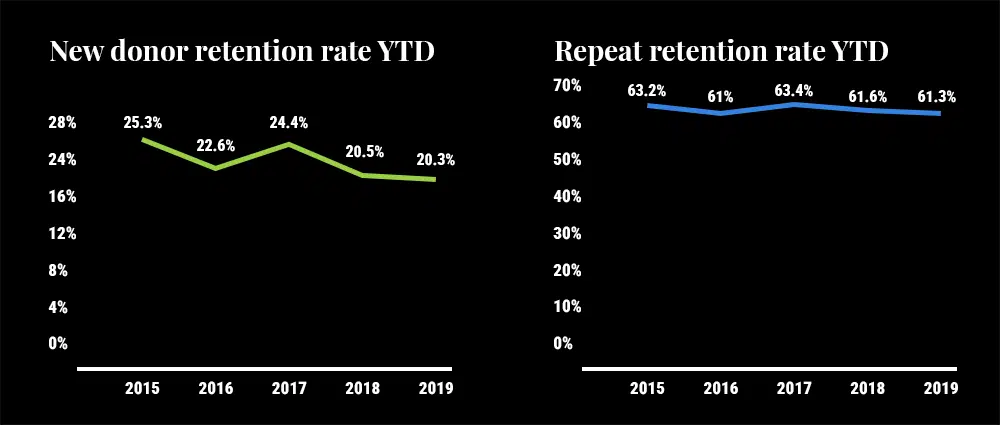
So what does this mean? Increasing your first-time donor retention is the fastest way to increase your overall retention rate.
The key to retaining more first-time donors is to give them special treatment.
Create a new donor segment for your first-time donors and don’t force them to merge onto your supporter communications highway. Instead, create a special path for your new donors to travel at their own cadence according to their needs.
We have a new donor cultivation timeline as an example of how to create a special lane for new donors, guiding them slowly toward a second contribution:
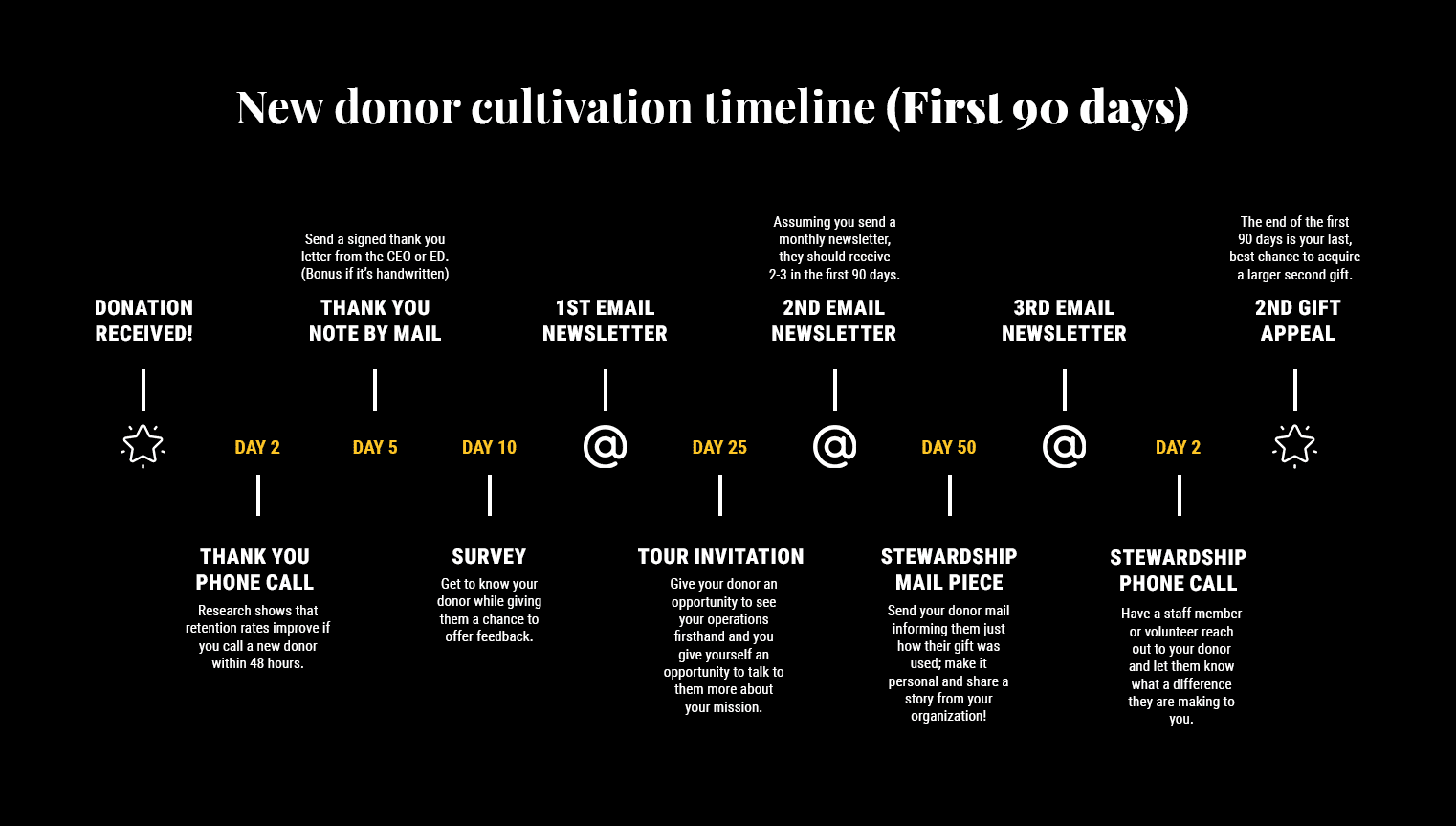
First, begin your engagement with a sincere thank-you for the donations from your new supporters. Then, provide information about your mission and ask your supporters for feedback. Follow up by inviting them out for coffee or a tour of your facilities. Finally, after a few months of interaction, invite these new supporters to give a second contribution.
2. Monthly donors
If your donors have signed up to give monthly contributions to your nonprofit, they’re incredibly special. On average, monthly donors have retention rates closer to 80% or 90%. They’ve already signed up to have a donation taken out of their bank account on a regular basis, so you don’t need to solicit donations from them as often.
Plus, you have additional opportunities to reach out to these supporters, further developing these relationships. In fact, by sending a thank-you email each time they donate, you have twelve opportunities every year to show your appreciation for their support. Get creative and try sending appreciation notes that differ each month. For instance, you might:
- Tell supporters about their impact and show them the unique things you did with your funding each month.
- Send fun holiday cards like National Salad Month for May or Admit You’re Happy Month in August.
- Add little trinkets to thank-you cards, like keychains or stickers branded with your nonprofit.
However, don’t limit your interactions with monthly donors to thank-you messages alone. You should also reach out to find new and interesting ways to keep your supporters involved with your organization’s mission and activities. Expand your relationship with these supporters in other ways, such as inviting them to events or to volunteer.
You should also make sure to alert them when there is an increased risk of lapse among monthly supporters. Set up a report to see which credit cards are expiring in two months. Send a special note before the expiration date. Remind them of all the great things you’ve been able to accomplish together. Don’t treat the donor like an ATM by simply saying, “We need your new credit card number.”
Creating a new donor segment for these supporters will help you avoid treating them like ATMs and help you retain more of them over time.
3. Lapsed donors
Achieving a 100% donor retention rate is just about impossible. You’ll naturally lose some supporters over time due to factors beyond your control, such as donors who have trouble affording regular contributions, move away, or want to give only once.
However, lapsed donors are still a great segment to create in your donor database. For those supporters who have simply become too busy to give or who still care about your mission despite not contributing, you have the chance to reach them and convince them to give again.
Our data shows that donors who haven’t given in the last two years are about 98% likely to never give again. That’s exactly where you should start! Try to bring that 98% down a few notches by identifying the donors who haven’t given in two years. From here, separate them into sub-categories and take action (or decide not to take action) by answering these questions:
- Were they memorial or tribute donors? These supporters may have only wanted or expected to contribute once to support their friend who is bereaved.
- Were they peer-to-peer donors? Supporters who contribute via peer-to-peer campaigns likely do so to support their friend, the fundraiser. In the future, consider asking the fundraiser to reach back out to their generous networks to provide additional information about the organization they’re supporting through the campaign.
- Did they give to you for many years consecutively and then suddenly stop? This could happen for a number of reasons, for instance, if a donor passes away or runs into financial hardship. The data service Deceased Suppression Processing notifies you when a current supporter has died, so you can respond respectfully. If they have stopped giving for other reasons, reach out and invite supporters to get involved in ways that don’t require them to dig deeper into their wallets, like volunteering or liking your Facebook page.
- Did they only give to you once? Again, there are several reasons a supporter might only give once to your nonprofit. They may have only wanted to make a single donation or forgotten that they had contributed. Try to learn more about these supporters before taking action.
Consider sending a survey to the other lapsed donor sub-segments to find out why they stopped giving and to assess whether you can bring them back into the fold. Doing so can give you more information about how to communicate with other donors. You may not get many responses, but there’s a chance to convert some of them into repeat donors.
While you should recapture as many supporters as possible, keep in mind that the average recapture rate for lapsed donors is only around 4%, so don’t stress too much about the ones who got away.
4. Volunteers who never gave
Volunteers are essentially low-hanging fruit for nonprofit fundraising. In fact, volunteers are around 11 times more likely to donate than the average person. If you have volunteers who have never given to your nonprofit, you should create a specific donor segment in your system for them.
That gives your organization the power to reach out to volunteers and guide them towards donating. You can also offer these supporters additional volunteer opportunities and encourage them to strengthen their relationship with your nonprofit through more interaction.
5. Donors who shared feedback
When donors share feedback with your nonprofit, whether positive or negative, it’s a good indication that they’ll be retained for a long time. While this may seem counterintuitive, it makes sense when you stop to think about it. Donors who actively give feedback to organizations are likely invested in that cause and want it to succeed. If they didn’t care, they would simply stop interacting.
Send donor surveys to all your donors, including first-time donors, every year. Ask them insightful questions about their interactions with your nonprofit and their motivations for contributing. For instance, you might ask questions such as:
- Why did you first give?
- What’s your connection to the cause?
- What are we doing right?
- What can we do better?
- What do you expect from us?
When you send these surveys, try to make them as easy as possible for supporters to fill out. Use multiple-choice or 1-10 rating questions to let supporters quickly provide their feedback. Then, include one or two short-answer questions at the end of the survey to wrap it up.
If supporters give positive feedback, you can assume that they care about your mission and are satisfied. If they give negative feedback, they may not be fully satisfied, but they want to see you do better and succeed. Receiving negative and constructive feedback can provide actionable ways to improve your organization.
Reach back out to supporters who give feedback and thank them for taking the time to complete your survey. Then, inform supporters who gave constructive feedback when you incorporate their suggestions, so they know you’re listening.
6. Social media followers who interact with your nonprofit
Donors who follow you on social media have opened up a channel for personal, one-on-one interactions with your organization that you can’t get through other channels.
A donor database that listens for mentions on social media, records those interactions on a constituent’s profile, and stores their usernames and profile URLs is indispensable in building this segment.
But it’s not enough to just wait for these interactions to come to you. Take initiative and highlight these supporters on social media yourself by thanking them or encouraging them to get involved directly on the platform. For instance, you might:
- Tag donors and volunteers to thank them for their previous support. These tags will show up on donor profiles and are a great way to promote your organization.
- Target current supporters with your social media advertisements. For instance, you might ask your current donors to start a birthday fundraiser on your behalf.
- Invite supporters to post crowdfunding or peer-to-peer campaign pages directly on their social profiles.
- Mobilize your supporters to share your content on social media, spreading information about your mission further and wider than you could do alone.
- Ask donors if they’re open to direct messaging on social platforms. Then you can contact them directly and enjoy one-on-one conversations about fundraising and engagement opportunities.
Building this segment will enable you to leverage these dedicated supporters during digital campaigns such as #GivingTuesday or other online days of giving.
7. Long-term donors
Your long-term donors have shown their dedication to your nonprofit time and time again. If you’re still treating them like average supporters, your strategy is long overdue for a change. For instance, if you’re still sending letters to your legacy supporters explaining what your long-standing programs are, you might be annoying them. They already have that information.
However, they may be interested in other aspects of your organization. For example, these donors would be interested in the story of a person or family whose life has been improved by your nonprofit, thanks to your supporters’ contributions. You can also go into more detail about new initiatives and seek their valued input.
When you’re interacting with your long-term donors, always treat them as partners who have truly invested in your mission. This is how you can continue engaging supporters for years and increase the lifetime value of your entire donor database.
How should you leverage donor segments?
Once you’ve established your donor segments, start using them to advance your donor cultivation strategy.
Stop sending the same generic gift acknowledgments or event invitations to every single person in your donor database. Start using your donor segments as a personalization strategy to tailor every message to your recipients.
We’ll provide several messages that show how personalization makes a difference across donor segments. These are copy-paste-ready templates that your organization can adapt to its unique needs.
New donor retention template
An animal shelter might send the following message to a brand-new donor in their system:
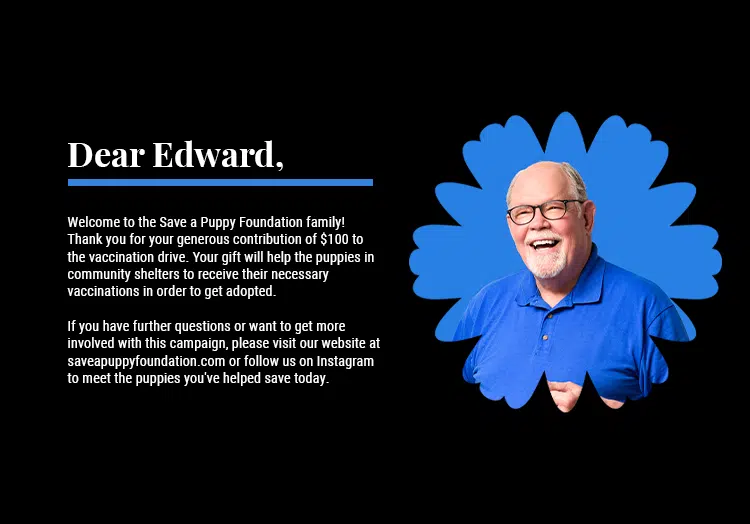
Dear Edward,
Welcome to the Save a Puppy Foundation family! Thank you for your generous $100 contribution to the vaccination drive. Your gift will help the puppies in community shelters receive the necessary vaccinations so they can be adopted.
If you have further questions or want to get more involved with this campaign, please visit our website at saveapuppyfoundation.com or follow us on Instagram to meet the puppies you’ve helped save today.
This message welcomes the new donor to the family and acknowledges that it was their first contribution. It also thanks them for their contribution and explains the impact of their gift. Finally, the message provides a next action to continue their engagement.
While this template welcomes new donors to your organization and encourages them to deepen their involvement, an example for a major donor may look more like this:
Dear [Donor Name],
Thank you for your continued generosity. Your recent $5,000 donation will enable our team to provide critical care to dozens of incoming animals before they find loving homes.
We’d love to acknowledge your contribution with a spotlight in our upcoming monthly newsletter. Please let us know if you’re open to this opportunity, and we’ll arrange an interview.
Monthly donor retention template
With donor segmentation, if that same animal shelter reached out to a monthly donor, they might take the following approach:

Dear Lilly,
Thank you for your continued support of the Save a Puppy Foundation. Contributions this month will help vaccinate a new litter of puppies recently rescued from a puppy mill. Our first priority is their health and safety, so they can find their forever homes.
Please share information about this drive with your friends and family on Facebook, encouraging them to support this cause as well, until every puppy has the vaccinations they need.
As you can see, this message is phrased differently to account for the fact that these supporters are already familiar with the organization. It also provides a next step that doesn’t require them to make another contribution.
Volunteer template
Finally, compare these messages to the following message that the shelter might send to a volunteer who has never given to their cause:

Dear Andre,
Thank you so much for taking time out of your day to help rehabilitate the puppies here at the Save a Puppy Foundation. Your time volunteering helps each puppy find their forever home.
Now, we need your help again! Last month, we rescued 50 puppies from a puppy mill and these new members of our family need their vaccinations. Would you consider donating to our vaccination drive campaign? Thank you in advance for your support. We appreciate everything you do to help these puppies in need.
This message is uniquely designed for a volunteer the organization wants to encourage to contribute to the cause again. The organization acknowledged past support and asked for help with a current campaign.
Stewardship template
Donor stewardship is crucial to retention, and segmentation helps you make your donors feel more appreciated by recognizing the specific impact they’ve made on your cause. Whether sending acknowledgments to your donors privately or publicly, you can customize your thank-you messages to your donor segments based on the type of donations they’ve made previously. You can also use your segments to thank your volunteers, event attendees, or sponsors.
Consider this example tailored to first-time donors:
Dear [Donor Name],
Thank you for contributing your first gift to our organization! It’s always touching when someone discovers our cause and feels passionate about it to donate, so thank you from the bottom of our hearts here at Animal Rescue Central.
Donating isn’t the only way to get involved in our nonprofit. Explore the volunteer opportunities listed below and follow our social media accounts to stay up to date on our latest events and activities.
Consider the segments you’ve created in your donor database and create rough templates tailored to different audiences. These templates can then be adjusted and configured according to each supporter and campaign.
Never again will you have to worry about new donors accidentally receiving additional donation appeals just days after their first contribution because you already had a campaign message queued for everyone in your donor database. You can also stop worrying about accidentally asking for an insultingly low gift amount from a potential major gift donor.
Donor segmentation will empower you to transition from a spray-and-pray communicator to a strategic, donor-centric champion!
6 tips for donor segmentation success
Donor segmentation requires concentration and work from your organization. However, once you put in the effort, you’ll be able to reach, engage, and retain your supporters more effectively and efficiently than before.
To help you succeed, we’ve compiled a list of six tips that you can use to optimize your donor segmentation strategy even further.
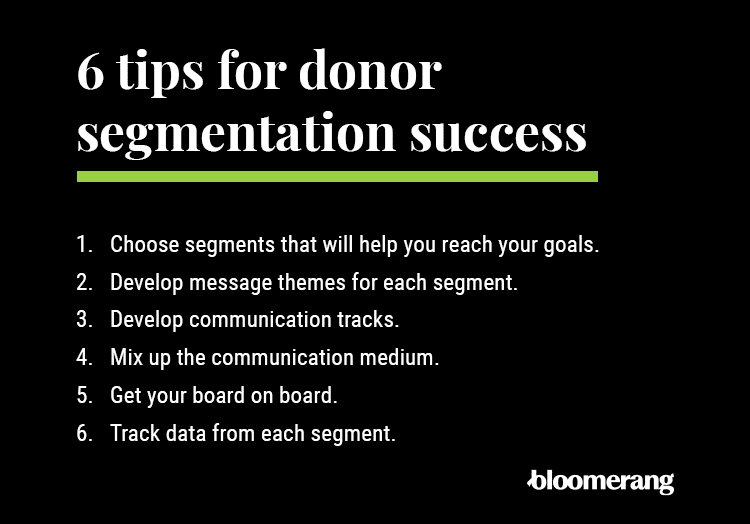
1. Choose segments that will help you reach your goals.
As mentioned, each nonprofit will use different segments to achieve its goals and objectives. Carefully consider which ones will be most effective for your specific organization. While you can crowdsource ideas and research examples, don’t forget to take your organization’s unique situation into consideration.
For example, animal shelters may create separate segments of dog owners and cat owners, while a nonprofit that serves homeless populations would find little use for that information.
2. Develop message themes for each segment.
Once you’ve developed segments for your audience, your organization will also need to update the common communication messages you use across your supporter segments. Some of the communication themes you might need to create for each segment include thank-yous, appeals, newsletters, emails, stewardship pieces, and more.
Then, consider how each of these message themes will differ for each audience segment. For example, thank-you letters for your brand-new donors will look different from those for your monthly contributors. Be sure to create templates for each message theme and donor segment to address common needs and communication interactions across different supporter audiences.
3. Develop communication tracks.
Communication tracks are a series of messages that lead your supporters—especially new supporters—to complete a specific action. These messages create a personalized experience for each of your supporters based on their current relationship with your organization.
Map out the types of messages and communications you’ll send out at specific points within an established timeframe. For instance, you might send your first-time donors a follow-up message after a set number of days following their initial donation. Remember the first-time donor timeline we explained earlier? Use that as a model for multiple supporter segments to guide them to the next step in the giving process.
4. Mix up the communication channel.
When was the last time you saw a commercial on television or heard about a product on a podcast, then a letter arrived at your home branded to that same product? Chances are, you had a flash of recognition during your second interaction with the product.
By mixing up communication platforms, you can establish a sense of recognition. Be sure to appeal to donors in whatever format they’re most likely to respond to.
For example, here are some communication channels you might decide to use after a donor contributes to your organization:
- An immediate thank you response after the donation
- A phone call to explain the impact of the donation directly to the supporter
- A handwritten thank-you note
- A monthly newsletter
- An invitation to take a tour within six weeks
These different outreach strategies create a multimedia communications approach that supporters tend to respond to more positively.
5. Get your board on board.
Which would you prefer: a letter from a company staff member or a letter from the CEO? The additional authority the CEO holds lends more credibility to the marketing materials you receive. At a nonprofit, your board is the governing body, meaning they can provide this additional authority when you reach out to your various donor segments.
Ask your board members to hold letter-writing sessions where they draft handwritten notes to send to supporters, adding a personal touch to the message. You may also ask them to call new supporters on the phone to show appreciation for their generosity.
6. Track data from each segment.
Even nonprofits that meticulously determine the best possible segments for their organization sometimes need to refine their strategies over time. Refining your donor management approach requires understanding how each donor segment functions at your organization. Is your nonprofit reaching these supporters? Has your retention rate increased? Are these supporters still giving?
Track data according to donor segments such as:
- Lifetime value of supporters
- Average donation sizes
- Retention rate
- Email open rate
- Conversion rate
Over time, this data will help you determine which strategies work best for each segment and how to further optimize your segmentation for more impactful relationships.
Getting started with a small donor file
When working with a small donor file—such as a database with just a few hundred donors—you don't need to pressure yourself into creating complex, hyper-specific lists right away. Instead, start simple with just three core segments:
- First-time donors
- Consistent recurring supporters
- Major gift prospects
Focusing on these few foundational groups allows you to tailor your messaging, deepen authentic human connection, and maximize your impact without stretching your team thin. Starting with a manageable segmentation approach frees you up to focus on what matters most: building lasting relationships with your community!
Using AI for predictive donor segmentation
Advanced technology can now handle the science of fundraising—the data analysis and pattern recognition—so you can focus your energy on the art of relationship building. By using AI for predictive donor segmentation, you can instantly transform raw data into clear, actionable outreach strategies.
For example, Penny, the intelligent AI sounding board built directly into Bloomerang's Giving Platform, acts as your strategic partner. Penny analyzes your complete supporter history in seconds to automatically group donors, surface individuals who are ready for a giving upgrade, and predict who is at risk of lapsing before it happens. With this smart, proactive guidance, you can confidently prioritize your outreach, meet donors exactly where they are, and ignite lasting support.
Free donor segmentation template
Use this template to help guide you through creating donor segments and determining the right communication approach and cadence for each group.
Frequently asked questions about donor segmentation
Still have questions? Here are a few quick answers to the most common queries about donor segmentation.
What is donor segmentation?
Donor segmentation is the process of dividing your nonprofit's supporters into groups based on shared characteristics, such as giving frequency, donation amount, geographic location, or interests, so you can send personalized, relevant communications to each group rather than one generic message to everyone.
Why is donor segmentation important for nonprofits?
Donor segmentation improves retention, which is critical because the average nonprofit retains only about 45% of its donors each year. Personalized communications, made possible by segmentation, help donors feel valued and understood, increasing the likelihood they'll give again. It also costs about 10 times as much to acquire a new donor as to retain an existing one, making retention a top financial priority.
What are the most common donor segments?
The most commonly used donor segments in nonprofits include: first-time donors, monthly (recurring) donors, lapsed donors, major donors, volunteers who haven't donated, donors who have given feedback, social media-engaged donors, and long-term loyal donors.
What is the RFM model in donor segmentation?
The RFM model stands for recency, frequency, and monetary value. It is a savvy, data-driven approach that for-purpose organizations use to evaluate supporter engagement. By analyzing how recently a supporter gave (recency), how often they give (frequency), and the size of their gifts (monetary), you can easily pinpoint your most passionate champions, as well as those who might be at risk of lapsing.
What data do you need to segment donors?
The core data points for donor segmentation are: recency (when they last gave), frequency (how often they give), monetary value (how much they give), giving type (one-time vs. recurring), interests or program preferences, volunteer history, event attendance, and social media engagement. All of this data should be stored in a nonprofit CRM or donor database.
What is the average donor retention rate for nonprofits?
According to Bloomerang's retention data, the average nonprofit donor retention rate has remained around 45% for many years. First-time donor retention is even lower, approximately 20%, meaning about 80% of new donors never give a second time. Monthly donors, by contrast, typically have retention rates of 80–90%.
How often should you update your donor segments?
Review and update donor segments at least quarterly, with a full database cleanup (removing duplicates, correcting typos, and updating contact information) at least once or twice per year. You should also revisit your segments whenever your organization launches a new program, completes a major campaign, or sees a significant shift in donor behavior.
What's the best software for donor segmentation?
A dedicated nonprofit CRM is the most effective tool for donor segmentation. Look for software that stores detailed donor profiles, allows you to filter and group supporters by multiple data points, tracks communication history, and integrates with your email marketing platform. Bloomerang is designed specifically for nonprofit donor management and segmentation.
Final thoughts
Donor segmentation enables your organization to provide personalized touches in your communications with donors, demonstrating your appreciation for their support. As a result, you’ll build deeper relationships with your supporters and retain them as part of your community for years to come.
Of course, strong donor segmentation starts with a comprehensive CRM that lets you store and organize donor data. Bloomerang CRM gives you a 360-degree view of every supporter, so you can segment donors and personalize your communications. Book a demo today to explore our award-winning platform.
Related resources to explore next:
- Donor Appreciation: Creating a Strategy (And 22+ Ideas). Donor appreciation is a key part of developing relationships with your supporters. Learn more about how you can show you care in this guide. Plus, steal one of our 22+ ideas!
- Online Fundraising | Ultimate Success Guide + Tips and Ideas. See how you can put your new donor segments into action by applying them to your online fundraising efforts. This guide provides more tips and ideas to use for online fundraising success.
- [Free Download!] Nonprofit Development Plan | 3 Helpful Tips. All of these strategies and donor segmentation tips are designed to amplify your fundraising efforts. Use this downloadable nonprofit development plan to see how these strategies can help your fundraising.
- Nonprofit CRM: The Buyer’s Guide + Top Solutions (Updated). Looking for a robust nonprofit CRM to support your donor segmentation strategies? Our buyer’s guide will help you find the perfect software for your nonprofit’s unique needs.