

Improving your first-time donor retention rate directly drives predictable, long-term revenue for your nonprofit while cutting steep acquisition costs. Even a modest boost in keeping new supporters can yield tens of thousands of dollars in compounding growth over time.
By shifting focus from continuous donor acquisition to building post-gift relationships, nonprofits can turn one-time donors into long-term partners who contribute larger, more frequent gifts.
Addressing the issue of first-time donor retention
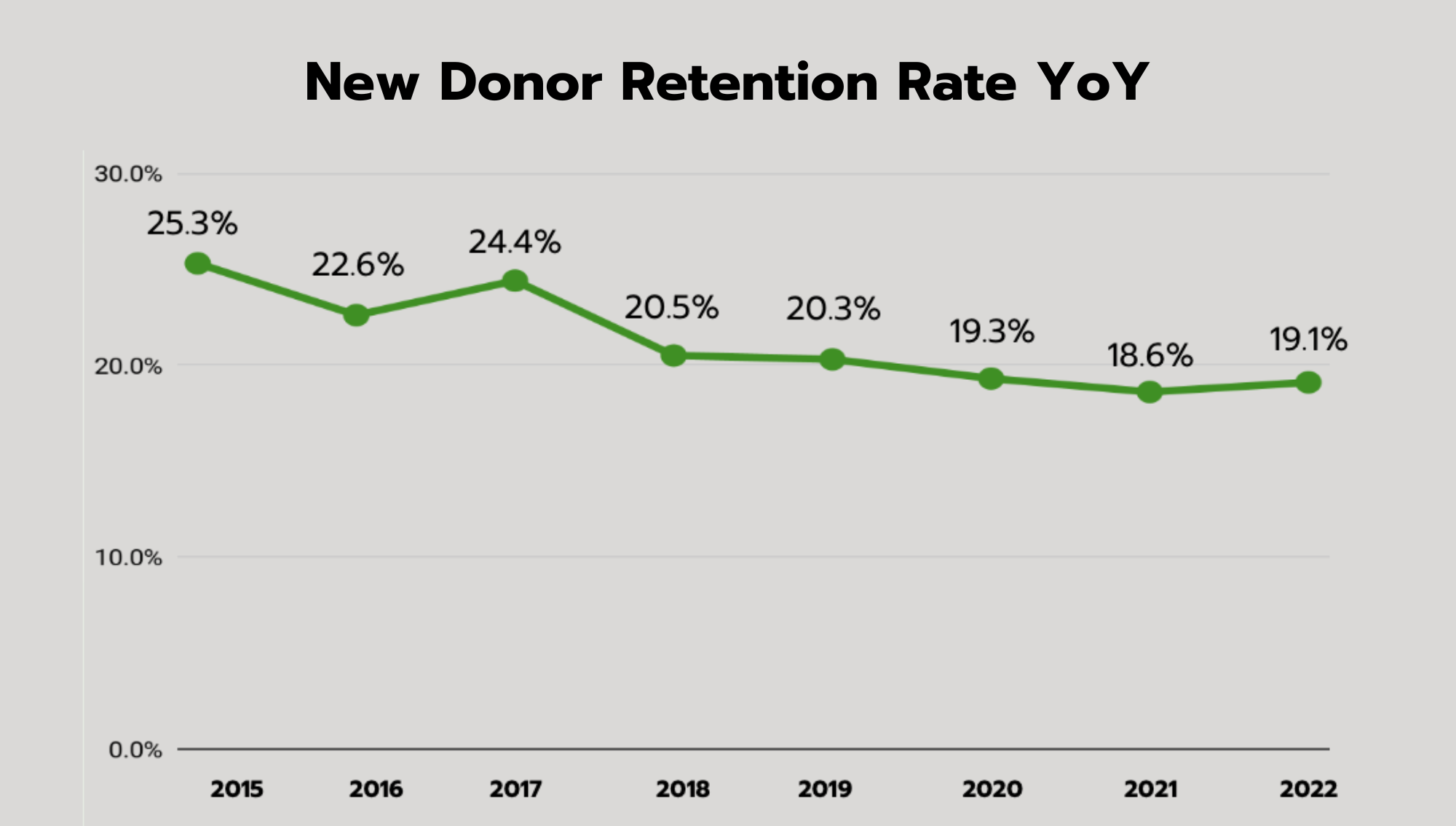
According to the Fundraising Effectiveness Project, the average retention of first-time donors by charities across America is a mere 18.9%!
Yes, that means for every 100 new donors, only about 18-19 give again the next year, and 81-82 of them do not renew their giving at any level!
Sadly, most of those donors who do not give again would probably be inclined to do so if even a small amount of proper attention is paid to them.
There are so many ways to do this. If your fundraising team applies just a few basic principles, you can improve the 18.9% retention rate.
To fix this retention gap and give new supporters the attention they deserve, fundraising teams first need a clear understanding of who actually fits this description. Defining this group ensures you can tailor your outreach at every stage of their initial year.
What is a first-time donor? (and when someone is still “new”)
A first-time donor is anyone who has made their very first financial contribution to your organization, regardless of the gift size or channel.
Typically, a supporter remains in the new donor category for the entire first 12 months following that initial gift.
In nonprofit fundraising, the first-time donor window doesn’t end after a few weeks or months. It spans a full calendar year, giving your organization enough time to steward the relationship and secure a second contribution before their initial giving anniversary passes. Once 12 months pass without a second gift, that supporter transitions from “new” to “lapsed.”
What is the average first-time donor retention rate?
The average first-time donor retention rate typically hovers between 19% and 23%, meaning roughly four out of five first-time donors never make a second contribution.
A good first-time donor retention rate falls between 30% and 40%. While beating the industry average of 18.9% is a great baseline goal, reaching this higher target means your organization successfully transforms roughly one out of every three new supporters into repeat contributors.
Hitting a 30-40% retention rate typically requires a structured welcome journey, such as delivering a multi-touch onboarding series, showing immediate impact, and sending a prompt, personal thank-you within 48 hours of that crucial first gift.
Top three principles for retaining first-time donors
Retaining first-time donors shouldn’t be rocket science, yet most nonprofits completely miss the mark by relying on a single, boilerplate thank-you letter. If you want to keep new supporters engaged, it comes down to three remarkably simple principles:
- Ensure at least three “touches” occur in the first 90 days after the gift is made, especially phone calls
- Make the touches as personalized as possible
- Be different than most of your competition
Those seem so common-sense that every charity engaged in fundraising would comply, but time and time again, we see only a boilerplate non-personalized letter as the only response or touch used with the donor. No wonder they soon forget your charity’s mission.
Why first-time donors don’t give again
When first-time donors never return, it’s rarely because they stopped caring about the cause. In most cases, donors lapse because of how they were treated—or ignored—after making that crucial first gift.
Here are the top four reasons first-time donors don’t give again:
- Radio silence (no follow-up). The most common reason donors walk away is simple: they never hear from the organization again until the next solicitation. Sending a generic tax receipt and then disappearing for months signals that you only value their wallet, not their partnership.
- No visible impact. Donors give because they want to make a difference. If you don’t show them what their specific contribution achieved—whether it funded a scholarship, planted 50 trees, or fed a family—they won’t see a reason to repeat the gift.
- Missing or impersonal thank-yous. An automated, “Dear friend” email receipt isn’t a thank-you. First-time donors need to feel appreciated. Without a warm, prompt, and personal acknowledgment, like a hand-signed note or a quick phone call within 48 hours, they feel like just another transaction.
- Treated like an ATM, not a partner. Asking a new supporter for another donation too quickly, without taking the time to welcome them, share story updates, or educate them about your mission, creates donor fatigue instantly.
Design a donor journey that they want to come back to
A great donor retention strategy isn’t about doing more. It’s about designing an experience donors want to come back to.
If that sounds familiar, it should. Streaming platforms figured it out years ago: keep people watching by giving them just enough payoff to feel good and just enough anticipation to keep them curious.
Nonprofits can apply the same thinking. Because when a donor makes that first gift, they’re not committing to a lifetime of giving. They’re pressing “play” on your story. And if what follows feels disjointed, impersonal, or inconsistent? They’re going to hit skip.
The good news: a binge-worthy donor experience isn’t about flashy production value or expensive perks. It’s about delivering value, building momentum, and giving people a reason to stay engaged.
Episode 1: The welcome
That first gift doesn’t signal commitment. It signals interest. They liked what they saw enough to try an episode. Now the pressure’s on. The next thing they experience determines whether they come back.
What makes them stick around:
- A fast, personal thank-you—something that makes them feel seen.
- A story or impact moment that shows their gift is already in action.
- A clear sense of what’s coming next—not another ask, but an invitation.
▶️ What this looks like in action:
A new donor gives on a Tuesday. By Thursday, they’ve received a personalized thank-you note from a program leader and a short story that shows how their gift helped right away. Instead of wondering if their donation disappeared into a black box, they’re immediately pulled deeper into the mission.
The welcome experience sets the tone for everything that follows.
▶️ What happens when it’s missing:
They give, get an automated receipt, and hear nothing else for two weeks—until the next ask. There’s no story, no context, no invitation. And just like that, the connection fizzles.
Episode 2: Don’t drop the plot
This is where many nonprofits lose their audience. After a strong opener, they go quiet—or jump straight to another appeal. But if your second touchpoint doesn’t build on the emotional momentum of the first, you’re not giving donors a reason to stay invested.
What keeps the story moving:
- Sharing updates that show real progress, not just polished stats.
- Offering behind-the-scenes access that makes donors feel like insiders.
- Providing an easy on-ramp to another kind of engagement—volunteering, events, community.
▶️ What this looks like in action:
A follow-up message a few weeks later gives a genuine update—not a newsletter, but a curated experience. The donor is invited to a behind-the-scenes virtual tour or asked to weigh in on an upcoming initiative. It feels personal, like they’re part of what’s next.
Only around 19% of first-time donors stick around—but retention jumps to 63% when they give again. That moment defines whether someone continues the donor journey—or drops off entirely.
▶️ What happens when it’s missing:
The next email is a mass update that makes no mention of their role in the story. Or worse, it’s another fundraising campaign, asking for more before the donor ever felt connected to the first gift.
Mid-season: Add a twist (Ongoing recognition)
Even loyal donors need to feel surprised now and then. Recognition is where the script usually flattens—generic thank-yous, templated messages, passive appreciation. But a thoughtful, unexpected gesture can reignite emotional connection.
For first-time donors, a message that feels like it was written just for them can set the tone for everything that follows. Small surprises go further than scripted gratitude.
What makes recognition memorable:
- Offering personalized shoutouts tied to their unique giving journey.
- Sending “only they would’ve gotten this” messages—like anniversary notes or custom impact videos.
- Delivering opportunities that evolve—advocacy roles, Q&As with your team, VIP updates.
▶️ What this looks like in action:
A donor gets a quick email on the anniversary of their first gift: “One year ago today, you changed someone’s story. Here’s what that impact looks like now.” Maybe they also get early access to a campaign preview or a call with a program lead. The message? You’re not just appreciated—you’re part of this.
One nonprofit, the Mara Elephant Project, increased retention by 15% by being consistent with thank-you emails, updates, and simple follow-ups that made people feel included.
▶️ What happens when it’s missing:
They’re included in the annual donor list or sent a generic thank-you email every December. Nothing about it reflects their journey. It’s technically recognition—but it doesn’t feel like it.
The season finale: Don’t end with a cliffhanger (Renewal)
Too many nonprofits treat the renewal process like a subscription reminder. (“It’s that time of year again!”) But strong retention is like wrapping up the season with meaning—and setting the stage for what’s ahead.
What makes the finale work:
- A look back that highlights their role in the story.
- A look forward that invites them into your next chapter.
- A feeling that their presence matters—not just their payment.
▶️ What this looks like in action:
At the end of the year, the donor receives a personal year-in-review message: what they made possible, where your organization’s headed next, and a soft invitation to keep the story going. It feels earned, not transactional.
A 10% bump in retention doesn’t just stabilize revenue—it can double your donors’ lifetime value. That’s not just a nice-to-have. That’s the growth strategy.
▶️ What happens when it’s missing:
Donors receive either an impersonal renewal email or a matching gift appeal without acknowledgment of their past support. There’s no emotional closure—and no compelling reason to say yes again.
The real-world math
When we look ahead to next year and think about where we can move the needle most in funding our mission, the math behind first-time donor retention is compelling.
If you are like most charities, a large amount of your focus is on attracting new donors each year. I know from my experience attending both board meetings and fundraising committee meetings that the conversation seldom shifts away from this topic of finding new donors. Vast sums of dollars and manpower are spent creating new special events, expanding existing events, designing new mailings, or conducting calling campaigns.
This is exactly where the math should begin.
First, we often spend more than a dollar to raise a dollar from a brand-new donor. This is not a sustainable strategy, especially if there are not large amounts of outside capital coming from grants or the government.
Second, and even more importantly, the first-time donor retention rate of 18.9% may be one of the easiest fundraising metrics to improve. Just retaining 10 more of the 100 new donors increases retention by more than 50%! Retaining just 20 more out of every 100 more than DOUBLES first-time donor retention rate!
So let’s now carry this out with a real-world, simple example with these details:
- A charity has 500 existing donors with an average gift of $250 and adds 500 new donors with an average gift of $200, thereby raising $225,000 in year one
- Each year, 500 new donors are added, and their average gift remains at $200
- Their existing donor retention rate is a solid 60%
- The existing donors continue to donate an average of $250 each year
- Their current first-time donor retention rate is 20% (roughly the national average of 18.9%)
- Their first-time donor retention rate improves 10% to 30% in the second example
- Their first-time donor retention rate improves 10% to 40% in the third example
Run those assumptions out over 10 years and the differences those retention rates make are striking.


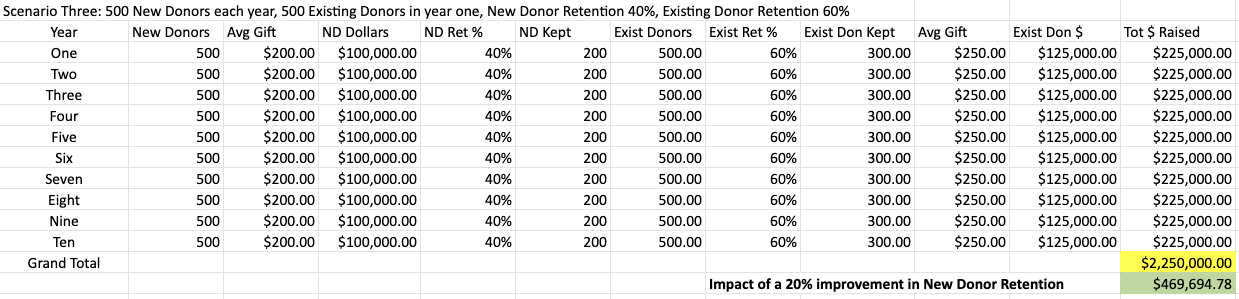
Here is a link to download the Excel spreadsheet so you can put in your own numbers and see what even a little improvement can do.
Notice the immense impact, even just a 10% improvement from 20% to 30% can have in a database of 1,000 donors. There is a difference of nearly $235,000 after just 10 years. That averages nearly $24,000 per year!
A 20% improvement in first-time donor retention goes further still. In that example, the financial impact is nearly half a million dollars!
My personal favorite portion of the impact is the number of retained donors gained. Both examples are dramatic; however, the second example brings to life the fact that the number of existing donors STOPS declining! Just imagine what that means to the potential pool of major gift and legacy gift prospects. We all know that the best prospects for either have been giving for five years or longer, so keeping that pool of people steady or even increasing is such an asset for the future.
How to calculate your first-time donor retention rate
Calculating your first-time donor retention rate helps you track how effectively your organization turns one-time contributors into repeat supporters over a 12-month period.
To find this percentage, you divide the number of first-time donors from a specific year who gave again in the following year by the total number of new donors acquired during that initial year, then multiply the result by 100.
For example, suppose your nonprofit acquired 500 new donors last year, and 125 of those exact supporters made another gift this year.
- Divide 125 by 500 to get 0.25.
- Multiplying 0.25 by 100 gives you a first-time donor retention rate of 25%.
It is important to track this metric as its own distinct cohort rather than blending it into your overall donor retention rate. Overall retention includes loyal, multi-year donors who naturally return at much higher rates, so combining the two groups will hide how many of your brand-new supporters are slipping through the cracks.
Frequently asked questions about first-time donor retention
How long does it take for a first-time donor retention strategy to show ROI?
Most organizations see early results from their first-time donor retention strategy within 90 days, as second-gift conversion rates begin to climb. However, the full financial impact typically compounds over 12 to 24 months, as retained donors renew their giving and gradually increase their contributions over time.
What is the ideal timeline for asking a first-time donor for a second gift?
Wait between 60 and 90 days after their initial contribution. Use the first 60 days strictly for gratitude, impact updates, and engagement. Once they feel appreciated and informed, present a clear, compelling opportunity for a second gift.
Can automated emails effectively retain new donors without feeling spammy?
Yes, as long as they are personalized and value-driven. Triggered email welcome series perform well when they deliver impact stories, behind-the-scenes insights, and thank-you videos rather than constant solicitations.
Summary
Whether you love statistics, or prefer a good novel, the evidence is overwhelming of just where you might find your biggest fundraising impact area.
If you and your team can establish the goal of improving first-time donor retention this year the impact on next year’s fundraising results could be monumental. We suggest you shoot for at least 10% and see what happens.
Here’s another link to the Excel spreadsheet we used. Try adding your own fundraising metrics and watch its impact.
May next year be your best fundraising year ever!