Creating a Monthly Giving Program: Tips for Nonprofits




Monthly giving program at a glance
A monthly giving program is a structured way for your nonprofit to invite supporters into an ongoing, automatic giving relationship instead of a single gift. It gives your organization a steady, predictable source of revenue and gives donors a simple, flexible way to stay connected to your mission. Building one well means naming the program, setting a clear ask, choosing a secure way to process recurring gifts, and thanking monthly donors consistently.

One-time donations are great, but nothing beats the ongoing positive impact of monthly giving. Why? Because monthly donations provide your nonprofit with reliable, sustainable funding year-round. These donations can help you continue working toward your mission even during low-giving times.
Online monthly giving has grown by 40% in recent years as recurring donation options have become increasingly popular among donors. Your organization can take advantage of this effective fundraising opportunity by encouraging more of your donors to become recurring contributors.
Benefits of creating a monthly giving program
Benefits to your nonprofit organization
Your monthly donation program can offer your nonprofit:
- A reliable, predictable source of ongoing fundraising revenue. Your monthly donations can fund everything from ongoing projects to unexpected expenses.
- A pool of planned and major gift prospects. Since monthly donors give consistently, they can offer a greater lifetime value to your nonprofit than one-time or occasional donors. You can conduct prospect research within your monthly donor pool to identify planned and major gift prospects.
- A higher donor lifetime value. Lifetime value is a prediction of how much each donor will give to your organization over the course of their lifetime. According to the M+R Benchmarks report, in 2025, the average size of a monthly gift was $28 (or $336 per year), while the average one-time gift was $139. With effective donor stewardship strategies in place, you can encourage donors to continue supporting your cause for the long term and raise more for your mission as a result.
Benefits for your donors
There are also several reasons why making a recurring donation is beneficial for your donors. These include:
- Convenience. Monthly donations are automatically processed, meaning donors don’t have to input their payment information or mail in their donations every time they want to give.
- Flexibility. Monthly donors can adjust their donation amount over time.
- Access to exclusive opportunities. You can offer donors additional benefits when they sign up for your monthly giving program, such as exclusive event access or free merchandise. This helps them feel more connected to your organization.
How to ask for monthly donations
Step 1. Identify prospective monthly donors
You should highlight your monthly giving program on your website, donation page, social media platforms, and other marketing channels to reach a general audience. You should also ask certain donors directly if they’d like to participate in your monthly giving program. Use the information stored in your donor management software or constituent relationship management software and other prospecting tools to identify prospective monthly donors.
Your best prospects are current donors, especially those who:
- Have made at least two gifts within the past year. This indicates that the supporters are willing to give more than once within a year.
- Contribute large amounts. Remember that 80% of gifts come from 20% of donors. Focus on major donors because you already know that they have a high giving capacity.
- Give through multiple channels. For example, a donor who gives via your online donation page, direct mail, or at events might appreciate the option to give regularly through just one channel—your monthly giving program.
Once you identify these donors, create an email marketing campaign or other outreach strategies to introduce these donors to your monthly giving program. Your campaign should highlight its impact and donor benefits.
Step 2. Include suggested monthly donation amounts
When creating your monthly giving program, make sure to include suggested giving amounts. Usually, nonprofits list three suggested donation amounts in addition to the field that lets donors input their own donation amount.
For prospective new donors, experts recommend figuring out your average donation amount and dividing it by three to determine your entry-level monthly donation request. So, if your average donation amount is $30, your monthly donation request would start at $10/month.
You can also consider charm pricing—specifically ending your ask amounts in "9" (like $19, $29, or $49). The brain processes numbers so quickly that we anchor heavily on the first digit we see. Even though $19 is only one dollar less than $20, mentally it feels like it belongs in the "teen" category rather than the "twenties." This tiny change makes it so much easier to sign up for a recurring commitment.
If you’re requesting monthly donations from current donors, personalize your request using each donor’s past giving history as a reference. For instance, if a certain donor has contributed three donations of $30, $45, and $50 over the past year, you might request a recurring donation of $14/month (which is roughly the average of their past donations divided by three). You can connect with donors directly using your email, text, and other communication platforms to request these personalized monthly donations.
Step 3. Add social proof to your donation form
Humans are social creatures. When we aren't sure how to act, we look to the crowd for cues on what is normal, acceptable, or expected. In psychology, this is called social proof.
On a donation page, social proof acts as a gentle, reassuring nudge. It reassures potential donors that they aren't acting alone and that others have already vetted your organization, found it worthy of their trust, and settled on a standard level of support. By highlighting a popular choice, you reduce the decision fatigue that often leads to abandoned donation forms.
For example, CARE's online donation form adds social proof to its monthly giving option by telling donors, "Most people are choosing to give $50 a month." When potential donors see what the most common giving amount is, they'll be more likely to choose that option to align with the norm.
Step 4. Use multiple channels to promote your program
Once you’ve established the basics of your monthly giving program, connect with your prospects to encourage them to sign up. Here are a few channels you can use:
- Your online donation form. Include an option for donors to turn their one-time gifts into recurring monthly donations.
- Your website. Spotlight your program by creating a web page explaining the purpose of the program, the benefits donors will receive from participating, and a link to sign up.
- Social media. Create a monthly giving program video to share on social media. Use direct messages to connect with the prospective donors you identified.
- Email. Reach out to prospective monthly donors via an email marketing campaign.
- Direct mail. If you have supporters’ home addresses, you can send them letters encouraging them to participate in the monthly giving program.
- Texts. Send information about your monthly giving program via text.
- At events. Invite prospective monthly donors to events and highlight your giving program.
- During phone calls or face-to-face meetings. Present monthly giving as a great option for smaller or mid-tier donors to make an even greater impact on your mission.
Make your monthly giving program a prominent giving option that you present to donors on a regular basis alongside your other giving opportunities.

6 best practices for your monthly giving program
As you carry out the steps listed above, incorporate best practices for making your monthly giving program more effective.
1. Set program goals
Set goals for your monthly giving program that are SMART: specific, measurable, achievable, realistic, and time-sensitive. When you set goals, you’ll know which tools you’ll need and which strategies to use to meet those goals.
Here are a few examples of goals you could set:
- We want to expand our monthly giving program by adding 50 new supporters by the end of the year.
- We want to boost our monthly giving program revenue by $5,000 over the next six months.
- We want to increase our monthly giving program retention rate by at least 20% by the end of the year.
These goals give your team an objective to strive for and offer a benchmark that will determine the success of your fundraising strategies.
2. Connect the program to a direct impact
In your monthly giving program marketing materials, describe how monthly donations allow your organization to work more effectively toward your mission.
For instance, if your organization facilitates local volunteer efforts, you might explain that your monthly giving program funds tools needed for a specific community project.
3. Collect donations with a secure payment processor
You’ll need a secure payment processing system to quickly and easily process monthly donations. Look for a payment processor that:
- Gives donors the option to cover processing fees
- Accepts both one-time and recurring credit and debit card payments
- Keeps donor information safe with best-in-class data security
4. Brand your monthly giving program
Make your monthly giving program stand out by giving it a unique tagline or name that communicates the purpose of the program. This will help you foster a strong sense of community for donors, making them feel like members of a special club. You can find examples of monthly program names in the last section of this post.
5. Offer incentives to join
Many donors will be happy to join your monthly giving program because of the impact they can have on your mission. Another way to entice them to join is to offer incentives that give donors something tangible in return for their support.
Offer monthly donors incentives such as:
- Free merchandise
- Free event access or discounted tickets
- Exclusive access to educational resources, such as members-only publications or webinars
- Having their name on your digital or physical donor wall
These benefits can help influence donors who might be on the fence about joining your program to get involved.
6. Develop a monthly donor acknowledgment plan
Just like your other donors, you must create a donor stewardship strategy to build relationships with monthly donors. This helps increase your program’s retention rate and gives donors a more fulfilling experience.
Send monthly givers an automated thank-you email every time you process a donation. Incorporate other appreciation efforts, such as sending handwritten thank-you notes or calling donors on the phone to express your appreciation for their generosity.
For example, you might send a welcome package to new donors and a letter each month letting them know about their impact and thanking them for being a member of the program. Create a communications calendar of year-round message ideas and engagement opportunities, like volunteer opportunities and events.
What you need to run a monthly giving program
Before you launch, make sure you have the basics in place: a dedicated landing page that explains your program and its benefits, a secure payment processor that can handle recurring charges, a donor database to track who's giving and when, and a simple acknowledgment plan so monthly donors always feel thanked. Having these pieces ready from day one makes it easier to promote your program with confidence across every channel.
How to name your monthly giving program
Keep your nonprofit's branding and story in mind when brainstorming a name for your monthly giving program. These tips can help you come up with the right name:
- Make sure the name is consistent with your organization's brand. Think about images, colors, or themes that are associated with your branding. Would any of these elements make sense to incorporate in the name of your monthly giving program?
- Ensure the name is different from your organization's name. Differentiate your giving program's name from your nonprofit's name to provide a sense of exclusivity for your monthly giving program participants.
- Think about the story you want to tell with your giving program. How can your giving program's name reflect that story? The name should connect donors with your mission and clarify what you want to accomplish.
- Emphasize the partnership between your monthly donors and your organization's mission. How can you make them feel like they're important collaborators?
Your giving program's name will be an important part of branding the program and increasing recognition. Make sure the name you choose is memorable and descriptive. You can even workshop the name among staff members or long-time supporters to gather input.
10 monthly giving program examples to inspire you
Looking for inspiration for your monthly giving program? See what other nonprofits are doing with their programs. Here are 10 inspiring nonprofit monthly giving programs to check out:
Charity Water: The Spring
The mission of charity: water is to provide global access to clean water. The organization’s monthly giving program, The Spring, brings together a group of dedicated donors focused on solving the water crisis.
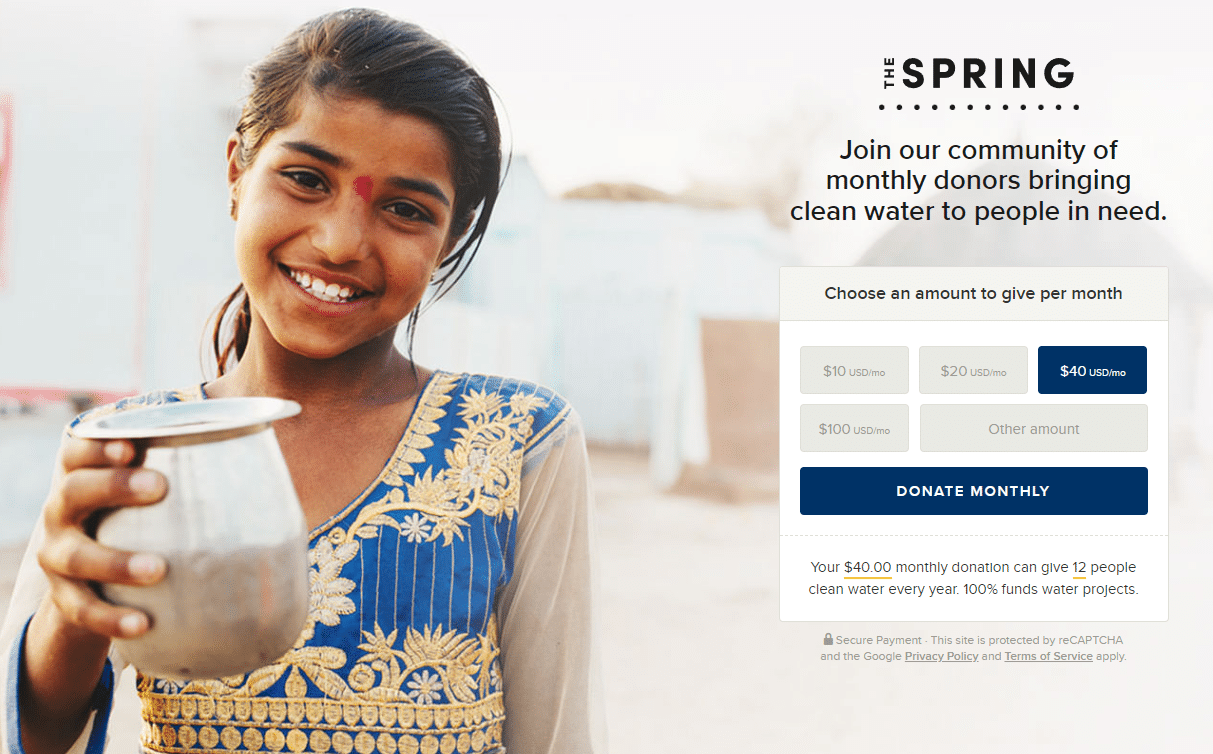
The donation form explains that a $40/month donation provides clean water for 12 people for a year and that 100% of donations go toward water projects. This lets donors know the real impact of their recurring donation and reassures them that their funds will be used for critical needs.
World Wildlife Fund: WWF Heroes
World Wildlife Fund (WWF) seeks to protect endangered species and conserve natural resources.
WWF’s monthly donors are called WWF Heroes. These donors enjoy benefits such as a quarterly magazine, an annual calendar, and exclusive members-only emails. Monthly donors can also select a thank-you gift, such as a set of tote bags or a pair of socks.
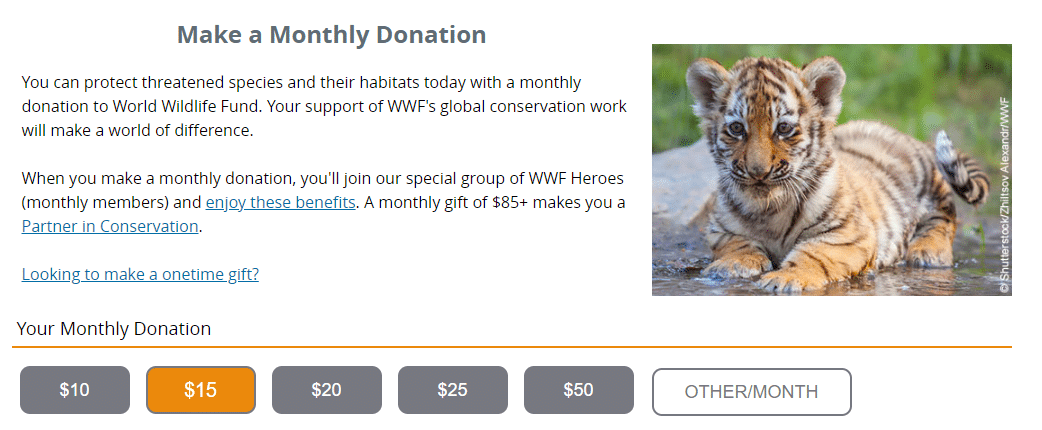
Donors who make a monthly contribution of $85 or more become Partners in Conservation. These donors earn special access and benefits, such as direct phone or email access to a personal staff liaison and invitations to exclusive webinars and events.
Doctors Without Borders: Field Partners
Doctors Without Borders is committed to delivering lifesaving medical care to people in need around the world. The organization’s monthly donors are called Field Partners, which positions the donor as someone who is just as integral to the success of the mission as a Doctors Without Borders employee who is working on the ground.
The Field Partners web page offers an extensive explanation of why supporters should become monthly donors, how recurring giving works, and the benefits of joining the program. It also provides a succinct reason to join, saying, “No matter the amount, your recurring donation has a serious impact: knowing we can count on receiving your recurring gift makes it easier for us to be prepared for whatever emergency or crisis we respond to next.”
The page also spells out the impact of giving at each level, so prospective monthly donors can see what their gift funds.
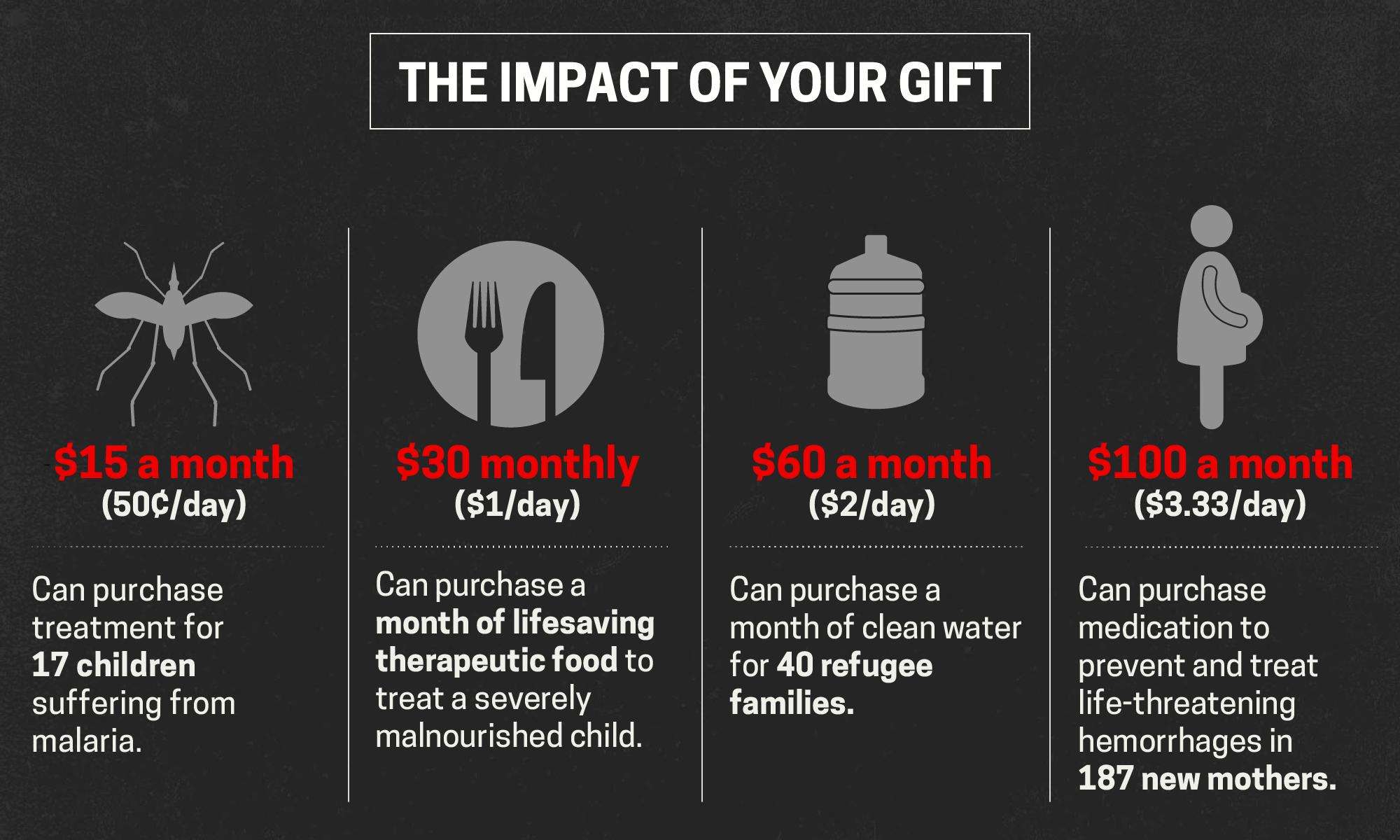
The organization also allows donors to join the program online, by phone, or via direct mail, giving more flexibility in how supporters can sign up.
The Nature Conservancy: Conservation Champions
The Nature Conservancy is dedicated to conservation, improving biodiversity, and tackling climate change. When supporters donate to the organization’s monthly giving program, they become Conservation Champions.
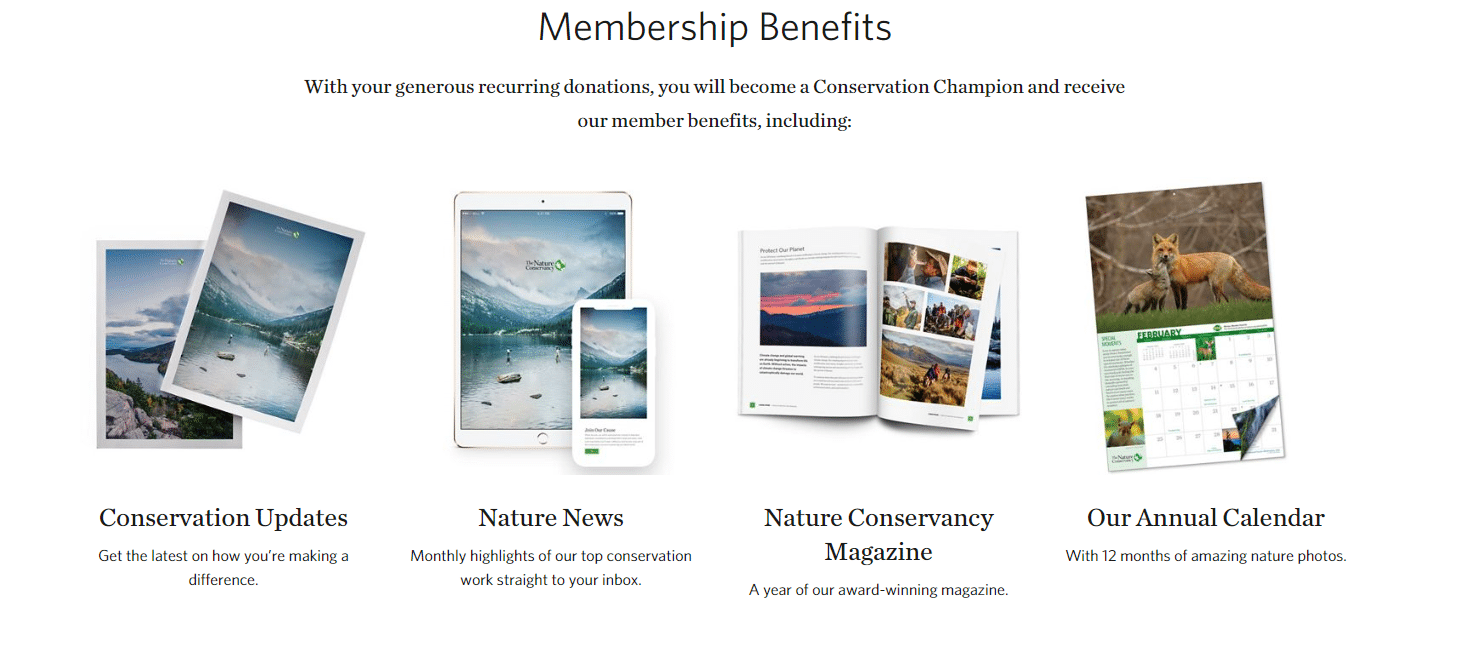
The monthly giving web page explains the benefits of becoming a Conservation Champion, such as the flexibility and convenience of the program. Plus, members receive special benefits such as news and update emails, an award-winning magazine, and an annual calendar.
CARE: Partners for Change
CARE works in more than 100 countries to fight hunger and malnutrition, support health initiatives, eradicate poverty, and provide other forms of humanitarian aid. Donors who join CARE’s monthly giving program are called Partners for Change.
The program’s web page offers suggested donation options and describes the impact of each monthly donation amount. For example, a $43 donation can provide a family of six with nutritious meals for 30 days, a hygiene kit, and six months of water treatment.
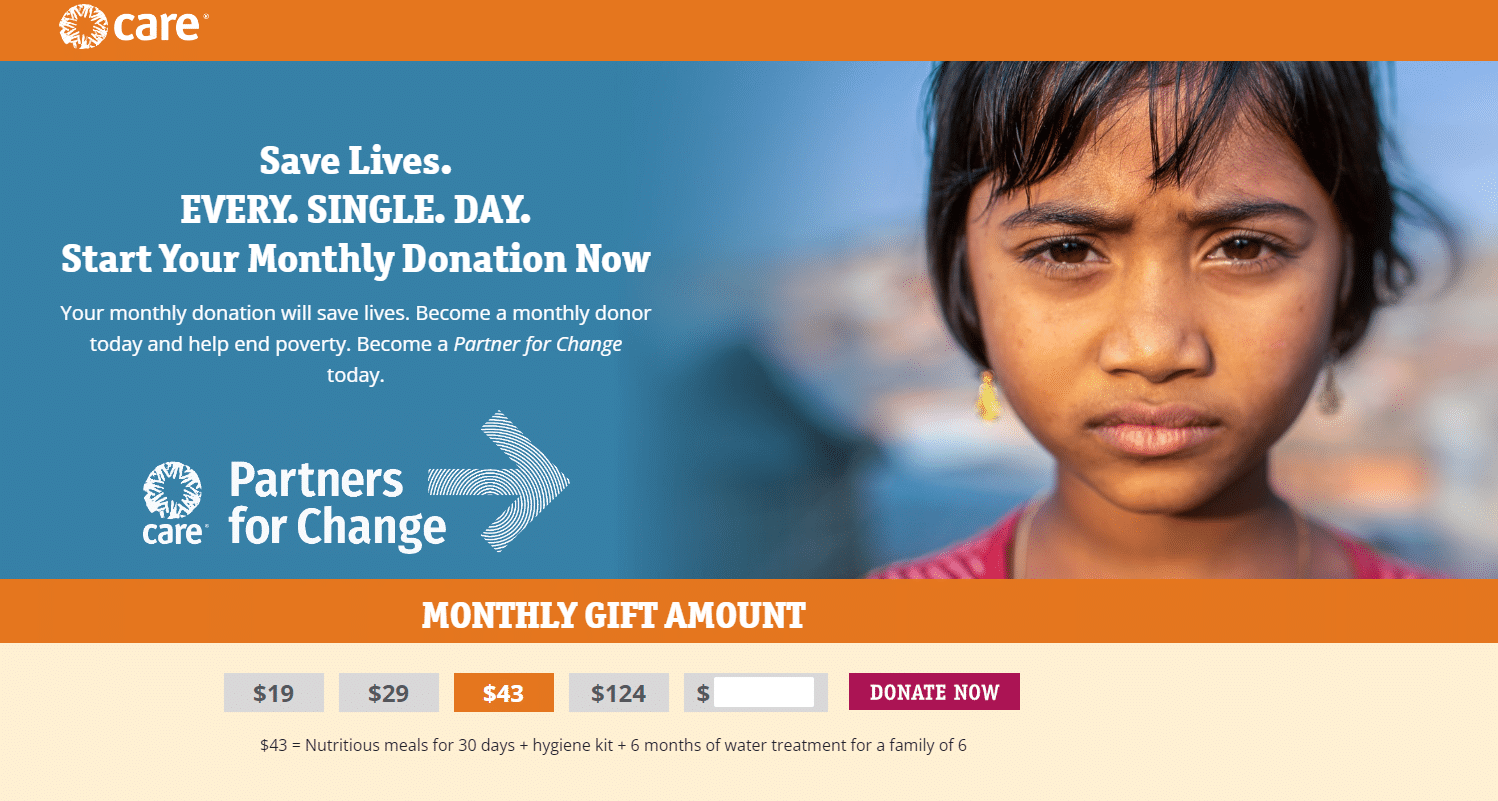
The page also breaks down the monthly giving process in three easy steps:
- Donors choose a donation amount.
- Donors are charged every month.
- Donors join a strong community of Partners for Change, receiving benefits such as a car decal, world report, and monthly impact stories.
Finally, the page also highlights how the organization allocates expenses, emphasizing the fact that 90% of donations are used to fund program activities, while 10% goes to support services and fundraising activities.
To Write Love on Her Arms: TWLOHA Blue
To Write Love on Her Arms is a nonprofit movement dedicated to presenting hope and finding help for people struggling with depression, addiction, self-injury, and suicide. The organization’s monthly giving program is called TWLOHA Blue.
The name "TWLOHA Blue" is inspired by the blue stitches on the first T-shirt the organization ever printed, serving as a reminder of their mission. The program's web page features a fundraising thermometer to track progress toward membership goals and displays a list of member names to build community. Members also receive tiered perks based on their giving level, such as team updates, birthday gifts, store discounts, and a physical TWLOHA Blue Partners Coin under the tagline, "help hope go farther."
She’s the First: The Front Row
She’s the First fights gender inequality through education, supporting girls who will be the first in their families to graduate from high school. Their monthly giving program is named The Front Row.
The program's classroom theme is built on the idea that students who sit in the front row are typically the most engaged in their education. To reflect this, She's the First assigns education-themed names to their monthly donation tiers rather than using generic levels. This setup connects recurring donors directly to classroom milestones and makes them feel like active participants in the girls' educational journeys.
American Red Cross: Champions
The American Red Cross prevents and alleviates human suffering in the face of emergencies by mobilizing the power of volunteers and the generosity of donors. Supporters who join their recurring donation program are called Champions.
The program’s sign-up page defines a Champion as someone who stands ready to help in moments of crisis, provides hope and comfort when disaster strikes, and delivers lifesaving relief. To build donor trust, the page features extensive FAQs, supporter testimonials, and official charity accreditations. It also highlights that 90 cents of every dollar donated goes directly toward humanitarian services and disaster relief programs.
Action Against Hunger: THRIVE
Action Against Hunger works to save the lives of malnourished children while providing communities with access to safe water and sustainable solutions to hunger. Their monthly giving program is called THRIVE.
The program focuses on funding treatments for children suffering from severe acute malnutrition. Rather than using generic statistics, the THRIVE page uses personal storytelling to connect with donors, highlighting the successful recovery of a young boy named Mohamed. This approach shows prospective monthly donors how recurring gifts directly fund life-saving therapeutic food and clinic supplies.
Glacier National Park Conservancy: Friends of Glacier
The Glacier National Park Conservancy funds projects that preserve Glacier National Park for future generations. Their monthly giving program, Friends of Glacier, allows supporters to contribute on a recurring basis.
The program page features vivid landscape photography of the park's iconic peaks and wilderness to remind donors of the environment they are protecting. While supporters can choose any recurring amount, the conservancy outlines specific park-themed benefits and impact levels starting at $35 a month. These tiers show how monthly gifts directly fund projects like wilderness trail restoration and wildlife research.
Frequently asked questions about monthly giving
What is a monthly giving program?
A monthly giving program is a recurring donation model where supporters automatically contribute a set amount to a nonprofit each month. By providing a predictable, steady stream of revenue, it allows organizations to plan long-term projects with confidence while offering donors a convenient, budget-friendly way to support their favorite causes over time.
How do I start a monthly giving program?
First, build a dedicated, mobile-friendly landing page with recurring giving set as the default option. Give your program a compelling name that reflects your mission. Next, target your current multi-time and recent one-time donors with a warm, personalized email campaign explaining how a small monthly commitment makes a reliable, ongoing impact.
How much should I ask for monthly?
Use the "divide-by-three" formula: take your average one-time gift and divide it by three to set your baseline. If your average one-time gift is $60, suggest a $19 or $20 starter tier. Provide three to four distinct tiers, and use psychological charm pricing ending in "9" (like $19 or $29) to make giving more accessible.
What is the average monthly donation?
The average monthly donation is $28. While one-time gifts are usually larger upfront, monthly donors have a dramatically higher lifetime value because they remain committed to your cause for years. Their steady, automatic support creates a secure financial foundation that helps your nonprofit thrive in the long term.
Wrapping up
Monthly giving is a convenient way for donors to increase their financial support and become more involved in your mission. Plus, monthly donations can provide your organization with a stronger source of revenue, allowing you to plan for what you want to do in the coming months and years.
For more information, check out these additional resources:
- How to upgrade nonprofit donors using suggested donations. Providing suggested donation amounts can make it easier for donors to choose their monthly contribution level. Use this post to understand the best strategies for choosing suggested donations.
- 15 fundraising apps that make nonprofit giving simple. Fundraising apps are tools that help your organization boost its fundraising success. Learn more in this guide!
- The ultimate donor engagement guide + top strategies. Ongoing donor engagement is key to growing loyalty among monthly donors. This guide offers effective donor engagement strategies to try.