20 Volunteer Recruitment Strategies That Work for Nonprofits





Quick answer
A volunteer recruitment plan is a structured, step-by-step strategy for attracting and retaining volunteers whose skills and motivation align with your nonprofit's mission. The best plans go beyond a list of tactics—they define who you're recruiting, why they should care, and exactly how you'll reach them.
Build yours around five core elements:
- Define your target audience. Identify who your ideal volunteers are and what motivates them.
- Build your case for support. Articulate the impact volunteers create and the personal benefits they gain.
- Write clear role descriptions. Use the Who/What/When/Where/Why/How framework for every role.
- Choose your channels. Pick three to five platforms where your target audience actually spends time.
- Launch, track, and refine. Monitor your recruitment funnel weekly and optimize based on what's working.
If volunteers make up a large percentage of your nonprofit's team, you know how important their support and dedication are in your efforts to achieve your mission. Across North and South America, 252 million people regularly volunteer each month, yet 26% of volunteer leaders still cite recruiting as a top challenge for their organization. Getting the right people in the right roles requires more than a sign-up form.
This guide offers insights and tactics for recruiting outstanding volunteers for your nonprofit's events and programs, optimized for quick scanning and organized so you can jump to exactly what you need.
What does a volunteer recruitment plan look like? A step-by-step how-to
Use this section as a working framework. For each of the five core elements, you'll find the inputs you need, the actions to take, a tangible output to aim for, and a brief example artifact to make it concrete.
Step 1: Define your target audience
Inputs: Volunteer history data, current roster demographics, role requirements, past campaign performance
Actions:
- Review past recruitment campaigns to identify which audience segments yielded your highest-retention volunteers.
- Build two to four volunteer personas with specific demographics, motivations, and preferred channels—one persona per major role type.
Output: Volunteer persona document with audience profiles for each major role type
Example copy — Persona one-pager
"Skilled professional volunteer — Ages 35–55, works in healthcare, motivated by community impact, available weekends, discovers opportunities via LinkedIn and email newsletters."
Step 2: Build your case for support
Inputs: Impact data (volunteer hours logged, outcomes achieved), testimonials from current volunteers, your organization's mission statement
Actions:
- Draft a one-paragraph "why volunteer with us" statement that speaks to both mission impact and personal benefits (skill development, networking, community connection).
- Gather two to three volunteer testimonials that reflect the experience of your target personas.
Output: A case-for-support document—the foundation for your landing page, email campaigns, and social content
Example copy — Case for support opening
"Last year, our 200 volunteers contributed 4,000 hours—worth an estimated $134,000 in time. More than the math: they helped 800 families access food, housing, and support. Here's what that meant to them." [Testimonial block]
Step 3: Write clear role descriptions
Inputs: Manager input on each role's tasks, time commitment, skills required, physical requirements, and success criteria
Actions:
- Use the Who/What/When/Where/Why/How framework for every role—one completed description per open position.
- Lead with the role's impact before describing the tasks. "You'll help families access groceries" lands better than "You'll stock shelves."
Output: A library of finalized role descriptions ready to publish across all channels
Example copy — Finished role description
"Food pantry volunteer — Saturdays, 9 a.m.–12 p.m. You will help families access groceries every week—making a direct impact every single shift. No experience required. Just bring reliability and comfortable shoes. [Sign up here]"
Step 4: Choose your recruitment channels
Inputs: Source data on how current volunteers found you (ask them), budget for paid promotion, staff capacity per channel
Actions:
- Pick three to five primary channels based on your audience personas—for example, email, Facebook, VolunteerMatch, LinkedIn, and local media.
- Map a content plan: what you'll post, on which channel, and how often. Assign an owner for each.
Output: A channel shortlist with posting cadence and owner for each
Example copy — Channel plan snapshot
Email: bi-weekly | Owner: volunteer coordinator Facebook: 3x/week | Owner: communications team VolunteerMatch: updated monthly | Owner: volunteer coordinator LinkedIn DMs: as-needed for skilled roles | Owner: programs director
Step 5: Launch, track, and refine
Inputs: A volunteer management platform to track applications, conversion rates, and source data—a defined set of weekly KPIs
Actions:
- Go live with your first recruitment campaign using the assets from steps one to four.
- Check your recruitment funnel weekly: How many people saw the post? Clicked? Applied? Showed up for their first shift?
Output: A recruitment dashboard showing source data, conversion rates, and cost per volunteer
Example copy — Recruitment funnel snapshot
"Of 150 form visits last month, 62 completed the application (41% conversion rate). Top sources: email (38%), Facebook (29%), VolunteerMatch (22%). Lowest-converting channel: X/Twitter (4%). Recommendation: reallocate X budget to email."
20 creative and effective volunteer recruitment strategies
1. Target the right audience
Knowing exactly who you're recruiting before you launch saves time and dramatically improves the quality of applicants.
How to do it
- Audit your current volunteer roster: note which demographics, skills, and motivations correlate with your highest-retention volunteers.
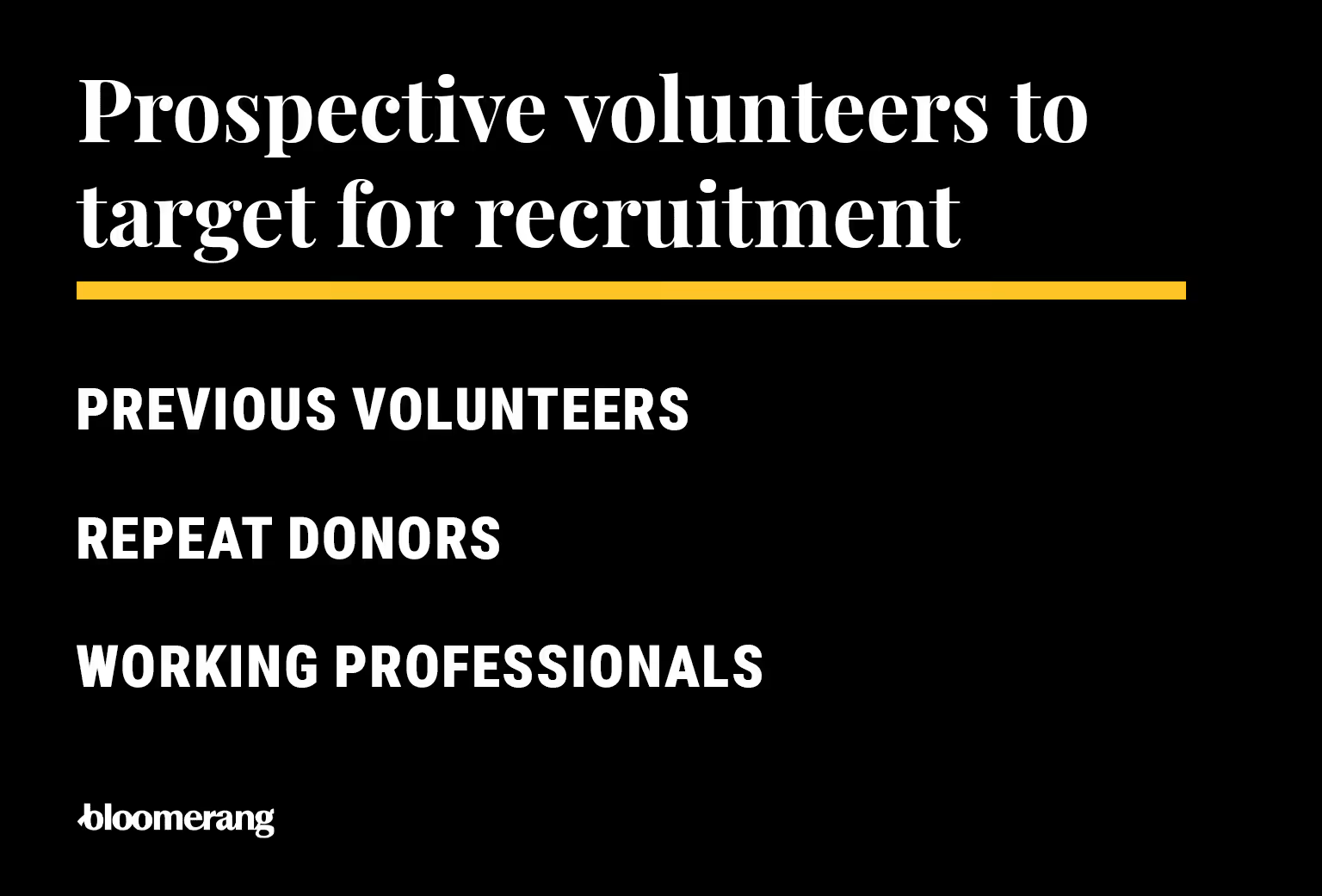
- Segment your target audience into three to four profiles—for example, retired professionals, college students, corporate employees, and previous donors.
- Match each profile to the specific roles and shifts they're most likely to fill.
- Use profile data to tailor your outreach channel, message, and ask for each segment.
Example copy — Re-engagement email to lapsed volunteers
Subject: We've missed you, [First Name] Hi [First Name], it's been a while since we've seen your face at [Program Name], and we're hoping to change that. We have new [role] openings that match your skills perfectly—shifts available [days/times]. Ready to jump back in? [Sign up here]
Track this: Applicant-to-role-fit rate (% of applicants who match the target profile for the role they applied to)
2. Share well-written role descriptions
Take the time to assess your operations and evaluate any gaps that volunteer work could fill. Here are a few tasks you might want to turn over to volunteers or recruit more volunteers for:
- Day-to-day office work or cleaning
- Door greeter roles
- Docent positions
- Event committee positions
- Event registration and ticketing
- Event set-up and clean-up
- In-kind donations collection
- Marketing and promotion tasks
- Fundraising tasks
- Teaching or tutoring
Once you've pinpointed what you need new volunteers to do, write out "job descriptions" for different volunteer roles to put on your volunteer website. A clear, specific role description is the single most effective thing you can do to attract the right volunteers and reduce no-shows.
How to do it
- Use the Who/What/When/Where/Why/How framework for every role—without exception.
- Lead with the role's impact before describing the tasks.
- Specify the time commitment precisely (for example, "Every Saturday, 9 a.m.–12 p.m. ET for six weeks").
- End with a single, clear call to action and a direct link to your sign-up form.
Example copy — Role description snippet
"Food pantry volunteer — Saturdays, 9 a.m.–12 p.m. You'll help stock shelves and distribute groceries to families in our community—making a direct impact every single week. No experience required. Just bring a positive attitude and comfortable shoes. Ready? [Sign up here]"
Track this: Application completion rate (% of people who start the form and finish it)
3. Host informational sessions for prospective volunteers
Informational sessions turn curious prospects into committed volunteers by giving them a live, personal preview of what it's really like to show up for your mission. These sessions can be virtual or in-person. Here's what you should cover:
- Your organization's mission and values
- Training procedures
- Program policies
- Current and upcoming opportunities (both in-person and remote)
- Information on volunteer grants
- How to sign up
It's also a good idea to ask a current volunteer to attend the info session to provide their perspective on your program. Leave time for questions at the end of the session. You could also make it even more fun by giving away free branded swag to everyone who attends!
How to do it
- Schedule recurring sessions—for example, the first Wednesday of each month—so there's always a low-pressure entry point.
- Use a 45-minute format: 15 minutes for an org overview, 20 minutes for role walkthroughs, 10 minutes for Q&A.
- Send an automated follow-up email within 24 hours with the sign-up link and role descriptions.
- Offer both in-person and virtual options to maximize attendance across schedules and geographies.
Example copy — Informational session invite email
Subject: Come see what we're about. We'd love to meet you. Join us for a 45-minute info session on [Date] at [Time]—virtual or in person, your choice. Learn about our mission, explore open roles, and get your questions answered. [Reserve your spot]
Track this: Attendee-to-applicant conversion rate
4. Craft a straightforward volunteer application form
A shorter, smarter form gets more completions—and the right fields let you match volunteers to roles automatically.
How to do it
- Limit your initial form to eight fields or fewer: name, email, phone, availability, skills or interests, and referral source.
- Sync form fields to role requirements in your volunteer management system so matches surface automatically.
- Test the form on mobile before launching—most applications are submitted on a phone.
- Remove any field that your team doesn't act on within 48 hours of receiving it.
Example copy — Form intro copy
"It only takes two minutes to sign up. Tell us a little about yourself, and we'll match you with the right opportunity."
Track this: Form completion rate (% of visitors who start and finish the form)
5. Optimize your digital promotion strategies
Integrating your website, email, and social media into a unified digital strategy typically yields better results than relying on any individual platform.
How to do it
- Keep your volunteer calendar page live and up to date with current openings—make it easy to find from your homepage in one click.
- Build a dedicated volunteer page with resources such as a link to your volunteer portal, volunteer opportunity calendar, and the coordinator's contact information.
- Apply for the Google Ad Grant ($10,000/month in free ad credits for eligible nonprofits) to capture search traffic from people actively looking to volunteer.
- Use paid social ads or boosted posts to reach new audiences on Facebook and Instagram.
- Send a dedicated volunteer opportunity email at least once per month, personalized for lapsed vs. active supporters.
Example copy — LinkedIn DM to a prospective skilled volunteer
Hi [Name], I noticed your background in [Skill] on LinkedIn. We're looking for volunteers at [Org] who can help with [Role]—it's a [X-hour] commitment on [days]. Interested in learning more? Happy to send over the details.
Track this: Volunteer landing page conversion rate (visitors to applications submitted)
6. Take a peer-to-peer recruitment approach
Your current volunteers are your most credible recruiters. One personal ask from a peer is worth ten cold posts.
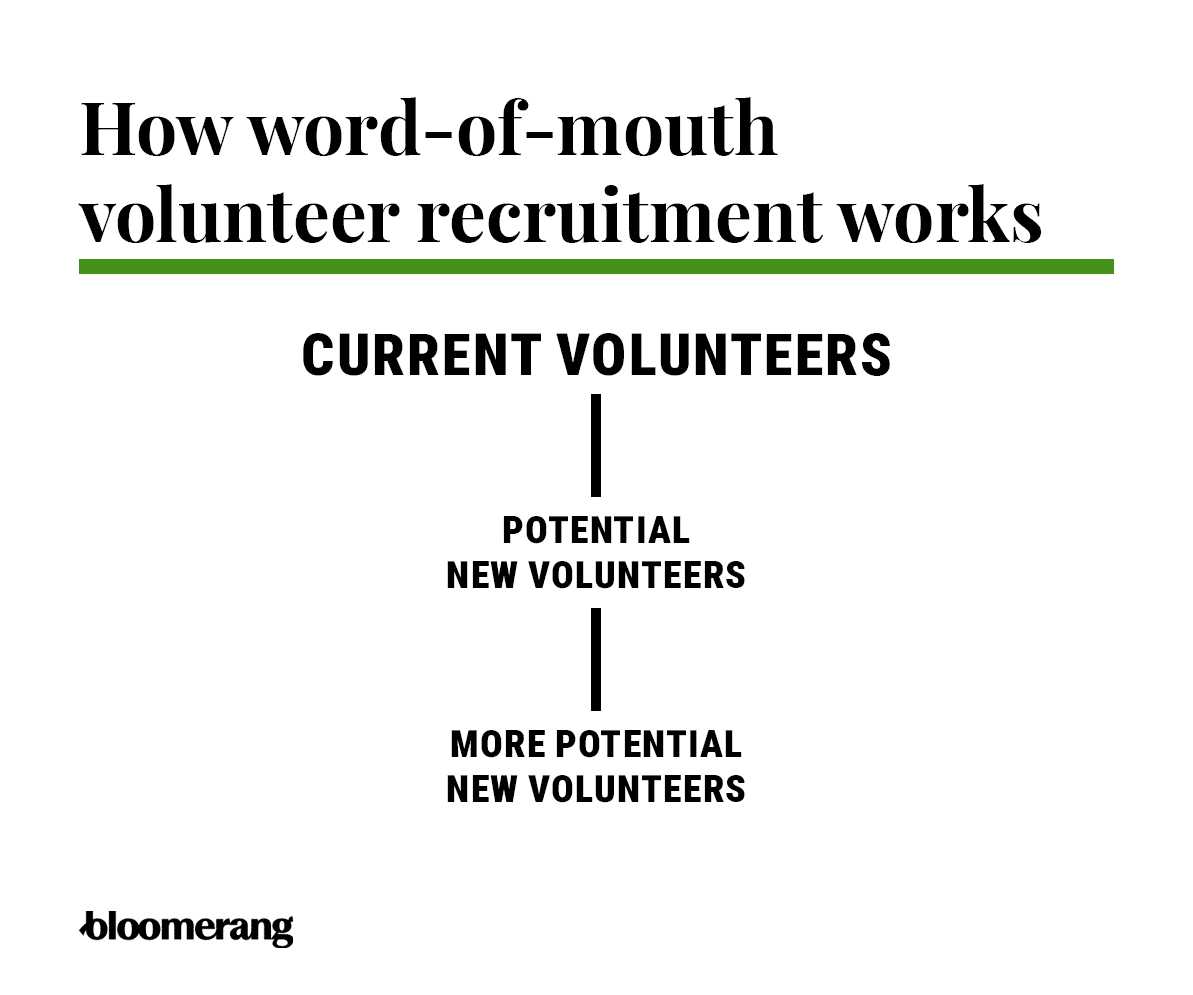
Make sure your volunteers can clearly articulate what your organization stands for and what makes it worth volunteering for. Try giving your volunteers "elevator pitches" they can use when encouraging others to join your volunteer program. Here are some examples you can use to base your own elevator pitches on:
- My nonprofit provides math tutoring to at-risk students in our community. As a regular volunteer, I find fulfillment through tutoring calculus students every Tuesday.
- This organization strives to rescue animals from abusive situations. As a volunteer, I get the opportunity to foster these animals and help them find new homes.
- Our nonprofit's mission is to increase young girls' confidence by hosting self-esteem workshops. As a volunteer, I help facilitate discussions about social media during these events.
How to do it
- Ask active volunteers to each invite one person from their personal network by a specific date.
- Provide a shareable link and a pre-written social post they can use in seconds.
- Offer a referral incentive—a gift card, extra raffle entry, or public recognition—for volunteers who successfully recruit a new member.
- Track referral sources in your volunteer management system so you know which volunteers are your best ambassadors.
Example copy — Shareable social post for volunteers to use
"I volunteer with [Org Name], and it's one of the best parts of my week. They're looking for more people—especially [role type]. If you've got [X hours] and want to make a real difference locally, here's the link: [URL]"
Track this: Referral sign-up rate (new volunteers who list a current volunteer as their referral source)
7. Explore corporate volunteerism
Corporate volunteer programs give you access to pre-motivated, often grant-eligible volunteers in bulk, and building even one business partnership can fill your roster for a season.
Seek support from corporations that have previously sponsored events or programs for your nonprofit. These organizations are great prospects for helping you recruit volunteers or for creating employee volunteer opportunities.
How to do it
- Research local businesses with published volunteer time off (VTO) policies or corporate social responsibility (CSR) programs.
- Pitch a "team volunteer day" with a clear time commitment, a specific task list, and a tangible outcome (for example, "Your team of 10 will pack 500 care kits").
- Remind corporate partners about volunteer grants—many companies donate cash for every hour their employees volunteer.
- Maintain a corporate partner contact list in your CRM and follow up annually with an impact report.
Example copy — Corporate outreach email
Subject: Bring your team. Make a real impact. Hi [Name], [Company] and [Org] share a commitment to [shared value]. We'd love to host your team for a half-day volunteer event. We handle all the logistics—you just show up and make a difference. Can we set up a quick 15-minute call? [Book a time]
For context: the Deloitte Volunteerism Survey found that 77% of companies believe volunteerism is essential to employee wellbeing, giving you a strong pitch for any CSR conversation. See our guide on corporate volunteering platforms for a list of tools that connect nonprofits to corporate volunteers.
Track this: Number of corporate partnerships active per quarter
8. Form relationships with other community organizations
Partnering with civic clubs, professional associations, and faith communities gives you a warm referral pipeline that self-renews every year.
How to do it
- Identify three to five local organizations whose members are required or incentivized to volunteer—Rotary, Junior League, Bar Association, faith groups, and civic clubs are good starting points.
- Local church leaders, in particular, are often looking for service opportunities for their youth groups and ministries. Connect with local religious leaders to find out what opportunities their congregations are most interested in, and share information about your program.
- Consider what other types of organizations might be interested in helping you find volunteers. For example, an organization seeking to support people with cancer might ask whether local cancer care clinics are willing to post flyers advertising its program. In a situation like this, you can find passionate volunteers and those who need your organization's services at the same time.
- Schedule a 30-minute meeting with each group's leader to explain the mutual benefit.
- Create a co-branded one-pager showing how volunteering with you helps their members meet personal and professional goals.
- Ask to be included in their monthly newsletter or member communications.
Example copy — Outreach email to a professional association
Hi [Advisor Name], I'm [Name] from [Org]. We work with local [cause] and we're looking for partners who can help us [specific need]. Members of [Association] would bring incredible expertise—and earn [volunteer hours / CLE credits / etc.] in return. Could we find 30 minutes to explore what this could look like?
Track this: Partner referrals per month
9. Promote opportunities on volunteer sites
Posting on dedicated volunteer platforms puts your open roles in front of an audience that is already motivated to get involved—without requiring you to build that audience yourself.
How to do it
- List every open role on at least three platforms: one national board, one local hub, and one channel that targets your specific volunteer persona (campus, corporate, or skills-based).
- Keep your listings up to date—stale postings signal a disorganized program and reduce application rates.
- Use the platform's tracking or source code feature to know which sites are sending you the most applicants.
- See the "Top 12 places to post volunteer roles" section below for a full breakdown.
Example copy — Listing description opener (for any platform)
"[Org Name] is looking for [role] volunteers to [specific impact statement]. Time commitment: [X hours/week or per shift]. Location: [city or remote]. No experience necessary—just [one quality]. [Apply here]."
Track this: Applications received per posting platform per month
10. Connect with your local media
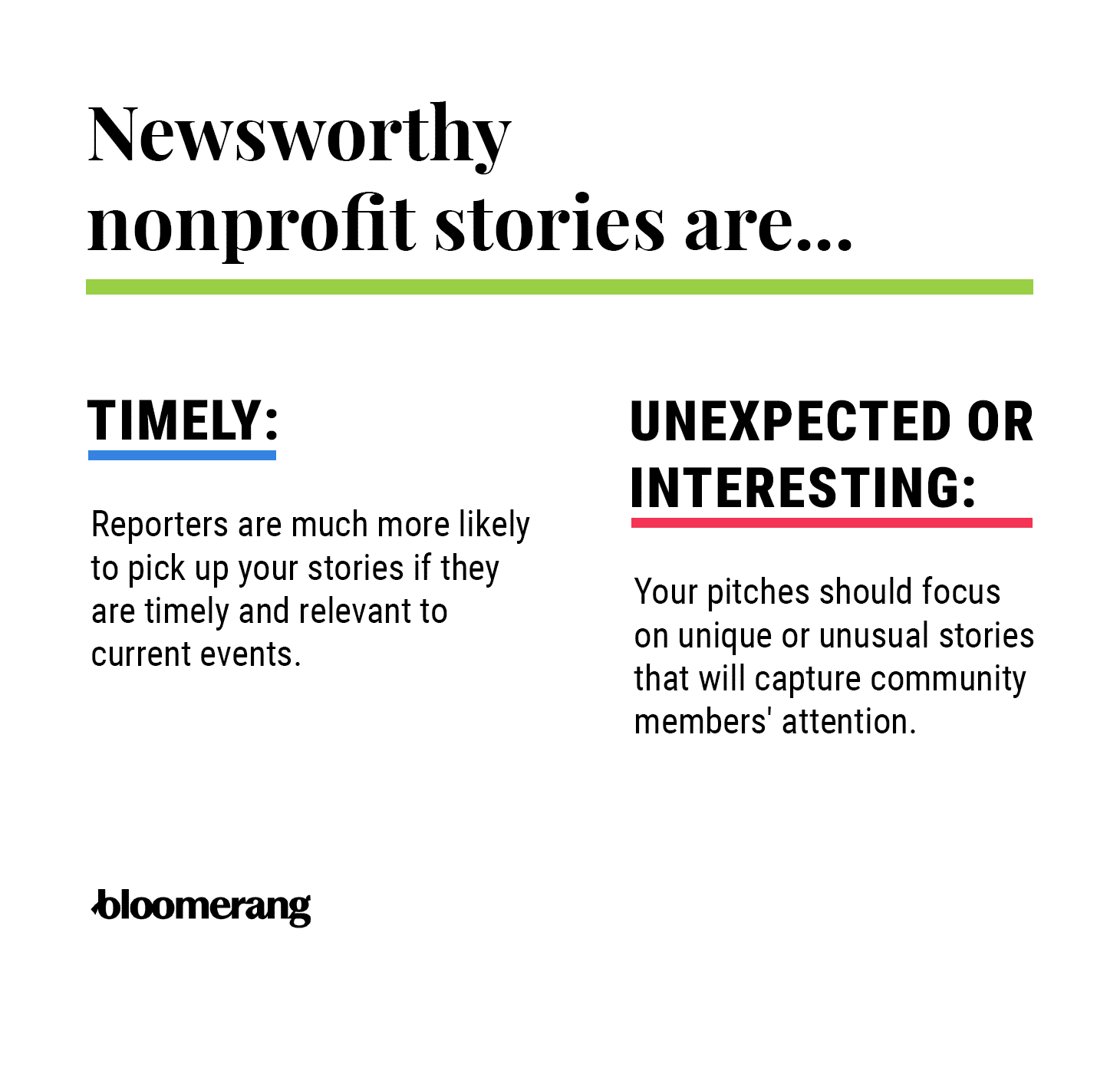
A well-pitched local media story puts your volunteer needs in front of thousands of community members you can't reach through your own channels.
How to do it
- Build a short media list: local TV news assignment desks, city newspaper editors, community magazines, and neighborhood radio stations.
- Pitch a human-interest angle—lead with a volunteer story that happens to mention your open roles, not a recruitment ad.
- Prepare a press release with your volunteer program's key stats, a quote from your director, and a compelling volunteer story.
- Offer exclusive access: a behind-the-scenes event visit, a filmed volunteer shift, or a first interview with a notable volunteer.
Example copy — Press pitch subject line and opener
Subject: 100-year-old volunteer still shows up every week. Want to meet her? Hi [Reporter], I have a story your audience will love. [Volunteer Name], age 100, has volunteered at [Org] every [day] for [X years]. She's part of our 200-person volunteer team that [mission impact]. I'd love to connect you for a short interview before our next [event]. Interested?
Track this: Press mentions and resulting new volunteer inquiries per quarter
11. Gamify your volunteer program
Adding competition and milestones to your volunteer program keeps current volunteers engaged longer—and makes it something worth telling others about.
How to do it
- Set up a digital points system in your volunteer management platform—award points per hour, per shift, or per special challenge.
- Display a public leaderboard (with opt-in consent) so top volunteers earn recognition.
- Create milestone rewards tied to specific hour thresholds: 25, 50, and 100 hours.
- Launch time-limited challenges during high-need periods like GivingTuesday or your largest annual event.
Example copy — Volunteer challenge announcement email
Subject: The [Fall Challenge] starts now. This October, we're tracking who can log the most volunteer hours. The top three finishers win [prizes]. Everyone who hits 20 hours gets [recognition]. Ready? Your hours start counting on October 1. [See the leaderboard]
Track this: Average volunteer hours per participant per campaign period
12. Offer volunteer incentives
The right incentives—especially ones that feel personal and mission-connected—significantly improve both new volunteer sign-ups and long-term retention.
How to do it
- Survey active volunteers on which rewards they actually value before spending your budget.
- Tier your incentives: small rewards for showing up (branded swag), mid-tier for milestones (gift cards), and meaningful experiences for top volunteers (behind-the-scenes tours, dinner with leadership).
- Highlight incentives prominently in all recruitment materials—they're a draw, not an afterthought.
- Make social recognition a core part of your incentive stack—a public shoutout costs nothing but lands powerfully.
Example copy — Volunteer appreciation social post
"Meet [Name]. She's volunteered 150 hours with us this year—and her commitment means [specific impact]. We couldn't do this without people like her. Tag someone who gives their time."
Track this: Volunteer retention rate (% who return for a second season)
13. Make your volunteer opportunities accessible
Removing physical, logistical, and language barriers to volunteering expands your potential pool and helps you build a more representative, resilient team.
How to do it
- Audit your volunteer site(s) for ADA compliance: accessible entrances, restrooms, parking, and workstations.
- Offer remote or virtual volunteer roles for those who can't travel to you.
- Translate your top-viewed role descriptions into the most common languages in your community.
- Create a transport coordination contact so interested volunteers can request help getting to your site.
Example copy — Accessible opportunity announcement
"Can't make it to our site? No problem. We have volunteer roles you can do from anywhere—phone banking, social media sharing, or remote data entry. Sign up today and make an impact from home. [See virtual roles]"
Track this: % of volunteer roster who self-identify as having an accessibility need met by your program's accommodations
14. Show volunteers your appreciation
Volunteers who feel genuinely valued stay longer, recruit others, and are far more likely to become donors.
How to do it
- Send personalized thank-you messages—not generic blasts—within 48 hours of each shift.
- Connect volunteers' contributions to specific, tangible outcomes (for example, "Your four hours helped us serve 80 meals today").
- Host an annual volunteer appreciation event with personal recognition for standout contributors.
- Share volunteer impact updates quarterly so supporters know their time is still making a difference months later.
Example copy — Thank-you email template
Dear _______
On behalf of [Name of Organization], I would like to personally thank you for your recent volunteer efforts. Our mission of [Explanation of Your Mission] would not be possible without the dedication and hard work of people like you. Thank you especially for [Personalized Acknowledgment of Volunteer's Specific Skills or Contributions].
I am happy to report that, thanks to volunteers like you, [Explanation of How Successful Your Event or Project Was].
Once again, thank you for your efforts! We look forward to working with you again soon.
Sincerely,
[Signature from Your Volunteer Coordinator]
Example copy — Appreciation text message
"Hi [Name], thanks for volunteering today! Your help made a huge difference by sorting 500 pounds of canned goods for families facing food insecurity. We hope to see you at the next shift!"
Example copy — Post-shift thank-you email
Hi [Name], thank you for showing up on [day]. Because of your [X hours], we were able to [specific outcome]. That's not a small thing—it's the whole reason we do this. We'll see you [next shift date]?
For a comprehensive appreciation playbook including event ideas, recognition frameworks, and messaging templates, see our ultimate volunteer appreciation guide.
Track this: Volunteer retention rate (% who return after their first shift)
15. Offer leadership opportunities to experienced volunteers
Creating a visible path from volunteer to leader gives ambitious supporters a reason to stay and gives your program a self-sustaining bench of trained coordinators.
How to do it
- Define your leadership track publicly: what qualifications, hours, or tenure qualify a volunteer for a team lead role?
- Announce the track in your volunteer communications—it's a recruitment draw, not just a retention tool.
- Provide structured training (even a one-day orientation) so new leaders feel confident before they step up.
- Compensate leaders with meaningful recognition: certificates, priority scheduling, and special invitations.
- Conduct succession planning. A succession plan is essentially a guide to what a volunteer should do if they can no longer fulfill their duties and need to pass them to someone else. You should, for example, make current committee chairs responsible for finding their co-chairs, naming potential replacement chairs, and bringing them up to speed on their duties before they leave your program.
Example copy — Leadership program announcement
"Volunteering since [year]? You might be ready for the next level. We're launching [Program Name]—a training track for experienced volunteers ready to help lead shifts and onboard new team members. Applications open [date]. [Learn more]"
Track this: Number of volunteers promoted to leadership roles per year
16. Gather volunteer feedback
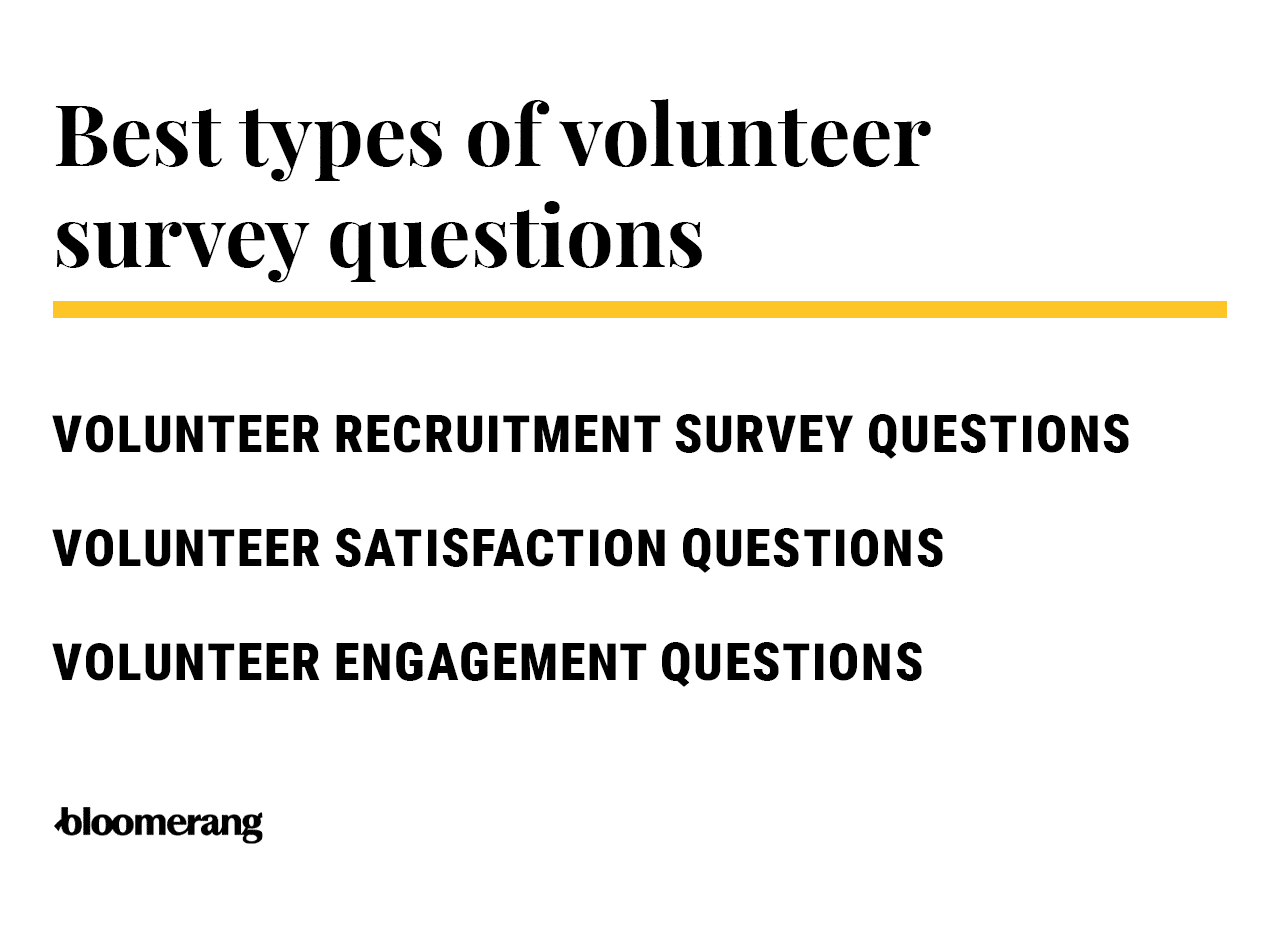
Regular, targeted feedback surveys help you fix the friction points that silently drive volunteers away and create a program people actively recommend to others.
How to do it
- Send a short post-shift survey (five questions or fewer) within 24 hours of each session.
- Include at least one open-ended question: "What's one thing we could do to make your experience better?"
- Review responses quarterly and share changes you've made in response to feedback—close the loop explicitly with volunteers.
- Use a longer annual survey to track satisfaction trends over time.
Example copy — Post-shift survey invite
"We want to hear from you. How did your shift go today? It only takes two minutes—and your feedback directly shapes how we run this program. [Take the survey]"
For ready-made survey templates and the questions volunteers actually answer, read our guide on volunteer surveys: tips and best questions to ask.
Track this: Survey response rate and volunteer Net Promoter Score (NPS)
17. Offer flexible volunteering opportunities
Rigid timelines and shift structures are one of the top reasons potential volunteers don't follow through. Flexibility removes the biggest barrier between interest and action.
How to do it
- Add weekend and evening shifts to every program where operationally possible.
- Create micro-volunteer opportunities (two hours or less) for people with packed schedules.
- Allow drop-in slots for roles that don't require training, so interested people can try before committing.
- List virtual volunteer opportunities alongside in-person roles on every channel.
Example copy — Flexible opportunity social post
"Busy schedule? Same. That's why we have volunteer shifts that fit around your life—weekends, evenings, even fully remote options. Two hours a week can change everything. [See what fits]"
Track this: % of available shifts filled within 48 hours of posting
18. Engage young volunteers
Teenagers and college students are an often-overlooked pipeline of motivated, high-hour volunteers. The organizations that meet them where they are can build loyalty that lasts decades.
How to do it
- Partner with high schools and universities where students need service hours to graduate or maintain scholarships.
- Contact student club advisors and campus service-learning coordinators directly—they're actively looking for placements.
- Design youth-specific roles with clear learning outcomes that they can add to a résumé or college application.
- Host a "youth volunteer day" tied to school calendars (spring break, summer) for high-volume, low-barrier participation.
Example copy — Email to a school service-learning advisor
Hi [Advisor Name], I'm [Name] from [Org]. We're looking for motivated students who need community service hours this [semester/year]. We can accommodate groups and individual placements—and we provide a verification letter for each completed hour. Could we connect for 15 minutes to see if this is a good fit?
Track this: Youth volunteers as a % of total volunteer roster
19. Use volunteer recruitment software to stay organized
The right volunteer management platform removes administrative drag from recruitment, so your team can spend time building relationships instead of chasing spreadsheets.
How to do it
- Centralize all volunteer data—applications, schedules, hours, and communications—in one system.
- Use automated workflows to send application confirmations, orientation reminders, and shift notifications without manual effort.
- Sync volunteer profiles to your CRM so you can track who converts from volunteer to donor and vice versa.
- Run end-to-end reports on your recruitment funnel: sources, application rates, conversion rates, and retention.
Example copy — Internal pitch for volunteer software to leadership
"Right now, [X hours/month] go to manual volunteer scheduling and follow-up. A platform like Bloomerang Volunteer automates this—giving [Coordinator Name] time back for the relationship-building that actually drives retention. Estimated time savings: [X hours]/month."
Ready to evaluate your options? Read our guide to volunteer management software for a side-by-side comparison of the top platforms, or schedule a Bloomerang Volunteer demo to see how it works for your specific program.
Track this: Cost per volunteer acquired (total recruitment spend ÷ new volunteers onboarded)
20. Ask your board to get involved
Your board members are some of your organization's most dedicated champions and possess extensive professional networks. Using their connections is a highly effective way to bring in skilled, committed volunteers who already have a degree of trust in your mission.
How to do it
- Equip board members with a short, easy-to-forward recruitment packet or "elevator pitch" outlining your most urgent volunteer needs.
- Ask each board member to commit to recruiting a specific number of volunteers (e.g., two to three people) for an upcoming major event or specialized committee.
- Encourage board members to share your volunteer opportunities on their personal LinkedIn profiles to tap into their corporate and professional networks.
- Invite them to bring a "plus one" (a colleague, friend, or family member) to your next low-pressure volunteer shift, open house, or orientation.
Example copy — Email template for board members to forward
"Hi [Name], I'm reaching out because I serve on the board for [Organization Name], and we are currently looking for passionate people to help with [Specific Project/Event]. Knowing your background and interest in [Skill/Cause], I immediately thought you would be a perfect fit. Would you be open to a quick 10-minute chat about volunteering with us?"
Track this: Number of new volunteers successfully referred by board members
Volunteer recruitment strategy comparison matrix
Use this matrix to quickly evaluate which strategies fit your team's capacity, budget, and goals.
Top 12 places to post volunteer roles
Not all volunteer boards are created equal. Here's how to choose the right mix of national boards, local hubs, campus platforms, and neighborhood channels for your open roles.
Pro tip: Aim for at least three types in your mix—a national board for scale, a local hub for community trust, and one channel tailored to your target persona (campus, corporate, or skills-based). Track which source drives your highest-quality applicants and double down there. For skills-based roles, Taproot Plus connects nonprofits with pro-bono professionals in legal, marketing, finance, and technology.
Volunteer recruitment FAQs
Why is volunteer recruitment so crucial for nonprofits?
For many nonprofits, volunteers are the face of the organization. They actively engage with the community, provide services, collect donations, and work to help your nonprofit achieve its mission and goals. Recruiting reliable volunteers is essential because it delivers tangible benefits and long-term support for advancing that mission:
- Volunteers are numerous: 75.7 million Americans volunteered in 2023, contributing nearly 5 billion hours of service. For many nonprofits, volunteers comprise a third or more of their effective workforce—making recruitment a mission-critical function, not an afterthought.
- Volunteers are valuable: According to Independent Sector, the current value of an hour of volunteer time is over $36. Recruiting and retaining volunteers isn't a soft activity—it directly affects your program's financial capacity.
- Volunteers are donors: Research from the Bank of America Study of Philanthropy consistently shows that donors who also volunteer give nearly three times as much as non-volunteer donors. With thoughtful stewardship, your volunteer base is your highest-potential donor pipeline.
What is a volunteer recruitment plan?
A volunteer recruitment plan is a strategy for attracting and recruiting new volunteers whose skills and interests align with your nonprofit's core needs.
How do I recruit volunteers fast?
The fastest volunteer recruitment combines re-engaging lapsed volunteers with peer-to-peer outreach from your existing base:
- Send a targeted email to inactive volunteers with a specific, low-commitment ask—one shift, no long-term obligation.
- At the same time, ask your five most active volunteers to share your sign-up link with one person this week.
Between these two tactics, most nonprofits see a measurable uptick in applications within days.
Where should I post volunteer roles?
Post on multiple types of platforms, such as:
- A national board (Idealist or VolunteerMatch)
- Your own social channels (especially Facebook and LinkedIn for skill-specific searches)
- A local platform (Nextdoor, a United Way hub, or a city volunteer center)
- Campus recruitment—contact service-learning coordinators directly—they maintain their own internal boards
What volunteer incentives work best?
Research consistently shows that volunteers are primarily motivated by mission connection and personal recognition. The most effective incentives are:
- Personalized thank-you messages that tie their contribution to a specific outcome (e.g., "Your four hours helped us serve 80 meals today")
- Milestone recognition at meaningful thresholds (25, 50, 100 hours)
- Social recognition that puts a face to their impact
Tangible rewards like branded merchandise or gift cards work best as a bonus on top of these—not as a primary motivator.
How do I convert volunteers to donors?
Treat volunteers as a distinct donor segment with a tailored cultivation pathway. The Bank of America Study of Philanthropy found that donors who also volunteer give nearly three times as much as non-volunteer donors. The recommended process:
- Sync your volunteer records with your CRM to identify volunteers who aren't yet donors.
- Build a simple cultivation sequence: impact story email → soft donation ask → recurring gift invitation.
- Keep your first ask small and mission-connected.
Bi-directional data syncing between Bloomerang Volunteer and Bloomerang CRM makes this seamless—your team sees a more complete picture of each supporter and can act on it without rekeying records or losing context between teams. For a full playbook, read how to turn volunteers into donors.
What is the difference between volunteer recruitment and retention?
Though they go hand in hand, volunteer recruitment shouldn't be confused with volunteer retention. Retention is everything your organization does to keep the volunteers you recruit, such as providing proper training and management, aligning volunteer assignments with individual volunteers' interests, and working hard to build personal relationships with your volunteers.
What are the 3 Rs of volunteer management?
Effective volunteer management relies on a continuous lifecycle, guided by these three foundational "Rs":
- Recruit: Attract the right individuals by aligning their unique skills and passions with your mission.
- Retain: Keep volunteers engaged and motivated through clear communication, adequate support, and meaningful work.
- Recognize: Consistently acknowledge their specific contributions so they know their impact is valued.
What are the four Cs of volunteering?
The four Cs of volunteering are four traits that volunteers should possess to be successful and productive supporters of your mission. They include:
- Commitment: Being reliable and showing up.
- Communication: Listening actively and asking questions.
- Collaboration: Working well with staff and other volunteers.
- Compassion: Caring genuinely about the mission and community.
What are the seven principles of volunteering?
The most globally recognized are the Red Cross's fundamental principles of voluntary service:
- Humanity: Alleviate human suffering wherever it may be found.
- Impartiality: Serve without discrimination, prioritizing the most urgent needs.
- Neutrality: Do not take sides in conflicts or controversies.
- Independence: Maintain autonomy from political, military, or economic pressures.
- Voluntary Service: Serve freely without the desire for financial gain.
- Unity: Work together cohesively, open to everyone within the community.
- Universality: Share equal responsibilities and duties worldwide.
Wrapping up
Your volunteers make your mission possible—they're the ones showing up, rolling up their sleeves, and turning your organization's goals into real-world outcomes. That's why investing in the right recruitment strategy for each program pays off so significantly: the time you spend crafting a thoughtful plan translates directly into reliable volunteers who stick with your organization for years.
Continue learning