How to Run a Silent Auction: 10 Simple Steps for Success




From peer-to-peer fun runs to bake sales, there’s no end to the types of fundraising events your nonprofit can host. Planning events is one of the best ways to raise money for your mission, and donors love participating in them. In fact, 81% of nonprofit donors attend fundraising events.
Silent auctions are a great fundraising event format if you want a unique way to engage your donors. These highly interactive experiences allow your nonprofit ample time to engage with supporters face-to-face.
First, let’s define exactly what a silent auction entails to give you a better understanding of how these events work.

What is a silent auction?
A silent auction is a fundraising event where attendees bid on auction items using mobile bidding software or paper bid sheets. Rather than having an auctioneer announce items, attendees can freely walk around the event to view items.
You can host a silent auction either in person or online. With an in-person event, attendees browse items displayed on a table and place bids on their favorites using paper bid sheets or a mobile bidding platform. In a virtual silent auction, supporters view auction items on a website or webpage and place bids online.
Why should your nonprofit host a silent auction?
As a particularly engaging type of fundraising event, silent auctions offer many benefits for nonprofits. Hosting a silent auction allows your nonprofit to:
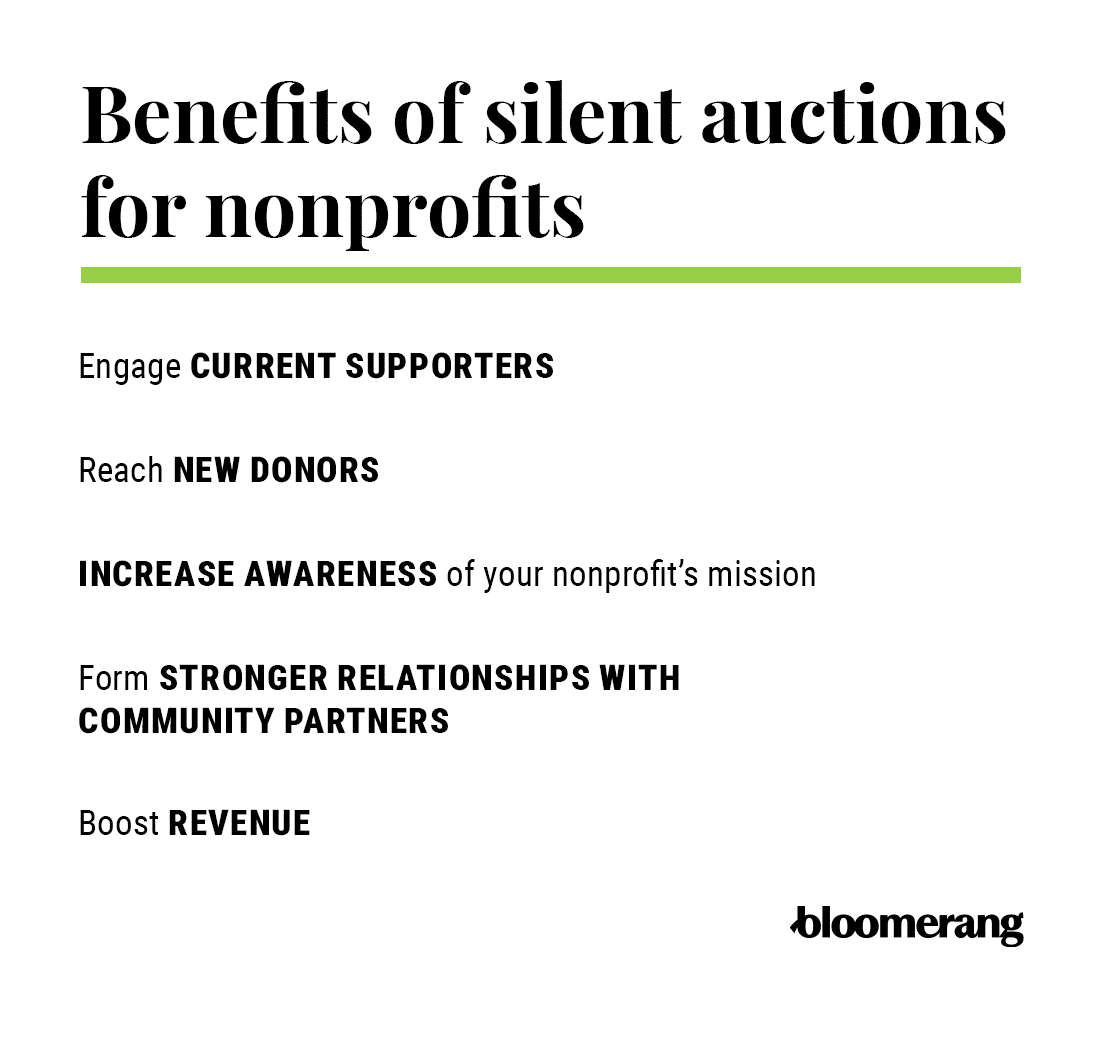
- Provide supporters with an engaging, fun experience. Auctions allow supporters to engage more directly with the fundraising process. Attendees can not only support your worthy mission but also leave your event with something valuable of their own to take home.
- Reach new donors. Hosting an auction gives your nonprofit the chance to connect with a new audience of potential donors, especially if your event offers multiple forms of entertainment. Prospective donors who don’t have a strong preexisting relationship with your nonprofit may be interested in attending your event if it features engaging elements like live music or a silent disco.
- Spread awareness of your nonprofit’s mission. A silent auction event provides a platform for your nonprofit to share mission-related information and updates. You can hand out information sheets, play inspirational videos, and invite live speakers to share their stories with attendees.
- Form stronger relationships with community partners. Community partners like local businesses and civic organizations can support your nonprofit by donating auction items or funding event overhead costs. In return, your nonprofit can include their logos in your event marketing materials, creating win-win benefits for both community partners and your organization.
- Drive revenue for your nonprofit. Of course, one of the most important benefits of hosting a silent auction is the opportunity to drive major new revenue for your organization. When you plan it carefully, you can turn your auction into a valuable recurring event that drives revenue for your nonprofit year after year.
Silent auctions may require a bit more planning than other fundraising events, but the effort is worth it because of these significant benefits.
Are silent auctions profitable?
Yes, silent auctions can be highly profitable for nonprofits. The primary reason for their strong return on investment (ROI) is that the items up for bid are typically procured through in-kind donations from local businesses, board members, and community partners. Because your organization is not purchasing these items out of pocket, the overhead costs remain incredibly low while the revenue potential scales with your guest list.
Furthermore, silent auctions tap into the psychology of friendly competition. When attendees get emotionally invested in winning an item, bidding wars naturally drive the final sale price higher, often exceeding the item's actual fair market value. When paired with mobile bidding technology that sends instant outbid alerts directly to guests' phones, you can maintain that competitive momentum throughout the entire event.
Beyond the direct revenue from the bids themselves, silent auctions are highly profitable because they serve as a powerful marketing draw. An exciting auction catalog helps sell more event tickets, secures higher-tier corporate sponsorships, and sets the stage for bidding wars later in the evening.
What are the basic rules for a silent auction?
Learning how to run a silent auction means understanding the rules and best practices. Common silent auction rules and guidelines include:
- Require bidders to register. Requiring guests to register helps you understand exactly which supporters will attend your event and create personalized engagement plans, especially for major donors. Encourage them to register in advance to take advantage of early-bird discounts and other incentives, such as early access to bidding. At the actual event, create multiple check-in lines. For example, you can have a VIP line, a line for pre-registered attendees, and a line for walk-ins.
- Determine the fair market value of each auction item. Conduct extensive research to determine the fair market value (FMV) of your auction items. Check the internet for similar items, seek an expert opinion (or two), and list the FMV based on your research. The more accurately you assess these items, the more value you’ll give your guests.
- Set minimum bids. To set a reasonable starting bid for each auction item, you must first determine its FMV and decide on your minimum bid as a percentage of that. If the starting bid is too high, you might not attract enough bidders. On the other hand, if it’s too low, you may leave money on the table. Consider what bidders would be willing to pay for the item in a typical setting and go from there. Ideally, you’ll set minimum bids at 30-50% of FMV, with popular items at 30% or lower and lower-ticket items at 50% or higher.
- Determine bid increments. Lower bid increments will increase the number of individual bids, while higher bid increments will encourage fewer people to place higher bids. It’s about striking a balance and considering the item being auctioned. Additionally, when you incorporate a mobile bidding app, it’ll be easier for bidders to place a higher bid because they can do so from their phone with a few taps, increasing the number of bids you receive! For paper bid sheets, pre-fill bid amounts in increments to speed writing and encourage higher initial bids.
- Properly display items. Avoid small and overcrowded silent auction item displays, poor lighting, or handwriting on display sheets. Instead, display everything like you would in a retail shop, keeping it well-lit and using detailed display cards. Ensure every item is in your mobile bidding system, and, if possible, keep items out of their packaging for a better view.
- Set your auction time frame. Open your auction as early as possible, even days in advance. This gives guests more time to familiarize themselves with your items, learn how to use your auction tools, and get ready to bid once the auction starts. Then, close the auction as late as possible on the event day.
- Communicate bidding deadlines. Develop a system to communicate the time left for guests to place their bids. Announce the time remaining before closing times. If you’re using an app-based auction product, you can create and send push notifications to all attendees. This helps boost engagement and encourage more friendly competition in the minutes leading up to the auction's conclusion.
- Set deadlines for final payments and item pickup. Set clear deadlines for making final payments and picking up items. To prevent last-minute bids, stagger item closing by shutting down the bidding on one of your item categories every 5 to 10 minutes. Make sure to have plenty of volunteers stationed at the correct items when it’s time to close that category. The minute your emcee announces that the category has closed, have your volunteers grab all the pens and bid sheets from the table, then circle the winning bid for each item. Silent auction software can streamline this process; guests can easily pay and check out after the evening. However, if a guest chooses not to pick up the item, you’ll have the data to identify the second-highest bidder.
10 steps to run a silent auction
If you’ve never hosted a fundraising silent auction before, it may seem intimidating. But when you break down the process into smaller steps, you can simplify planning and make the process much easier for your auction committee. Let’s explore the main steps of running a silent auction.

1. Create a planning committee.
The first step in planning your silent auction is recruiting a dedicated team of passionate staff members and volunteers to organize your event. The majority of your planning committee will likely be comprised of internal staff members from your nonprofit’s fundraising team. However, if you need more support, reach out to your supporter network for volunteers—especially if you’ve had people mention their interest in helping you plan events in the past.
Assign the following initial tasks to your planning committee members:
- Establish an event budget. Provide information about costs for past similar events you’ve hosted to give committee members a clearer idea of your budget range.
- Determine whether your auction will be in person, online, or hybrid. Assess the geographic location of your supporters to determine the right format for your event.
- Set fundraising and supporter engagement goals for the auction. These could include how many auction participants you want to attract, what percentage increase you’re looking for in new donors, and the total amount of donations attained at your auction.
Then, work with your planning committee to check the other items off this to-do list. Establish open communication with your team using an instant messaging system or email cadence to keep everyone on the same page.

2. Choose a venue.
If you’re hosting an in-person or hybrid event, you’ll need to find the perfect venue to host your fundraiser. Your quest for the right venue for your fundraising auction depends on several factors:
- Size and location. Determine how many guests you anticipate having at your auction and who they are. Ensure your venue can comfortably host all of your guests and is accessible for all attendees. Also, pick a venue in a central location for your guests. The easier it is for people to get to your event, the more likely they are to attend.
- Equipment capabilities. If you’re hosting a hybrid or virtual event, the venue you choose must have reliable audio and video capabilities for a livestream, especially if you’ll have some form of entertainment. Determine what kind of style and ambiance you’re going for in your livestream. Do you only need a simple, one-angle video stream, or are you opting for a system of cameras streaming from different angles for a dynamic, in-the-room experience? Make sure you have sound equipment that easily hooks into your stream to minimize technical sound issues.
- Catering. No matter what time of day your auction is scheduled, offer some type of food to keep your guests happy. Assess whether your venue offers food options on-site or you’ll need to bring in outside vendors.
As you’re picking your venue, also keep in mind what entertainment options you want for your guests. If you know any local musicians or bands willing to play a set or a local comedian willing to perform a standup routine, try to find a venue with a good stage area. Providing entertainment for your guests will keep your auction fun and engaging.
Bonus tip: Strategize ways to make the event layout visually appealing. Just like you’re more likely to purchase something that is presented in a visually appealing way at a store, making your auction look nice can result in a higher perceived value and higher bids! Jazz up your event space with themed decor or soft lighting that adds ambiance.
3. Procure auction items.
Finding items for your auction guests to bid on can be stressful if you don’t know where to look. Luckily, your nonprofit likely has corporate partners and donors in your area who’d be excited to support your event. Use these strategies to gather valuable, unique auction items:
- Reach out to past sponsors. For example, if your nonprofit is an animal shelter and you’ve worked with a local pet store before, reach out to see if they would be willing to donate a few items or gift certificates for a pet care basket.
- Find new sponsors. Use your auction event as an opportunity to connect with new corporate sponsors in your community. Present the benefits of getting involved, such as a marketing boost and positive PR opportunities.
- Make a plan for storing, cataloging, pricing, and showing off your auction items. Auction item management software can help you organize your items once you’ve collected them and display them for your guests (more on this in the next section!).
If you need help determining which items will be most enticing for your guests, don’t hesitate to ask! Send a pre-event survey asking for suggestions or encouraging supporters to rank their interest in potential items. This can help you narrow down your search and be more specific when requesting donations from corporate partners.
Aim for one item for every 5-10 expected guests. This ratio provides enough variety of items while also creating scarcity to drive bidding wars. Smaller events often feature 10-40 items. If you don’t get the ratio exactly right in your planning, you can adjust the presentation of your items to match this.
Once you’ve acquired your items, you’ll want to set your minimum bids at 30-50% of their fair market value (FMV), with popular items closer to 30% FMV and lower-ticket items closer to 50% FMV to encourage competitive bidding.
Bonus tip: Consider picking a theme for your items. A theme can tie your items together and make your event more memorable. Consider theme options like Winter Wonderland, Summer Splash, or Outdoor Adventure.
4. Select an auction platform.
Thanks to advancements in the event fundraising technology world, paper bidding is no longer the only way to bid on silent auction items. Auction software makes bidding easy for your organization and your auction guests.
In a traditional auction, your guests use bid sheets placed next to items to write down their name and bid amount. However, with mobile and online bidding, guests can bid directly from their smartphones or web browsers no matter where they are, making virtual or hybrid auctions easy to run. You never need to worry about losing pens or ripped bid sheets ever again.
When choosing an auction platform, there are a few factors to consider:
- Does the platform support mobile bidding? This allows attendees to make bids and see if they’ve won items directly from their mobile devices.
- Does your auction software have both app-based and web-based bidding options for your guests to choose between?
- Does the system integrate with your CRM of choice?
- Will your software work with your nonprofit’s size and needs? Will it grow with your organization?
- Does the software enable other mid-event fundraising opportunities, like raffles or merchandise sales?
- Does the software offer simplified checkout with multiple payment options, such as credit card and Apple Pay?
For example, Bloomerang Fundraising’s Auctions feature is great for all organizations, big and small. It’s simple to use, includes award-winning customer support, and offers unlimited users, allowing large organizations to add as many accounts as they need. Plus, with Bloomerang Fundraising, you can set up as many auction events as you’d like, ensuring you can host multiple events throughout the year.
Real nonprofits have seen real results using Bloomerang Fundraising for auctions. For example, Feeding South Florida improved efficiency and event fundraising by 60% after moving to a unified platform, and the Grand Rapids Public Museum raised 130% of its gala goal after switching from Greater Giving.
Paper bid sheets vs. mobile bidding
For decades, nonprofits relied on clipboards and pens to run their events. However, as technology has evolved, using a dedicated silent auction app has become the industry standard. Here is a quick look at the advantages silent auction apps hold over traditional paper bid sheets:
- No bid camping. Guests often physically hover over or "camp" at popular items to block others from writing down a final bid, which artificially caps your revenue. Mobile bidding eliminates camping entirely. All guests can bid simultaneously from their smartphones via a silent auction app, regardless of where they are standing in the venue.
- Outbid alerts. With paper bid sheets, bidders must constantly walk back to the auction tables to check whether they have been outbid, diverting their attention from your speakers, mission moments, and socializing. On the other hand, silent auction apps generate automated text messages or push notifications the second a donor is outbid, prompting instant counter-bids and driving up the final sale price.
- Checkout speed. Paper bidding requires your staff to manually collect sheets, decipher messy handwriting, tally totals, and swipe credit cards one by one, which can lead to long, frustrating checkout lines. Mobile bidding offers frictionless, automated checkout. Guests pre-register their credit cards when they buy their tickets and can easily pay from their phones at the end of the night.
- Data integration with your CRM. Transferring data from your paper bid sheets to your CRM requires extensive manual data entry, which takes time and can introduce errors into your database. However, a silent auction app can integrate with your donor management software to automatically push new donor profiles, bid histories, and payment data directly into your CRM as soon as the event ends.

5. Provide additional ways to give.
The auction itself will be your organization’s primary fundraising method, but that doesn’t mean you can’t incorporate other strategies to raise even more from your event.
In fact, not all of your guests will have placed bids or won items. To maximize your fundraising, implement additional revenue-generating strategies at your silent auction.
Let’s briefly look at a few of the most popular options:
- Raffle. Your organization has already done all the work procuring auction items, so you can easily take one of those items out of the auction and feature it in a raffle. Check local legislation to see if you need to follow any specific guidelines to host your raffle, as many jurisdictions have raffle-related regulations.
- Fund-a-need items. “Fund-a-need” items are popular with silent auction attendees who want to support the cause but can’t necessarily afford to bid on more lavish items. These aren’t prizes that participants take home, but are smaller-dollar donations that provide tangible items for your cause. For example, if your organization is an animal shelter, you could give donors the option to fund the purchase of dog food, leashes, collars, and dog beds for your shelter.
- Donation page. Make a live appeal to attendees to visit your online donation page and contribute a gift if they feel inclined to do so. Offer a QR code or link leading to the page so attendees can easily access it on their phones.
- Merchandise. People are attending your event expecting to leave with something, so those who don’t win items will likely love the opportunity to purchase merchandise. Offer branded t-shirts, sweatshirts, mugs, water bottles, and tote bags.
With these additional revenue streams, every attendee can leave knowing they contributed to your mission’s success.
6. Build an auction website or webpage.
Once you’ve put the details of your auction together, make it easy for your guests to find information about the amazing experience you have planned. Building a website or online event page means you can point your guests to a one-stop shop whenever anyone has questions about your event.
Your digital resource should include:
- An event-specific logo and banner image alongside your organization’s logo
- Impact statements so guests understand how their involvement in your organization is changing the communities you serve
- A donation form for those who aren’t bidding on gifts but would like to contribute anyway
Share links to your auction website in your digital and traditional marketing materials (read on to the next section for event marketing tips).
7. Promote your event.
A thorough event promotion strategy will help increase RSVPs for your event, leading to greater fundraising potential. These channels can come in handy to help get the word out:
- Social media: Note which types of social media posts on your pages receive the most engagement and impressions, and design your auction posts based on past successful messages. If your auction has a sponsor, provide them with graphics and videos they can share on their channels to attract new faces. Encourage your guests to share their involvement with your event on their personal channels as well.
- Email: Share auction logistics, item previews, and a link to RSVP using your email marketing channel. You can also create communication segments in your email platform to send personalized messages to different audiences. For example, you could present your auction as an effective way to get more involved with your cause to new donors. On the other hand, you could use your email communications to thank past donors for their previous involvement and let them know you’d love to catch up with them at the auction.
- Direct mail: Direct mail is a tried and true way to connect with supporters who prefer traditional marketing methods. Print personalized event invitations with supporters’ names. Include all the who, what, when, and where information and a link or QR code to register for the event.
Increase your event outreach in the weeks and days before the auction to boost excitement and ensure everyone who may be interested has a chance to see the event’s details.
Bonus tip: Personally invite specific guests to your auction event. Some supporters would be incredibly valuable guests to invite to your event. This includes major donors, who could potentially help you raise a lot of money through bidding on big-ticket items. Personally invite these supporters to your event with a handwritten note or phone call. Let them know you’d love to catch up with them at the event and get their take on your organization’s recent mission-related efforts.
8. Create a smooth checkout process.
Long checkout lines are frustrating for guests. After the excitement of the event, attendees want to quickly claim their prizes and head home to enjoy them.
However, the traditional silent auction checkout process isn’t as efficient as it could be. Between deciphering handwriting on paper bid sheets and slow payment processing on computers or registers, the process could be significantly delayed, leading to long lines and agitated guests.
By incorporating silent auction software into your event, your checkout process will look more like this:
- The auction ends.
- Your organization opens checkout.
- Guests who have already entered their payment method through your online registration process can easily pay for transactions such as bidding on items, purchasing events, and funding needs.
- Guests will receive a paid receipt, and the organization can scan the QR code to see a list of items they won, which are then retrieved and handed to the guests.
Additionally, your fundraising auction software should help you arrange items so your supporters can easily see and bid on them. To make the checkout process smoother, once an item has been pulled, pull its sign with it so you can keep a visual tally of which items are left to be picked up. Let your supporters know how to claim their items if they purchased them online or left the event before the auction closed.
Bonus tip: Make sure your auction software offers a secure payment processing system. Your payment processor should have security measures in place such as PCI compliance and data encryption. This gives donors a smooth, painless, trustworthy checkout process.
9. Run through your event.
As the big day approaches, your planning committee should conduct a practice run of your event so you can iron out any potential issues you may encounter during the auction. Prioritize the following tasks during your run-through:
- Streamline check-in and check-out processes to get your auction guests in and out of your auction painlessly. Make your check-in tables a one-stop shop, and ensure your staff and volunteers fully understand their roles and responsibilities. Host a software training day to ensure they’re all familiar with your auction platform, including the mobile tools you offer and how to take payments.
- Prepare a VIP attendee list. This list should include your major donors and anyone else who should receive special attention during the event. Your staff and volunteers should make a point of personally interacting with these individuals.
- Pay attention throughout your practice run for any common points of confusion staff members and volunteers may experience. Compile a list, and then create and distribute FAQ sheets to everyone after the rehearsal to avoid any issues when the day of the auction rolls around.
At the end of the day, organization and communication are key when throwing a successful fundraising auction. Brainstorm with your team any pitfalls that may arise during the event and plan ahead for how to avoid them and what you could do if an issue takes place.
Bonus tip: Don’t crowd your tables. If you’re throwing an in-person event, make sure your items are evenly spaced. They shouldn’t be crowded together at the same table because this will overwhelm your guests and may result in certain items being overlooked. When arranging your items, consider alternating items like gift cards and larger physical items so the tables don’t get too crowded with just one type of item.
10. Conduct event follow-up tasks.
Did you know the average donor retention rate hovers around 40-45% across the nonprofit sector? In fact, 70% of new donors will only give once.
If your silent auction fundraiser attracts new supporters and introduces them to your mission, you should do everything possible to keep them around. One of the best (and easiest) ways to retain new donors is to follow up after the campaign.
Once the event is over, send thank-you emails to each of your participants, including donors, bidders, volunteers, and corporate sponsors. Explain how much you valued their participation and demonstrate donors’ impact on your mission. Often, people don’t give again because they don’t know what happened to their previous gift, so providing a detailed follow-up is critical. For example, let them know how many more beneficiaries you’ll be able to help or how many new pieces of equipment you’ll be able to purchase.
Along with increasing donor retention and starting new relationships on the right foot, following up with participants after your silent auction fundraiser allows you to:
- Let donors know how to pick up their winnings if they participated virtually or left the event early.
- Share your plans for items that didn’t sell, like saving them for a future auction or selling them online.
- Explain wins/losses/growth opportunities to supporters in a transparent way.
- Provide an opportunity for participants to give feedback with a survey or an optional questionnaire.
Additionally, review your results to identify your wins and celebrate them with your staff and volunteers. Also, identify the growth opportunities for your future events. Could you tweak your event layout for greater impact? Can you provide a more positive attendee experience by offering a variety of entertainment options? Note these opportunities so you can keep them in mind when planning your next event.
Common silent auction challenges and how to solve them
Silent auctions are some of the most complex and rewarding fundraising events out there. While that means that silent auctions are lucrative and engaging, it also means that planning one can be somewhat involved. Because there are so many moving parts to oversee, it’s easy for nonprofits to run into challenges when executing their events.
Luckily, these problems are completely avoidable (or, at the very least, correctable). All it takes is being aware of some of the issues you might encounter and knowing how to tackle them!
Here are some of the most common silent auction challenges:
- Not enough room to display items. If you run out of room to display your items, your organization should do everything in its power to keep your auction items to one row per table. Packing more items onto a table can make your display look cluttered and obscure some items, both of which can make them seem less valuable to your bidders. Instead, try creating packages by grouping related smaller-ticket items into bigger groups. Often, you’ll receive higher bids on packages than you would when auctioning off these items solo.
- More items than bidders. When your items outnumber your bidders, it greatly reduces competition for those items. To raise the most funds, adjust the number of items based on the number of bidders, aiming for one item per 5-10 guests. You may also package similar items together or consider hosting an online pre- or post-auction.
- Identical items decrease competition. The key to featuring two identical items is to obscure the competition between them as much as possible. If you received the items from the same donor, keep one under wraps. If you received them from different donors, display them separately. Once the bidding has closed, approach the bidder who placed the second-highest bid on that item. Tell them that you still have an identical item up for sale and would be willing to part with it if they’re willing to pay as much as the winning bidder. Since they want the item and have usually only lost by a small margin, the bidder will almost certainly say yes.
- Camping by items. To see higher bids and free up more time for mingling with your guests, reduce camping by either using mobile bidding software or filling out bid sheets before opening the bidding. Mobile bidding allows guests to bid and browse items from their smartphones, receive outbid notifications, and set maximum bid amounts on certain items. If your organization chooses to use bid sheets, you can still address this problem by filling out the bid amount fields in advance. Start by filling in the first column with the minimum bid amount, then raise it incrementally by the minimum raise to fill in each subsequent field. This strategy will speed up bidding by reducing the time guests spend handwriting their bids and by allowing them to initially submit the highest amount they’re willing to pay.
- Sneak-in bids after close. By implementing mobile bidding or staggering item closing when you’re using bid sheets, your organization can better prevent cheating and, consequently, any hard feelings among your attendees. Stagger item closing by closing bidding on a different item category every 5 to 10 minutes.
Final thoughts
Planning an auction is hard work, but as a special event that engages and excites your guests, the payoff is well worth it. If you’re looking for even more tips to help you host a successful event, here are a few blog posts to check out:
- The Ultimate Nonprofit Event Planning Checklist for Success. Use this additional event planning checklist for any nonprofit event your organization hosts.
- 100 Themed Silent Auction Basket Ideas for Fundraisers. Review effective auction basket ideas in this comprehensive roundup.
- Elevating Nonprofit Events: A Strategic Guide To Guest Curation. Find out how strategically curating your guest list can significantly elevate your nonprofit’s events.