When Time is Scarce: The Busy Fundraisers Guide to Predictive Intelligence



How fundraisers are starting the week with clarity instead of a report stack
Monday morning. You've got coffee, a browser tab full of reports, and somewhere between 200 and 600 donor relationships sitting in a spreadsheet or your CRM. No analyst to pull the data and help you prioritize. No development associate to hand off the smaller gifts. Just you, the database, and a to-do list that grew over the weekend.
For a lot of development directors and fundraising coordinators, knowing where to start takes an hour all by itself. You skim the lapsed donor report. You check who gave last month. You pull the people whose pledges are coming due. You cross-reference major gift prospects with whoever's been to an event recently. By the time you've got five names on a short list, the morning is mostly gone.
This is what fundraising looks like when you're working solo, and it's not rare. According to the Center for Effective Philanthropy's State of Nonprofits report (2026), 30% of nonprofits have already cut staff, and 46% of nonprofit CEOs now cite burnout as a top concern, up from 29% just one year ago. The workload hasn't shrunk. The teams have.
Why does a nonprofit CRM still leave fundraisers without direction on Monday morning?
You probably have plenty of data. Your CRM has years of giving history. You can see who opened your last email. You know which donors have lapsed. Information isn't what's missing.
What's missing is direction. A list of 47 donors who haven't given in 14 months doesn't tell you which three of those donors are most likely to give right now, what amount to ask for, or what to say when you reach them. That sorting job falls to you, and it takes time you don't have.
A Bloomerang survey of 461 fundraising professionals found that 83% lack a reliable way to diagnose whether their fundraising is performing at its potential (Bloomerang Fundraising Blind Spot Survey, May 2026). When asked what would actually help, 62% said they want clear recommendations, not more dashboards.
How does Bloomerang’s predictive donor intelligence tell a fundraiser who to contact each day?
No separate login required. No data export. Starting in July 2026, Bloomerang customers access predictive donor intelligence directly inside their existing Bloomerang CRM workflow, thanks to partnership with Dataro.
Predictive donor intelligence analyzes patterns in a nonprofit's donor data to forecast near-term behavior (such as likelihood to give, lapse risk, or readiness to upgrade) and surfaces clear next actions directly inside the fundraising platform. Rather than handing you a set of reports to interpret, the platform interprets them for you and surfaces who to focus on first.
Before and after predictive donor intelligence
Daily Actions is a recommendations tile in the Bloomerang CRM dashboard that surfaces a prioritized list of donors who need attention, updated overnight, with clear guidance on what to do and why (without requiring the fundraiser to run a report or filter a list). Every donor in your database gets updated weekly scores: likelihood to give in the next 90 days, lapse risk, readiness for a giving upgrade, suggested ask amount, and monthly giving conversion potential. No filtering, no configuration, just the list.
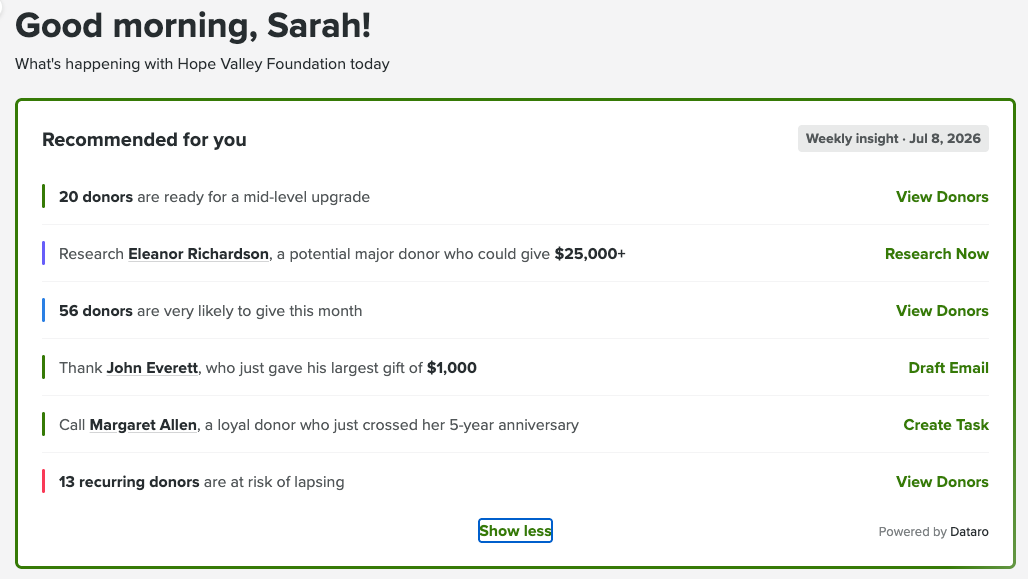
Here's what that looks like in practice.
Scenario 1: The donor who's ready to give more
What you see: A donor shows up on your Daily Actions tile Monday morning. Her score flags a high likelihood of giving in the next 90 days, a strong signal for monthly giving conversion, and a suggested ask in the $150 to $200 range. She gave $100 last February to your after-school literacy program and opened your last three emails.
What you do: You click into her record. Her giving history goes back four years, all to the literacy program, all in late winter. She's attended two virtual events. No personal outreach from your organization in over a year.
You ask Penny, Bloomerang's AI fundraising partner, to draft a note. Penny can explain donor recommendations in plain language, draft outreach messages for fundraiser review, and help prepare next steps, keeping the fundraiser in control of every decision. Penny pulls the relevant history and drafts a personal check-in that references the literacy program, mentions that spring enrollment numbers just came in, and includes a soft ask about joining as a monthly supporter at $15 per month.
What you adjust: The draft is close. You change one sentence to mention a student story you know she'd connect with. You review it, approve it, and send it. Total time: about eight minutes.
That's not a campaign. It's a personal outreach to someone who was already inclined to give more, at exactly the right moment to ask. A one-person team can do this every day, because the platform has already identified who's ready.
A simple weekly prioritization routine
- Open your Bloomerang dashboard. The Daily Actions tile is already loaded with prioritized donors based on overnight scoring. No report to pull.
- Review the top recommendations. Each entry shows the donor's name, the signal driving the recommendation (giving likelihood, lapse risk, upgrade readiness), and a suggested next action.
- Click into the first donor record. Review giving history, engagement patterns, and any logged notes. Confirm the signal makes sense for this relationship.
- Ask Penny for a draft. Penny generates an outreach message based on the donor's history and the recommended action. You review it, adjust the language, and approve it before anything goes out.
- Make the contact. Call, send the email, or schedule the follow-up. Log the outreach in the record.
- Move to the next name on the list. The whole sequence, from dashboard to sent message, typically takes 5 to 15 minutes per donor.
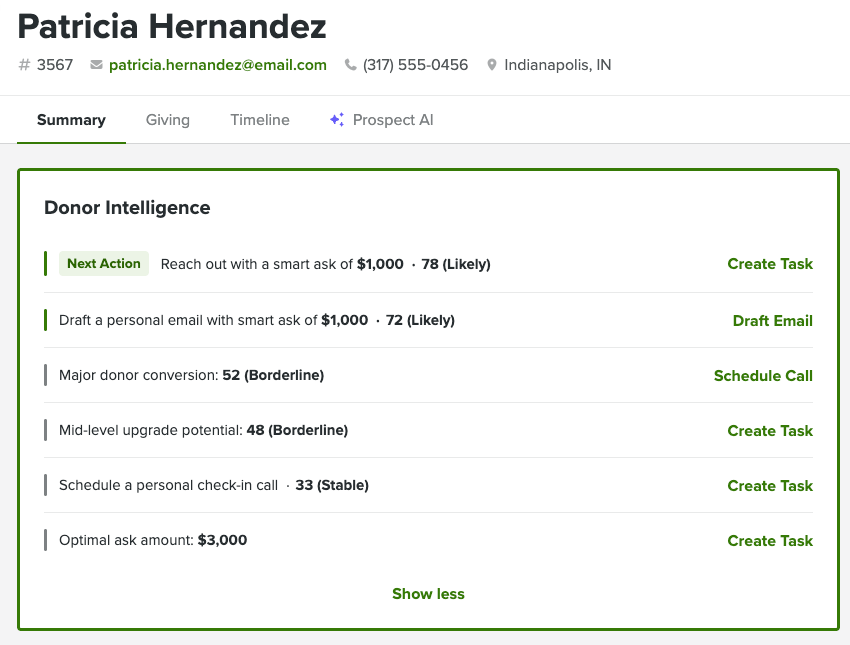
An example of how a donor record will display in the Giving Platform with predictive intelligence.
Scenario 2: The donor whose lapse risk just spiked
What you see: David Park's lapse risk score jumped this week. He's been a reliable $250-a-year donor for six years, always to your emergency housing fund. His score has moved from low-risk to high-risk in the last 10 days. The signal: he hasn't opened your last four emails, and his typical giving window (October through December) is still months away.
What you do: You click into his record. He attended your annual breakfast in 2023 but hasn't been to an event since. There's a note from two years ago that he met your executive director and asked about the housing fund's long-term plans. No follow-up was logged after that.
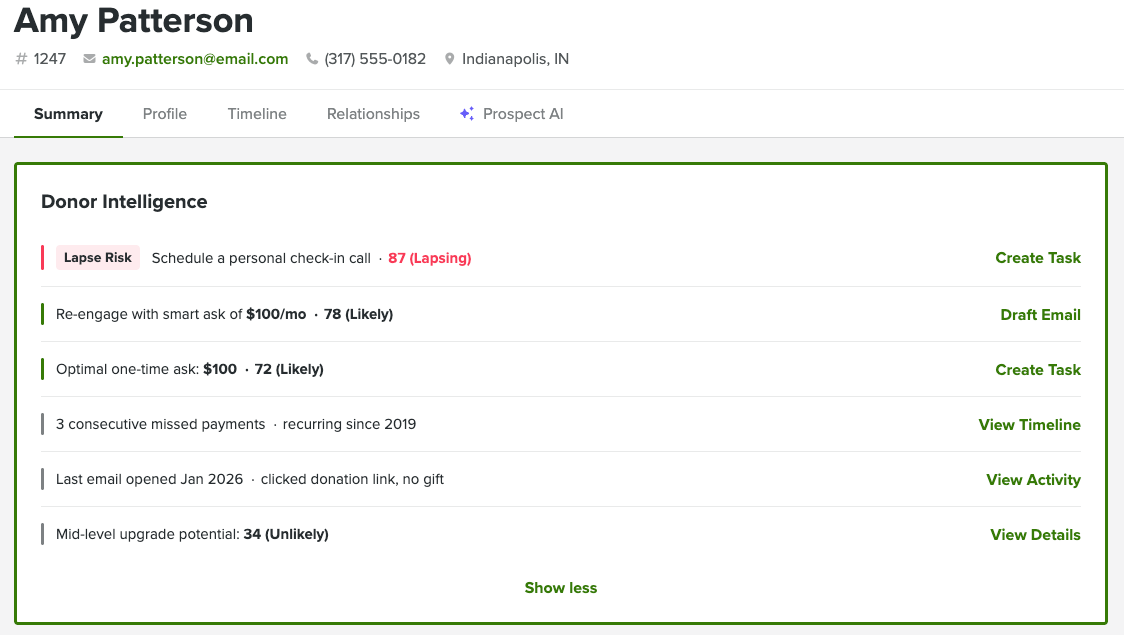
An example of how an at-risk donor would display in the Giving Platform with predictive intelligence.
This is a phone call, not an email. You can see that clearly. You pick up the phone. You tell him you've been thinking about donors who've supported the housing fund long-term, and you wanted to share something about where the program is heading. You don't lead with an ask. You're checking in while the relationship is still warm.
Why this matters: David won't show up on a lapsed donor report for another three to four months, if your cutoff is 14 months from last gift. By then, the relationship has cooled. The window for a natural conversation has closed. The predictive score surfaces him now, while a check-in still feels genuine.
That's the difference between proactive and reactive retention. One of them feels like relationship work. The other feels like a rescue call.
How does predictive donor scoring help with donor outreach?
There's a common workaround for not knowing where to focus: contact everyone. Send the appeal to the full list. Reach out to all lapsed donors. Cast wide and see what comes back.
That approach has costs. It takes more time. It creates more noise for donors who aren't ready. It dilutes the attention you give to the people who are most likely to respond.
Predictive scoring changes the math. When you know a particular donor has a high likelihood of giving in the next 90 days and is a strong candidate for a monthly gift, you can invest real relationship time there: a personal call, a handwritten note, a tailored ask amount. When a different donor scores low across the board right now, you keep them warm without overinvesting.
The Bloomerang Giving Signals Report 2026 found that 87% of active donors say giving is values-driven and 92% say it's not primarily transactional. What that means in practice: the donors most likely to give again are the ones who feel a genuine connection to your mission. Surfacing them at the right moment, and making contact that feels personal rather than broadcast, is how that connection gets reinforced.
For a one-person development shop, this kind of direction isn't a nice-to-have. You can't spend Monday morning sorting through noise to find the signal. You need the signal ready when you sit down.
What does a fundraiser's Monday morning look like with Bloomerang predictive intelligence?
The goal of good fundraising software is to get out of your way. The best version of this technology isn't a tool you spend more time in. You spend less time in it, because it's already done the work of analysis, prioritization, and preparation.
Daily Actions, predictive scoring, and Penny work together to answer the question you're asking every Monday morning before you've had a chance to ask it: who do I call today, and what do I say?
You log in. The list is there. You click into the first name, review the signals, adjust Penny's draft, and make the call. The hour you used to spend building the short list is now the hour you spend working it.
If you're managing a full donor portfolio without a team behind you, you deserve a platform that does the sorting. Your donors deserve the attention that frees up when it does.
Frequently asked questions about predictive intelligence
What is predictive donor intelligence?
Predictive donor intelligence is what powers Bloomerang with Dataro: machine learning models that analyze donor behavior and predict who's about to give, lapse, upgrade, or convert, then turn those predictions into daily recommended actions, weekly donor scores across six propensities, and on-demand prospect research through ProspectAI. Instead of donors, all treated the same, every donor comes with a ranked priority, a plain-language reason, and a clear next step, right inside the tools your team already uses.
How often do donor scores update inside Bloomerang?
Donor scores update weekly. That means every Monday morning, your Daily Actions tile reflects the most current giving patterns, engagement signals, and risk indicators across your full donor database. You're always working from a current picture, not a snapshot from last quarter.
Will I need to export donor data to a separate platform to access these predictions?
No. Bloomerang customers don't need a separate Dataro login or manual data export. Predictive scores, lapse risk signals, and recommended next actions are all available inside the Bloomerang CRM you already use.
What signals does Bloomerang’s predictive scoring track?
Dataro's models analyze giving frequency, recency, gift size trends, email engagement, and other behavioral patterns within your donor data. Your data remains your property. Only de-identified data is used for modeling, and personal information is never shared between customers. Scores are calculated across a large anonymized dataset and updated weekly so they reflect current donor behavior, not historical averages.
See how Bloomerang’s predictive intelligence surfaces your most important donors, without a single extra report. Book a demo to see it in action.