
Capital Campaign Guide for Nonprofits: Raise More, Do More




Capital campaigns are springboards to increase the impact of your nonprofit. They raise money to move your organization from business as usual to doing more good for more people.
Capital campaigns help your nonprofit make a difference in the world by providing special funds to increase your capacity, whether through creating a new building, conducting essential renovations, or providing funds to start new programs.
This guide is designed to walk you through the details of a capital campaign, helping your organization decide whether you need to launch one to achieve your goals, understand the associated risks, and get a general sense of what a capital campaign looks like for nonprofits.
Specifically, we’ll cover:
- Reasons to launch a capital campaign
- Assembling your capital campaign team
- The timeline of a capital campaign
- Your capital campaign feasibility study
- The capital campaign quiet phase
- The capital campaign public phase
- The aftermath of a capital campaign
Ready to dive a little deeper into capital campaigns? Let’s get started.
What are capital campaigns?
A capital campaign is an intensive effort by a nonprofit organization to raise significant funds within a specific period.

Capital campaigns are not broad-based campaigns; they rely on a few large gifts to reach a goal that funds a specific, large-scale project.
Because of the nature of capital campaigns, a failed campaign can be absolutely detrimental to your nonprofit. If one of your major donors provides a large chunk of change to make an impact on a project that never comes to fruition, you’re likely to lose that donor altogether.
Reasons to launch a capital campaign
To each nonprofit, this “significant” amount of money might mean different things. To some, it might mean raising half a million, while for others it might be multi-million or even billion-dollar fundraising campaigns. There are certainly some educational institutions that are raising funds in the billions.
Typically, when we discuss capital campaigns, we do so in terms of raising money to meet a capital need. These capital needs are immediate and strong. For instance, you might be raising money to:
- Build a new building
- Renovate current buildings
- Purchase land
- Create an endowment
- Purchase a major piece of equipment
Sometimes, nonprofits even launch campaigns to achieve multiple goals at once. For instance, a hospital might want to build a new wing, expand endowment funds, and purchase a major piece of equipment all at once. We would call this campaign a comprehensive campaign.
This is more common than you’d expect because, in most cases, although you’re raising money for your immediate needs, you also need money for programming. If you’re building a new building or buying more land, it’s usually to create room for expanding programming.
Beyond just raising money for significant needs, there are a few additional intangible benefits of capital campaigns, including:
- Strengthened annual giving programs
- Seeds planted for major and planned gifts
- The opportunity to make a bigger difference
Don’t underestimate these benefits, as they can lead to continued funding and powerful donor engagement well after your campaign concludes.
The 7 essential elements of a capital campaign
- Mission alignment: How clearly do the goals of the campaign advance the organization’s purpose and mission?
- Compelling reason to move forward: Is there a compelling rationale, cost, urgency, and impact on the organization’s future direction?
- Reputation of trust and achievement: Do you have a track record of following through with promises and progress towards your mission? Appropriate and timely donor follow-up applies here as well.
- Unified board: Is the board “willing to assume the mantle of responsibility for the success or failure of the campaign?”
- Fully engaged president or chief executive: Is the CEO willing to be chief fundraiser, and not merely the vision-caster?
- Wise and competent advancement team: Is there a team in place that can execute the vision of the board and chief executive?
- Qualified and capable givers: Do you have a way to identify your top 100 prospective givers?
How to prepare for a capital campaign
To properly prepare for a capital campaign, organization leaders must:
- Conduct a feasibility study to gauge donor willingness and test the financial target.
- Assemble a dedicated campaign team and craft a compelling case for support that clearly articulates the project's impact.
- Build a gift range chart that maps out exactly how many major, mid-level, and general gifts are required to hit the target.
- Establish a clear goal and budget, backed by a solid contingency plan, to ensure your organization can confidently navigate unexpected shifts in fundraising.
Assembling your capital campaign team
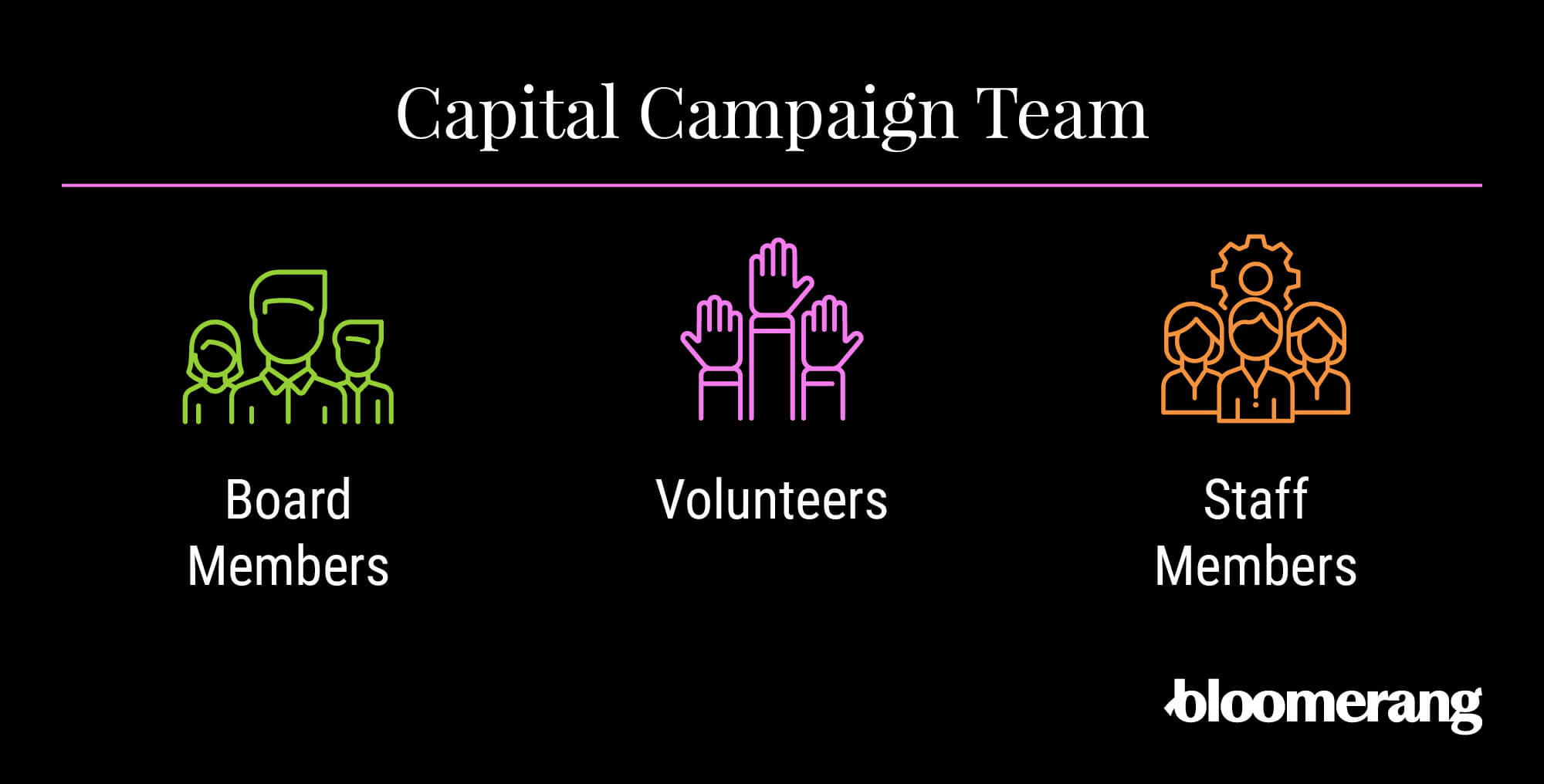
Your capital campaign team is one of the most vital factors that determines the success (or lack thereof) of your campaign. A good team can help you accomplish your goals, while an ineffective team can hold your campaign back.
There are a few different stakeholders who will get involved with your campaign and are considered an important part of your team. All of these parties should be completely committed to the success of your nonprofit capital campaign.
By “completely committed,” we mean that these members should be financially and emotionally invested and willing to spend their valuable time working to make the campaign a success. Your CEO should be willing to be the chief fundraiser, and not merely a vision-caster.
Some of the parties who will make up your team include your board members, volunteers, and staff committees.
Board members
Fundraising expert Linda Lysakowski explains that capital campaigns are worked from the top down and inside out.
Working from the top down means that you need to reach out to your major donors first (we’ll cover that in more detail later). Meanwhile, working from the inside out means that those closest to your organization (your board members) should be among the first to commit to the campaign.
Your board members should be some of your strongest supporters in the campaign. They should be some of the first to:
- Donate to the campaign
- Volunteer for campaign leadership positions
- Help your organization with fundraising activities
If your board members aren’t fully invested in the capital campaign, it could be detrimental to your nonprofit’s chances of success.
Organization volunteers
Highly invested volunteers are the most likely to join committees such as your planning and steering committees.
- Planning committees consist of about 10 to 15 members, including both volunteers and staff, who will work together to help plan a capital campaign.
- Steering committees help a capital campaign run smoothly after it’s been launched.
Great organization volunteers are those with previous experience supporting your organization and a deep commitment to your mission. They believe in you and your organization. They’ll also likely have contact information for other helpful people to get involved in the campaign.
Staff members
There’s a lot of work that goes into a capital campaign. Be careful not to overwork your staff. While committed staff members are likely to be willing to put in some extra work to help your campaign succeed, capital campaigns are long-lasting, and working that hard for too long will burn out some of your staff members.
Consider hiring additional staff members to take on some of the extra workload. You may hire supplementary people (or ask volunteers!) to do nonprofit campaign activities such as:
- Coordinating meetings and events
- Handling internal and external communications
- Maintaining the website
- Writing your regular newsletter
- Crafting press releases
Your staff members are busy writing grants, conducting usual fundraising, running organization programs, and more. Without additional hands on deck, they’d have trouble adding a capital campaign to their to-do list.
The 3 sequencing principles of a capital campaign
To maximize fundraising momentum, successful capital campaigns adhere to three strict structural rules:
- Inside → Out: "Start with your internal contacts and then move outward." Begin your outreach with your closest stakeholders—such as board members, staff, and core volunteers—before soliciting external networks or the broader community.
- Up → Down: "Secure large gifts first." Focus the initial phase of fundraising exclusively on major individual donors and high-impact foundations before asking for mid-level or general contributions.
- Quiet → Public: "Secure at least 50% of the total goal before publicly declaring your goal." Keep the campaign in a private, quiet phase until at least half of the financial target is officially committed. This builds the institutional trust and social proof necessary to inspire confidence in public donors.
The timeline of a capital campaign
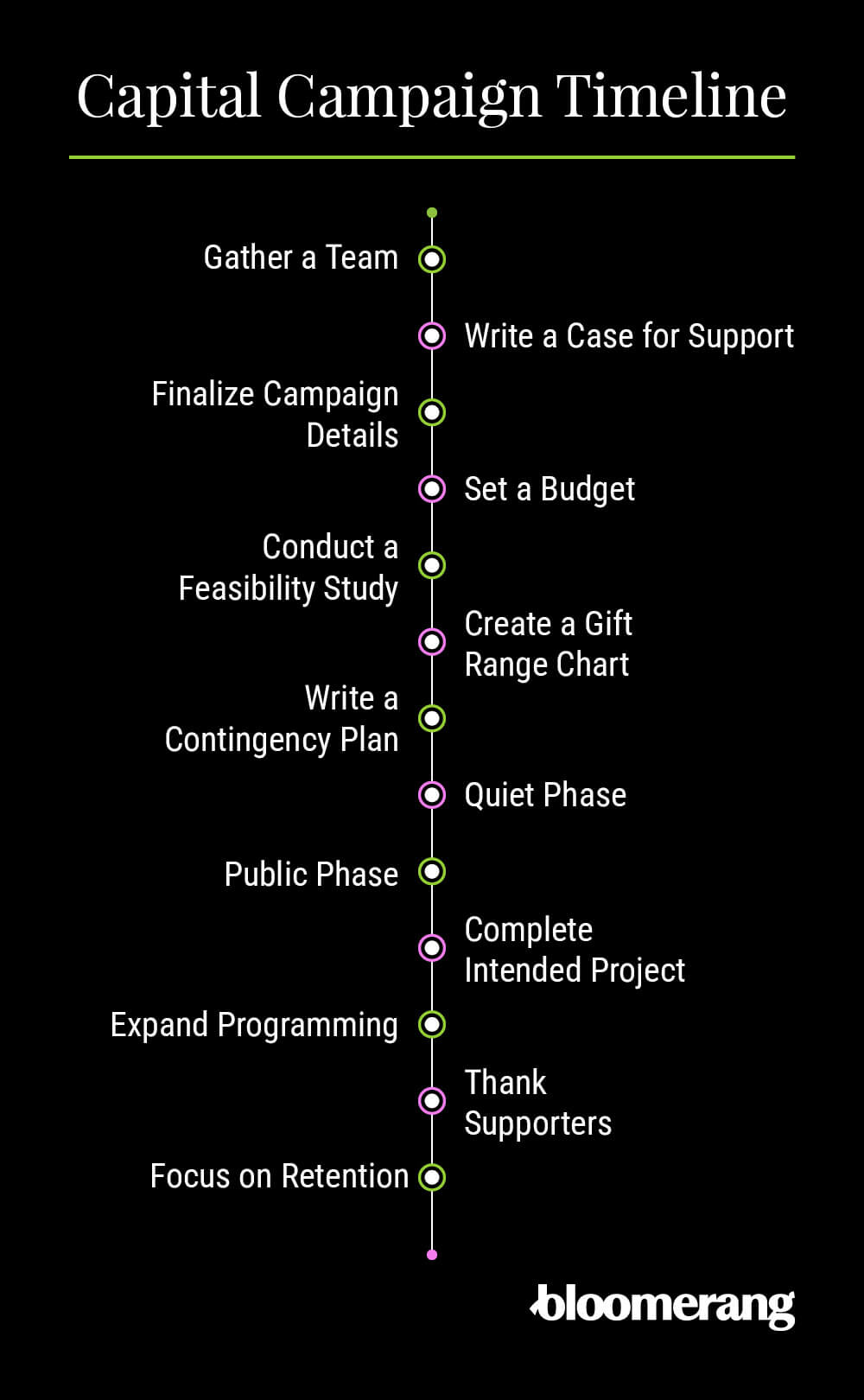
There are three major stages of your capital campaign: the planning phase, the implementation phase, and the aftermath.
Each stage requires a slightly different mindset. We’ll provide a brief overview of the different aspects of each phase of your nonprofit’s capital campaign before diving into each phase in more detail later on.
The planning phase
1. Gather a team
As mentioned, one of the first things you’ll need to do when you decide to launch a capital campaign is to collect a team of highly motivated and committed individuals to work on the campaign together.
2. Conduct a feasibility study
Feasibility studies review your past fundraising campaigns, your historic successes and failures, and your objectives for the upcoming campaign to see if you’ll be able to reach your intended goals. Feasibility studies also have the added benefit of informing your top stakeholders about the capital campaign and soliciting their input and support for the effort.
3. Set a campaign budget
Create an honest, realistic budget to raise what you need without overspending and undermining your hard work.
4. Write a case for support
Your case for support should be both emotionally and rationally compelling. You want to pull at your supporters’ heartstrings while showing them that you will use their contributions responsibly. Show them you’re compassionate and have a plan.
5. Create a gift range chart
Gift range charts break down your overall fundraising goal into the gift ranges you need to reach that goal. For instance, a large organization may be looking for one $1,000,000 donation, two $500,000 donations, five $100,000 donations, and ten $50,000 donations to reach a goal of $3,000,000. This will guide the fundraising asks your organization makes so you can reach your goal.
6. Create a contingency plan
A failed capital campaign can be detrimental to your nonprofit. That’s why it’s so important to prepare for this possibility. While you hope never to use it, a contingency plan will help your organization feel more secure during the capital campaign.
The implementation phase
1. The quiet phase
The quiet phase of your capital campaign implementation plan is when you ask key supporters for contributions, but don’t publicly market the campaign yet. Generally, the bulk of your capital campaign fundraising happens during this phase.
2. The public phase
The public phase of your nonprofit capital campaign is when you turn your fundraising to the masses. Don’t do this too early. The public phase should be the final push for additional donations in order to reach your overall goal.
The aftermath
1. Complete the intended project
After you’ve raised the funding through your capital campaign, it’s time for the fun part: completing your project. If you’re expanding your community center, start building! If you’re purchasing land, get to buying! Use the money for its intended purpose and get to work.
2. Expand programming
The whole purpose of your capital campaign is to expand your services or create more programming. While you were raising money for the project, you should’ve also been raising money to complete this programming expansion. This way, you can make the most of your capital campaign funds and their purpose.
3. Thank your supporters
Don’t forget to thank your donors for coming out and supporting your campaign. After all, without them, your success wouldn’t have been possible. Tell them about the incredible impact they’ve had on your organization and the greater impact this will have on your community.
4. Focus on retention
Reach out to capital campaign supporters and involve them in your other activities, like peer-to-peer fundraising events or volunteering. Retaining these donors will help strengthen your annual fundraising campaign and grow your organization as a whole.
Your capital campaign feasibility study
Your capital campaign feasibility study is one of the most important aspects of the planning phase.
During your feasibility study, you’ll discover if there’s enough interest in your project and the right people willing to give in order to reach your goal.
Throughout this process, you’ll examine your organization’s fundraising history and current support base. You’ll interview 20-40 community members in order to reveal information such as:
- Potential candidates for capital campaign leadership positions
- How effective your case for support is
- Prospects for campaign contributions
Given the importance of capital campaigns and their potential to make or break an organization, nonprofits often prefer to have an expert on their side during the planning phase. Traditionally, it’s been recommended that your nonprofit hire a fundraising consultant to help conduct the feasibility study. This is because consultants:
- Bring expertise to the table and can best determine the study's outcome.
- Provide an unbiased opinion and encourage truthful answers during stakeholder interviews.
- Have seen it all before and can walk you through the more difficult aspects of your study.
While other tools, such as the Capital Campaign Toolkit, have been developed and allow for a more self-sufficient approach to your feasibility study and campaign, that doesn’t mean fundraising consultants are obsolete.
Your organization will have tradeoffs no matter which route you choose:
- Fundraising consultants tend to be a little more expensive, making them a great choice for larger organizations with many moving parts. However, smaller organizations may find it difficult to afford a consultant or believe the cost is not worth the input they can provide.
- Fundraising consultants can be well worth their cost for many organizations, given their objective viewpoint and expertise in the field. Organizations that opt against hiring a consultant may find it more difficult to achieve transparency or objectivity from leaders, given leaders' close emotional proximity to the organization’s mission. Plus, they’d be opting out of having an additional expert on board.
Carefully consider all of the benefits and drawbacks of hiring a consultant or conducting the feasibility study (and campaign) on your own. If you do hire, peruse your consultant options carefully and choose one who will work best with your nonprofit.
The capital campaign quiet phase
The quiet phase of your nonprofit capital campaign is almost like the soft opening at a restaurant. A capital campaign quiet phase is the stage prior to the public rollout. Nonprofits typically raise 50-70% of their overall goal during this time.
These donations typically come from major donations, government agencies, and corporations. To obtain these donations, your organization should leverage the data from your feasibility study. After all, those you interviewed during this phase are likely to help make your campaign possible.
Some best practices for your capital campaign quiet phase include: purposefully selecting and asking prospects, polishing your case for support, and closing with a strong kickoff event.
Purposefully select and ask prospects.
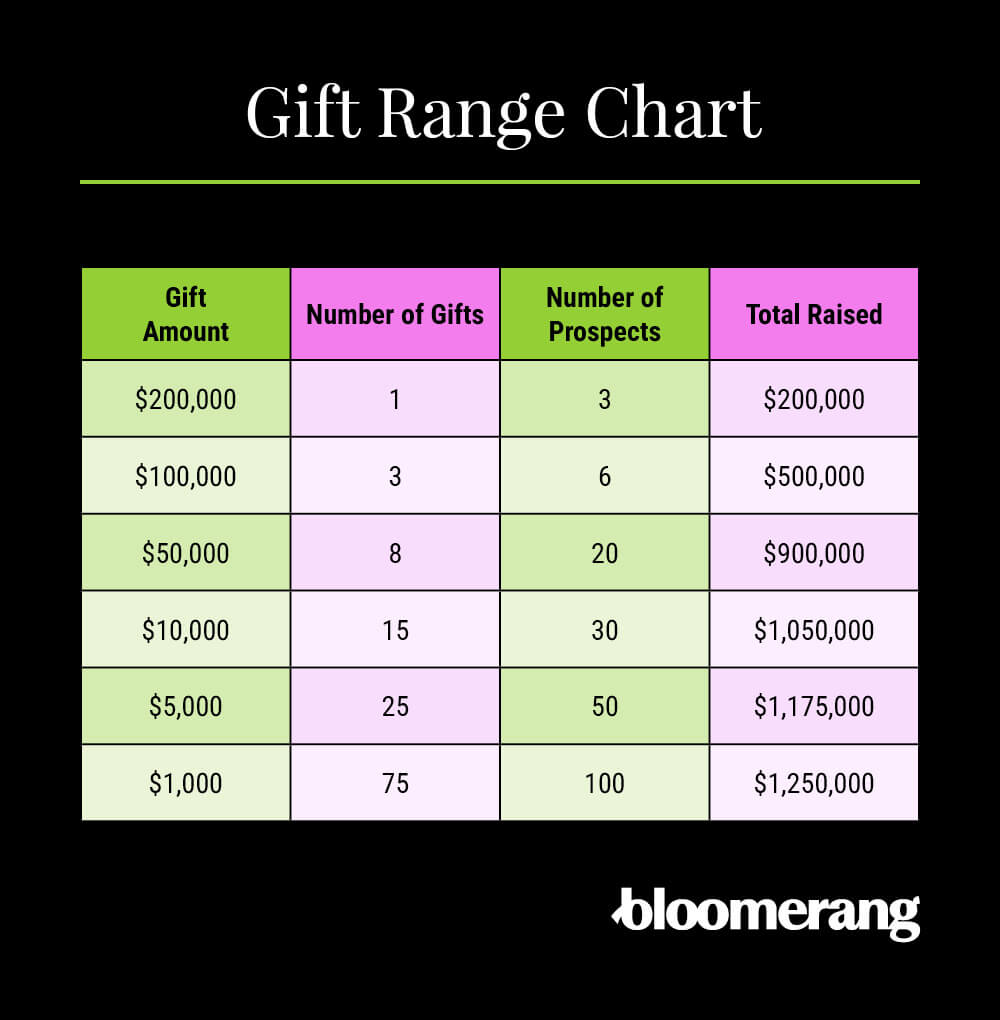
You probably know the importance of prospect research when identifying major prospects for your capital campaign. As you conduct wealth screening and estimate asks for your major donors, make sure to follow the guidelines of your gift range chart.
A gift range chart (such as the one below) shows how many donors you need at each giving level to reach your overall goal. This will help you stay on track when asking for major donations during the quiet phase of your capital campaign.
Examine your donor database and look for those with high generosity and engagement scores to start. This is much easier when your donor database integrates with prospect research and wealth screening technology.
On the corporate level, you may ask local companies that have previously sponsored your events or have participated in activities related to your mission in the past.
Remember, your prospecting approach should be purposeful and deliberate, but that doesn’t mean your search has to be narrow. Aim for a happy medium that makes the most effective use of your team’s time during this pivotal phase.
Strategically offer donor recognition and naming opportunities.
Many capital campaigns honor major donors with a formal donor recognition and naming rights policy. This policy is a great way to incentivize and recognize major donors’ massive, multi-year commitments.
To manage this process professionally, organizations typically implement two distinct recognition frameworks:
1. The naming rights matrix
For physical projects, your campaign committee should build an itemized menu that assigns specific funding thresholds to different areas. As a benchmark, naming rights for prominent spaces usually require funding of at least 50% of that space's total construction cost.
Here’s an example framework for how you might decide naming rights:
- Top-tier anchors (prominent facilities): The entire building, main lobbies, outdoor plazas, or central courtyards are reserved for your highest-impact investors.
- Major donors (operational spaces): Individual classrooms, patient wings, conference centers, research labs, or gallery rooms are matched with mid- to high-tier donors.
- Community contributors (fixtures & landscapes): Commemorative brick pathways, garden benches, and trees provide highly visible opportunities to engage local grassroots supporters.
2. Physical recognition and donor walls
For contributors who do not secure individual naming rights, you can recognize them with a prominent, permanent physical installation, such as a modern donor wall, within the new facility.
Group donors into ascending, named categories (e.g., Founders Circle, Visionaries, Benefactors) rather than publishing exact, individual dollar amounts.
Then, structure the visual layout to honor major investors alongside grassroots public contributors.
Crucial policy safeguard: Every naming opportunity must be secured through a formal written gift agreement that includes a strict morals clause. This grants your board of directors the explicit legal right to remove a donor’s name from a facility or endowment if their future actions or public conduct severely compromise your organization's reputation
Polish your case for support.
Your case for support is one of the most important documents you’ll create during your capital campaign. It’s the backbone of the rest of your future marketing materials.
This document should be between one and two pages and clearly formatted for easy reading. Your capital campaign case for support should include information such as:
- An introduction to your organization and its mission
- The purpose of your capital campaign and the impact of the proposed project
- A persuasive statement as to why prospects should show their support
- Statistics and rational reasoning behind the campaign and proposed project
- Your financial plan for the campaign, project, and future programming
Your case for support should adhere to both the rational and emotional sides of your supporters’ minds. Make sure it’s persuasive, honest, and descriptive to best reach your supporters.
Close with a strong kickoff event.
As your quiet phase comes to a close, host a kickoff event to announce your capital campaign to the world. This helps bridge the gap between the quiet and public phases of your campaign.
While at the event, you should make sure to:
- Encourage your campaign leaders to mix and mingle with attendees. Face-to-face interactions not only help your campaign leaders explore additional prospects but also make your attendees feel welcome and integral to the process.
- Acknowledge those who have already given to your capital campaign. Thank your quiet-phase donors with short speeches at the campaign event.
- Keep looking forward. Keep in mind that this event is a kickoff. You want to inspire your attendees to give and support your campaign. Announce your future timetable and tell everyone how they can get involved.
A smooth kickoff event brings your quiet phase to a close and launches the public phase on a high note.
The capital campaign public phase
Your capital campaign public phase is after you’ve announced your plans to the world. During this phase, you reach out to a broad audience to secure the final 30-50% of fundraising and close out the campaign.
During this phase, you should still use donor levels to estimate and ask the right supporters for gifts. However, the levels might be smaller—for instance, focusing on $500, $1,000, and $5,000 donations rather than the major gifts you sought during the quiet phase.
Some best practices for the public phase of your capital campaign include:
- Keep it short. Donors and campaign leaders tend to lose motivation quickly during the public phase if it’s dragged out too long. Try to keep it around or under six months.
- Practice smart marketing. Communicate your fundraising need with well-crafted emails, social media posts, phone calls, newsletters, and other materials. For a capital campaign, direct mail is one of the best ways to grab and retain your audience’s attention!
- Incorporate matching gifts. Matching gifts from your supporters’ employers can make a big difference and help you reach your goal faster. Ask your supporters to check their eligibility.
During the quiet phase of your capital campaign, you want to secure enough funding so that your supporters feel confident that your organization will reach its final goal. Build trust with your supporters by entering the public phase with at least 50% of funds already raised.
The aftermath of a capital campaign
Congratulations! Your capital campaign has ended. That’s a big achievement for your organization, and you deserve to be proud. Now you get to jump into completing your project and expanding your programming.
But your work for the capital campaign isn’t quite over, even after the money is raised. You still need to debrief, acknowledge your donors, thank them, and review the fundraising data from the campaign itself.
After your capital campaign is over, here are some steps your organization should be sure to take:
- Debrief with your leadership and staff. Discuss the different aspects of the capital campaign. What was effective? What was ineffective? What notes would you make for your next large-scale campaign?
- Remind donors about outstanding pledges. You’ll need to keep moving forward by expanding your planning and achieving the broader impact your capital campaign is designed to deliver. Therefore, keep reminding those who pledged to give to your campaign even after it ends.
- Focus on retention. After an intense campaign, you’re probably experiencing increased public awareness and media recognition among your donors and community. Reach out in appreciation and encourage further engagement to retain this support in the future.
In the aftermath of your organization’s capital campaigns, be sure to save relevant and important data to your organization’s CRM. Use this data to retain campaign donors and for reference ahead of your next major fundraising initiative.
Be sure to take a minute and congratulate your team on this incredible accomplishment. They worked hard to help increase the impact of your work.
Frequently asked questions about capital campaigns
What is a capital campaign?
A capital campaign is an intensive, multi-year fundraising drive designed to raise substantial capital for major, non-routine projects, such as constructing buildings, purchasing equipment, or expanding an endowment.
What are the phases of a capital campaign?
A campaign typically moves through seven phases: planning, the feasibility study, the quiet phase (soliciting major gifts), the kickoff, the public phase, fulfillment (collecting multi-year pledges), and stewardship.
How much should you raise before going public?
Organizations should raise 50% to 70% of their total financial goal during the quiet phase before launching the public phase to build confidence and momentum.
What is a feasibility study?
A feasibility study is a diagnostic assessment—usually featuring 20 to 40 stakeholder interviews—conducted by a consultant to test community support and financial readiness before launching.
What is a gift range chart?
A gift range chart is a matrix that maps out the exact number and size of major, mid-level, and general gifts required to reach the campaign goal.
What are the essential elements of a capital campaign?
According to industry frameworks, a capital campaign requires mission alignment, an urgent case for support, organizational trust, a unified board, an engaged CEO, a competent team, and qualified givers.
How do you prepare for a capital campaign?
Prepare by running a feasibility study, building a campaign team, writing your case for support, designing a gift chart, setting a budget, and drafting a contingency plan.
What is the 80/20 rule in capital campaigns?
The 80/20 rule, also known as the Pareto Principle, states that roughly 80% of your campaign's total funding will come from just 20% of your donor base, typically major gifts.
How do pledges work in a capital campaign?
Unlike annual fundraising drives, where donations are typically immediate, capital campaigns rely heavily on charitable pledges. A pledge is a formal, non-binding commitment by a donor to contribute a specific amount of money, generally recommended to be paid over a three- to five-year period.
This multi-year timeline is a crucial mechanism for both the nonprofit and the donor:
- Amplified giving capacity: Spreading payments out allows donors to make much larger investments than they could manage in a single, upfront cash gift. For example, a supporter who cannot write an immediate check for $50,000 can comfortably pledge $10,000 a year for five years.
- Structured payments: Donors negotiate a custom payment schedule that aligns with their personal cash flow—whether that means monthly, quarterly, or annual installments.
- Institutional planning: These structured commitments are documented through written pledge agreements. This allows your organization to project reliable long-term cash flow, which is essential for securing construction loans, signing contractor agreements, or breaking ground on physical projects before all the cash has physically arrived.
Wrapping up
Your capital campaigns are more than an opportunity to raise a large amount of money for your nonprofit. It’s an opportunity to increase the overall impact your nonprofit has on your mission.
Now that you know the basics and key tips to earn more, you’re ready to get started. Start talking to leaders at your nonprofit. Ask them if they think your nonprofit needs a capital campaign. If you still want more information before jumping into the process, check out the additional resources below:
- Bloomerang’s Partner Directory. If you want a professional by your side throughout the capital campaign process, check out our favorite consultants for nonprofits.
- Capital Campaign Toolkit. The Capital Campaign Toolkit provides all of the resources your organization needs to plan and execute a capital campaign. It walks you through each step in the process.
- Major Gift Fundraising for Small Shops. If you’re a smaller organization worried about collecting major donations during your capital campaign, this eBook is for you. We discuss how anyone can secure major gifts.




![[ASK AN EXPERT] How to Restart a Stalled Capital Campaign](https://cdn.prod.website-files.com/6996de43eb5bbc35466bf590/69e7b7559298991c8e7136cd_Ask_an_expert_blog.webp)
