Nonprofit Storytelling: The Quick and No-Nonsense Guide




Nonprofit storytelling refers to a specific way of communication that organizations use to personalize their mission. It gives your audience a tangible transformation to observe through the sharing of the written word, photos, testimonials, and videos. And once shared effectively, storytelling will change the game for your organization.
Let’s be honest: for many nonprofits, staff is small and time is limited. We all have certain skills and special passions. Most nonprofit professionals can relate to the idea of wearing many hats, some of which we don’t always feel super confident with, which is where a quick, no-nonsense guide to nonprofit storytelling can come in handy.
Many times, communication isn’t people's strong suit. So, what do we do when our time is limited, and we need to communicate with the community and our donors? We tell stories. Stories are the most effective form of communication because they immediately engage the reader on an emotional level and in ways that are interesting to them. But don’t just take it from me – Forbes named storytelling the #1 most important career skill of the future.
This guide offers multiple storytelling frameworks you can use when deciding the best ways to tell your nonprofit’s story, along with tips for crafting stories expertly and maintaining ethical storytelling.
How can storytelling improve your nonprofit’s communication strategy?
Nonprofit storytelling helps give your mission a face and a name. Storytelling makes it personal and transforms the heart and mind of your target audience by showing them why something is important, instead of just telling them.
When a good story is shared, scientific research shows that our brains connect to the storytelling:
- According to cognitive psychologist Jerome Bruner, stories are remembered 22x more easily than data, facts, and stats
- Princeton’s Uri Hasson shared that neural activity increases 5x when listening to a story
- Storytelling engages our sensory cortex in the brain, allowing the listener to feel, hear, taste, and even smell the story
Storytelling can offer many benefits to your organization. It can:
- Make your organization more memorable
- Create stronger relationships, build bonds, and increase loyalty
- Cut through bias by communicating various perspectives and voices
- Prompt action from your audience
6 steps to telling your nonprofit’s stories
Now that we know that storytelling is crucial to your next campaign, here is a simple yet effective step-by-step guide to nonprofit storytelling – broken down for even the busiest of fundraisers like yourself!
Step 1: Understand story structure
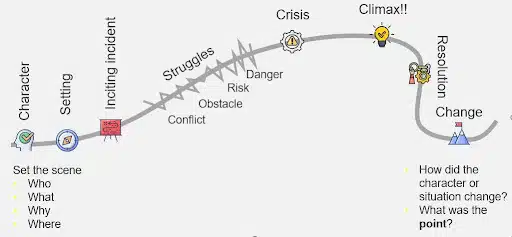
Effective stories are told in a three-act structure.
All well-crafted stories fit a three-act story structure. Since childhood, we have been taught to expect a certain structure for stories. Knowing basic story structure will help you start to formulate a story that connects well with your audience.
Act one – set up
Set the scene. This is where the audience learns the who, what, where, and why of the story. Act one is where we learn what normal life looks like before the story is set in motion.
Act one is also where the “hook,” or inciting incident, occurs, setting the story in motion. Think of act one as meeting Harry Potter and learning about his dreary life before he receives that Hogwarts letter informing him he is, in fact, a wizard.
Act two – confrontation
This is where the rising action occurs. Act two is the part of the story where we witness the character's goals and struggles. What various conflicts, obstacles, risks, and dangers arise? What would it mean to the character to overcome them? How does the tension of the story build over time?
Act three – resolution
This is the act where the big moment occurs, and change is witnessed. Act three is when the audience sees the transformation in the character’s situation. What lessons were learned, or what circumstances were shifted? In essence, you need to tell them “the point.”
Providing the audience with a crystal-clear takeaway or message will help ensure their satisfaction with your story and prompt action.
Step 2: Focus on one character
All good stories focus on one main character. This is called the singularity effect. Pick one main character for each story you tell. The term “character” can imply that someone is fictitious, yet it refers to the real individual at the heart of the story.
You may include physical photos of the character or describe their appearance. Visual storytelling with photos and videos is extremely valuable when available.
When gathering information about the central character, it is important to understand their background, likes, and interests. Seemingly small or unrelated elements of their personality, such as where they grew up or what they like to eat, may be the bridge that connects them to the story's audience. I call these “common denominators.”
In other words, introduce characteristics of the individual that cross between the reader’s world and the subject’s world. The more an audience can relate to the character on some level, the more interested and emotionally engaged they will be. Creating strong bonds between the character and the audience will help increase loyalty and the likelihood of action!
Pro Tip: Use direct quotes and testimonials whenever possible when showcasing the main character, as this will help bridge the gap between them and your audience and highlight their personality. This also helps preserve the story's integrity and avoid exploitative storytelling.
As storytellers, it is not our job to re-doctor a story to fit our needs. It is important to tell the story as it was told to us. Showcase your character’s story as they see it, not as you see it.
If you need help developing your character, review Bloomerang’s guide to conducting nonprofit interviews!
Step 3: Communicate the conflict, goals, and successes
This is the core of any good story: the conflict to be overcome or the conflict that was overcome. This is what makes their story significant to your nonprofit. Communicate what challenges your character is facing or has faced that led them to your organization. Giving backstory and context can help your audience see how these conflicts may have come into play.
Beyond just communicating the struggle, be sure to communicate how your character showed courage, insight, and strength in the midst of struggle. This step is important to avoid exploitation or casting the character as a “victim.” This also gives an extremely important value to your audience, hope.
It is also crucial to communicate the goals, hopes, and aspirations of your character and your organization. Be sure to clearly demonstrate how your organization helps provide a solution to the struggle, and be clear on how necessary your audience’s support is to make this happen.
Step 4: Highlight the result
Your audience is looking for a clear lesson or takeaway as a result of the story that you shared. A change could be emotional, physical, or circumstantial. Think of how your character felt and what their circumstances were at the beginning of the story and at the end of the story. The audience wants to feel as though there was a point to the story, and communicating that is important for your audience to feel satisfied.
Before and after photos are a great testament to this concept. How can you show your audience what you are trying to tell them? Elements that relate to resilience and determination will help the reader feel inspired – remember, the goal of telling the story is to inspire your audience into action.
Step 5: Call readers to action
The call to action leads seamlessly from the emotional engagement that just took place. It’s how the reader can help the character; how they themselves can make things better, do good, and make a positive impact.
In other words, once you’ve told your character’s story and showcased your nonprofit, it is crucial to invite the audience to become the “hero” of their own story. Remember to keep your communications focused on how the audience can help, not just the great work your organization does. Donor-focused storytelling is the difference between:
“Jim now has a roof over his head thanks to our organization’s work.”
“Jim now has a roof over his head thanks to your support!”
See the difference? That subtle change is an invitation to your supporters to take a front-seat role in the work you do and take center stage in the story.
Be sure to keep your call to action clear and limited. Giving too many different links to click or too many different asks in one meeting can confuse your audience. Less is more when it comes to a call to action!
Step 6: Edit
Now it is time to proofread your story. It is important to give your readers or listeners context so they can create a mental picture of what is happening. It is also important to remember not to bog this part of the story down with too many details that distract from the main point. While we want to lend the audience imagery, we don’t want to overcomplicate things too much. Remember the core components of a story are: Character, Conflict, Goals, and Change.
While descriptions and details can be helpful for interest and engagement, remember to keep the main message of your story central in an easily distracted world. Go through the story you have written and cut out unnecessary fluff. Especially when it comes to social media, keeping a story concise is key. Remember, the main message of your story is always the mission and how it relates to your audience.
BONUS Pro Tip: Allow your audience to remain a part of your character’s journey. Keep sharing updates, photos, quotes, or anything that will help your audience identify with the mission through familiarity. It is okay to share the same story more than once in different contexts, such as through social media, at fundraising events, through direct mailers, and by email. Multi-channel storytelling approaches will help reinforce your message and your brand with your audience through consistency.
The story of self, the story of us, and the story of now framework
I used to conduct advocacy, communications, and fundraising trainings for local nonprofits and political candidates, and one of my favorite frameworks to share with them was the Story of Self, Story of Us, and Story of Now. These are the three components that make up “public narrative,” but this storytelling framework can help to shape all of your organization’s public communications—from social media and web content to emails and letters to interpersonal interactions with donors and other supporters.
This storytelling framework asks you to answer three basic questions:
- Story of Self: Why have you been called to serve?
- Story of Us: What connects you with the group?
- Story of Now: What can you accomplish together with your audience’s help?
Sounds simple, right? It is, but there are other considerations for each of these stories, as well as the added challenge of telling each of them well. By employing these tools, you can craft a powerful narrative that resonates with your supporters and moves them to action. Once you develop your stories, you’ll be able to refine them each time you tell them and create different iterations to use with specific audiences and in specific formats.
Let’s dive into the storytelling framework below!
Story of self
The Story of Self is your call to leadership. This is your chance to let your audience get to know you and to communicate your values. Why are you doing what you do? What motivated you to do this work?
Almost everyone has an experience that motivated them to get involved in a given cause. For example, I became involved in LGBTQ+ organizing because I found community in a way I had never experienced before with an organization in college that worked to support LGBTQ+ students. That’s a part of my personal Story of Self, though I would tell of a specific experience of showing up to an event and feeling that I belonged.
As you think about how to structure your story, consider these questions:
- What challenge did you face? Why was it a challenge?
- What choice did you make about how to deal with that challenge? Why did you make that choice?
- What was the outcome? How did the outcome feel, and what did it teach you?
The story you tell of how you got where you are today will give your audience a chance to emotionally connect with you and your values.
Story of us
The Story of Us communicates the values and experiences shared by a community, organization, campaign, or movement, and the capacity or resources that the community of “us” has to accomplish its goals. Think of it as an expansion of your Story of Self. In my example from above, I might go on to talk about how I saw others finding a sense of community in student, local, and statewide LGBTQ+ organizations. This would further highlight the particular need for community for LGBTQ+ people of all ages and backgrounds.
Your Story of Us may focus on what you have already done together, challenges you have already faced, and outcomes you have achieved. Or it may be a story of shared heroes, challenges they faced, and outcomes they achieved. As part of a community, hearing how we have met challenges in the past gives us hope that we can face new challenges together as they come. It’s important that your audience feels like they are a part of the Story of Us.
Story of now
The Story of Now is rooted in the values you celebrated in your Story of Self and Story of Us. Here, you present a challenge to those values or an opportunity to advance them that requires collective action, meaning everyone must work in the same way toward the same goal.
The Story of Now is urgent. This is where you bring in a specific organizational (or personal) goal and tell your supporters exactly what they can do right now to help achieve it. It requires more than a description of a problem or initiative—in the Story of Now, you have to inspire your audience to act together with you to solve the problem. There are four basic elements of a Story of Now:
- A strategy. This is your plan to achieve your goal. Think of this as something you do, not something you have. Your strategy should be intentional, creative, and unique to the work you do and how you do it.
- A strategic hopeful choice. Each person in your audience must understand what will happen if they don’t act, what could happen if they do, and what action each of them could take that could start to bring about the desired outcome.
- A specific ask. There needs to be one specific ask of each person that involves a commitment of time or resources. Remember, everyone needs to be working together in the same way toward the same goal.
- A vivid description of a hopeful future. Your audience needs to be able to connect to the hopeful future you want them to work toward. This requires a vivid description of what can be achieved if we take action collectively.
Email campaign
To demonstrate how to break your stories up into three acts, I will share an email campaign that the organization I work for, Morning Light, used that won us a Storyteller of the Year Award. Morning Light focuses on hospice care for those who do not have anywhere to go or anyone to care for them at the end of life.
Hospice and homelessness can both be taboo subjects that can make people uncomfortable. By sharing a story, we are able to break through some of those barriers in our audience by sharing a real human story to potentially create a real human connection.
The campaign structure we used is a three-part series structured after the three acts of a story. This campaign is so successful because it plays on a common marketing truth – an audience needs to see something 3-5 times before taking action. By structuring this storytelling campaign into three acts, it keeps the audience engaged because they want to know the ending of the story, while providing several opportunities for multiple “touches” of the audience.
Our campaign was a year-end campaign that took place in December. Each day, we sent one email containing one “act” of the story. For example, day one was the introduction, day two was the rising action, and day three was the resolution. We also posted the stories to our social media and sent out a direct mailer component with the story to reach our audience multiple times and in multiple ways.
See below for an example of the campaign. Please note that each email used the singularity effect by focusing on just one person and had a call to action at the end. The call to action invited the audience to take the next step to learn more or make a donation/contribution.

Act 1: Set up
Meet Dewey: Part 1
As with the end of the year, the end of life is often a time for reflection. At Morning Light, we are honored to carry on the legacy for our hospice residents at the award-winning Abbie Hunt Bryce Home. The stories we are about to share with you over the next few days are filled with trials, regrets, triumphs, optimism, and wisdom. Meet Dewey, fondly known as Mr. Dewey. You may have seen his face before – but do you know his incredible story? As a man in his ninth decade of life whose body was failing him, Mr. Dewey was hard of hearing and confined to a wheelchair. “Parkinson’s got the best of me,” he says. While he may not have had his health, he still had his memories – memories he held close. He was full of stories of his past as a farm boy, veteran, and father. Dewey served in the U.S. Air Force. Dewey trained and showed horses professionally for 50 years. And, Dewey danced. “I can’t walk. But I can dance,” said Dewey. He especially loved to dance with his daughter. But, like many of us, Dewey had heartache and struggle. More on that tomorrow. Continue to check your daily emails from us this week to learn more about our inspiring Abbie Hunt Bryce Home resident, Mr. Dewey. In the meantime, please visit our website www.morninglightinc.org to learn more about our mission and what you can do to be a part of it! Sincerely,

Morning Light & The Abbie Hunt Bryce Home Staff
Act 2: Rising action
Subject line: Meet Dewey: The Bad with The Good
Meet Dewey: Part 2
Yesterday, we introduced you to one of the residents who made the Abbie Hunt Bryce Home extra bright, Mr. Dewey. Like any other life, Dewey experienced joy and also pain. Dewey’s wife and the mother of his two children was killed in a car accident when the kids were just 11 and 12. Dewey raised them the best he knew how and hoped he did a good job – as most parents do. His children visited as they could while Dewey lived at the Abbie Hunt Bryce Home. Dewey also lost his brother to Parkinson’s, the same disease that slowly stole his own independence. During the reflection of his life, Dewey wished he had “done more good.” Though he wasn’t one to dwell on regrets. At the Home, he vowed to do whatever he could to “do good” in his final chapter. While he was not as physically able-bodied as he used to be, he certainly knew how to brighten the days of everyone who had the pleasure of meeting him at the Abbie Hunt Bryce Home. Dewey made the most of the life he lived at the Home. He enjoyed bird-watching, television, snacking, and holidays. As you’ll soon see, Dewey even developed a very unlikely friendship that is guaranteed to warm your heart. But – that’s a story for tomorrow. Until then, please “LIKE” us on Facebook below to stay connected and show your support of free residential care for the terminally ill.
Sincerely, Morning Light & The Abbie Hunt Bryce Home Staff
Act 3: Resolution
Subject line: Meet Dewey and his new friend, Julia
Meet Dewey: Part 3
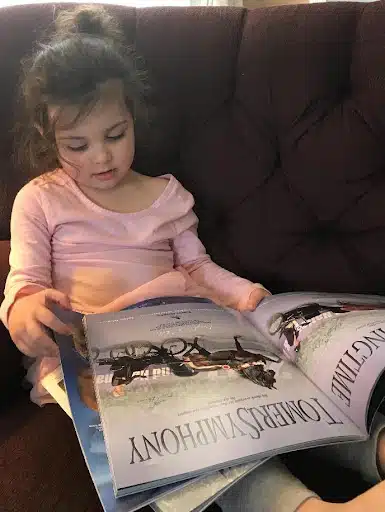
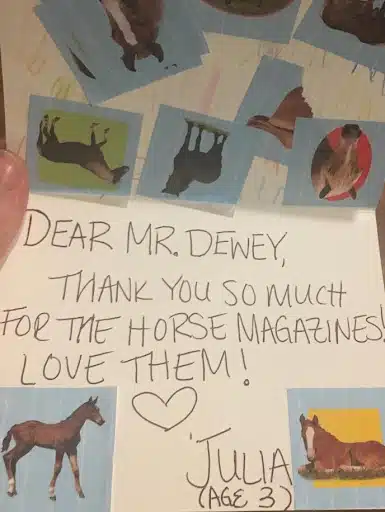
In yesterday’s email, we promised you an extra special story of friendship. So today, in addition to introducing you to Mr. Dewey, we would also like you to meet Julia. Julia is the daughter of Madison Gonzalez, the Community Involvement and Events Manager at Morning Light. Julia shared the same love of horses as Dewey, and when Dewey learned this, he began sending Madison home with his special collection of horse magazines for Julia to read. Julia began sending him cards and art in return. The two formed a special bond. Three-year-old Julia even made a special visit to the Home to see her pal Mr. Dewey and brought chocolates, flowers, and a horse balloon. Together, the two of them proved it is never too late (or too early) to make a new friend.
If you would like to see more on this touching story – CLICK HERE to watch a special video! As Dewey himself states in the video, “This place is like home. They treat you like whole people. More than a number.” These special bonds and memories could not have been made possible without your support. If you would like to support free hospice care for patients like Dewey, shop our Morning Light Catalog: Warm Their Winter Edition! The catalog is full of tangible ways that you can give back this Holiday Season. To make a financial contribution or enroll in our monthly donation program, click HERE! Thank you, as always, for your generosity!
The Team at Morning Light and The Abbie Hunt Bryce Home
Video storytelling
Charity Water does an excellent job with storytelling. In one of their videos, we are able to see that we don’t always have to share the story of a beneficiary for impact. As long as there are people in a nonprofit, there are stories!
That video focuses on the founder’s story, and thus, the origin story of Charity Water. We get to know the founder of the organization and discover the “why” behind his mission. Knowing why something is important to someone else helps us see that it should be important to us, the audience, as well.
In this example, we get to see bits of the founder’s life and backstory and get to know him as a character, so we can trust him and his vision. The video shows us the conflicts that he faced in his life, but then introduces the even greater conflict at hand – the lack of accessible water in other countries. That conflict is then explored, and a resolution is offered through the work of the organization.
Storytelling at an event
PUNT Pediatric Cancer Society in New York shines as an example of storytelling at an event. In 2019, their showcasing of a family member of a child they served made such a touching impact. PUNT shared a story of one of the children they supported thanks to their donors’ support. The sister of that child then took the stage to play a piece on the piano in honor of her sister. The story was not only shared at the event, but also via Facebook.
“A promise kept. A gift shared. A sister’s dying wish.”
“She grabbed my hand shortly before she passed, and she made me promise her something, that no matter how long it takes, I would overcome my fear of singing in front of people.” Victoria Mordaunt shared that story two years ago at our bereavement weekend. And Friday night, she honored that promise again as she shared her gift before 300+ guests at our Wine Pairing in loving memory of her sister and cancer fighter, Kali.
We thank Victoria with our whole heart for giving our guests this unforgettable and soul-stirring moment…”
As you can see, storytelling can take on many forms, but the core is the structure, the key components, and the mission. If you can take your audience on a journey from beginning to end, highlighting how your organization helped someone overcome a challenge, and how the audience can help too, you are sure to make an impact!
Happy storytelling!