

Matching gifts are an often overlooked aspect of corporate philanthropy programs in which companies match employee donations to eligible nonprofits.
Donor retention is a metric that measures the percentage of donors who continue to give to a nonprofit organization year after year. It should be a major priority for any organization seeking a sustainable and successful future.
To most, these are just two concepts in the nonprofit sphere, but that’s not the case. In fact, matching gifts can be a major asset for nonprofits looking to improve donor retention!
Boosting donor retention rates, that is, building lasting relationships with repeat donors, is a common challenge shared by nonprofits of all shapes and sizes. Strategically leveraging matching gifts can be part of the solution. In this guide, we’ll explore how to do so by covering:
- What are matching gifts?
- Who is eligible for matching gifts?
- Strategies for building donor relationships through matching gifts
- How to promote matching gifts
- How to acknowledge matching gifts
- Show the impact of matching gifts
- Frequently asked questions about matching gifts and donor retention
What are matching gifts?
There are basically two types of matching gifts.
Corporate and personal matching gifts match a donation up to a specific amount of money. These gifts can come from a donor’s employer and require completion of matching gift paperwork, or they could come from individuals who agree to match donations they receive.
The second type of gift matching comes from matching gift campaigns. Typically, your organization recruits a business, benefactor, board member, or foundation to promise to match gifts made up to a certain dollar amount. Then, you send appeals letting donors know about the match and encourage them to give. Your organization then reports the amount of money in donations it received to the match provider, who matches up to the promised amount. You can acquire match sponsors through personal asks or, in the case of some foundations, via a formal grant application.
Corporate matching gifts vs. matching gift campaigns
Here is a side-by-side comparison of corporate matching gifts and matching gift campaigns:
In short, corporate matching gifts are year-round, employer-sponsored benefits triggered by individual employee actions, while matching gift campaigns are time-limited fundraising events powered by a major donor to create community-wide urgency.
Who is eligible for matching gifts?
Because corporate matching programs are managed individually by each company, there is no single rulebook. Instead, eligibility is determined by a specific set of criteria outlined by the employer's corporate social responsibility (CSR) policy.
Corporate matching gift eligibility hinges on four primary factors:
- Gift thresholds (minimums and maximums): Typically, companies will only match donations that fall within their established financial boundaries. Donations below a certain baseline (often $25) are ineligible for a match. Companies also cap the total amount they will match per employee per year (commonly between $1,000 and $10,000). Any amount over this ceiling will not be matched.
- The 501(c)(3) requirement: To receive a corporate match, the recipient organization must generally hold a valid 501(c)(3) tax-exempt status. Furthermore, many corporate policies dictate that the nonprofit must actively affirm that it does not discriminate when providing its services to the community.
- The religious organization exception: Houses of worship and explicitly religious organizations face unique restrictions. Religious organizations are excluded from traditional corporate matching programs, except if the donation is explicitly designated for a non-religious, secular purpose that benefits the broader community regardless of their religious beliefs (e.g., a church-run homeless shelter or food pantry).
- Paperwork and verification requirements: A match requires a formal verification pipeline that begins when the employee proactively initiates a match request through their company. The corporate matching program will then send paperwork via email or letter to the nonprofit organization. The strict catch is that the nonprofit must quickly complete and return this paperwork to verify that the donation was actually received, confirm the exact gift amount, and certify its tax-exempt status, or else the match is voided and the funds are left on the table.
Strategies for building donor relationships through matching gifts
There are several key matching gift strategies for cultivating deeper engagement with your donors through matching gifts:
1. Use matching gifts to boost your donors’ impact and make a great impression.
This strategy is particularly effective if your nonprofit has any number of major donors. One major gift is impactful; one matched major gift can improve your entire fundraising year.
Repeat matched major gifts can be game changers for your nonprofit indefinitely.
Major donors already hope to see their support making a sizable impact on your organization’s operations and projects. Imagine how they’ll feel knowing that they’ve doubled their impact at no extra effort or cost!
Plus, most of those donors come from high-level corporate backgrounds and expect their favorite nonprofits to be run efficiently. Proficiently managing every aspect of their matching gift process can make a strong impression on your major donor and help influence them to keep coming back. After all, you clearly know how to properly steward their gifts and responsibly make the most of them, too!
The matching gift process starts as soon as your supporters make a donation (of any size). One of the most damaging mistakes a nonprofit can make is thanking too late. In terms of following up with a matching gift ask, it will fall on deaf ears if you haven’t led with a sincere acknowledgement.
Once your acknowledgements have been appropriately addressed, it’s time to raise awareness of matching gifts.
Remember that your donors are busy people and likely won’t be motivated to submit a request if the process seems too complicated or time-consuming. This means it’s up to your stewardship team to get the ball rolling! Screen your donor list and analyze their employment information. Take the time to do a little extra matching gift research in one or more ways:
- With a prospect screening service
- Through personal communications with donor
- With donor surveys
- Online, via Google or LinkedIn
With an employer list in hand, next find the donors who work for companies with matching gift programs and target your asks to them.
It’s important that you fully customize and personalize these correspondences. Matching gift solicitations can’t be one-size-fits-all. Show the donors that you’ve taken the initiative to do the research for them and that the impact of their generous gifts might be doubled.
Next, explain to each donor how their employer’s matching gift program works, its matching rate, deadlines for request submission, etc. Then provide instructions for the next steps. If the employer has an online matching gift portal, include the link.
A strong matching gift ask that strikes the right tone and includes helpful information will make a strong impression of professionalism, gratitude, and eagerness. This is one key to building long-term partnerships with your major donors!
Plus, your major donors already believe in the value of your mission. Helping them double the impact of their gifts is an easy way to help them feel even better about supporting your work!
2. Use your matching gift communications as an extra touch point.
Donor acknowledgement is standard practice, but a follow-up thank you after a donor’s company submits a matching gift will be an perfect surprise for your donors who took the time to submit requests. This is an excellent opportunity to express appreciation without making any extra asks.
After all, donors respond to varied communication. No one wants to constantly be contacted for money alone. They’re a part of your nonprofit’s community, not its bankrollers. Simply taking advantage of the chance to acknowledge their support will make a strong positive impression and set the stage for continued engagement.
There are plenty of effective methods for acknowledging matching gifts. Let’s look through some examples.
Example 1 — A Thank-You Email from NC State
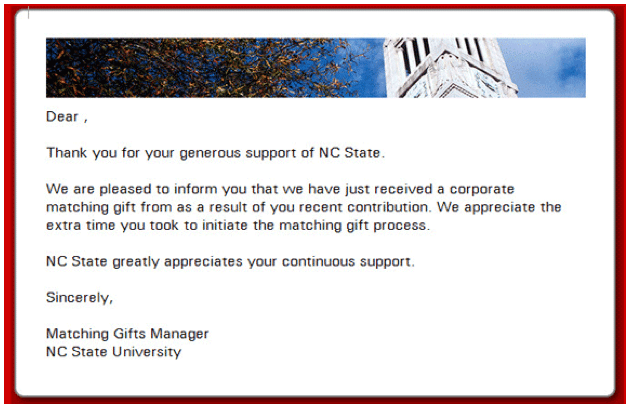
Here, NC State does a great job of thanking the donor for the gift, and the letter specifically acknowledges the additional time that the donor put into securing that donation for the university.
Also note that the email is coming from a matching gifts manager. You could appoint a staff member or volunteer to lead your matching gifts efforts as an alternative to hiring full-time help. Either way, dedicating an individual to matching gift stewardship makes a great impression on donors.
Example 2 — A Thank-You Post on Facebook from Halos of Hope
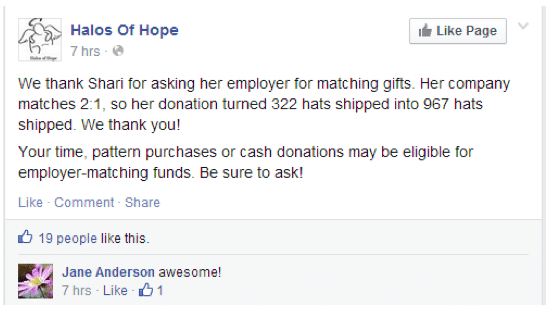
Halos of Hope got creative with this acknowledgement and it reflects positively on the organization. The donor probably doesn’t want the amount that she gave announced on a public profile. The number of hats demonstrates Shari’s very real impact without revealing her gift amount.
A thank-you to a matching gift donor on social media goes a long way. It shows that your organization is grateful and wants to shout it from virtual rooftops.
You’ll also notice that the second part of the post is a short matching gift promotion. It doesn’t ask anything more of Shari, instead simply reminding others to ask about their eligibility. Shari gets to lead by example, which is certain to affirm her relationship with the organization and keep her engaged.
Example 3 — A Thank You Postcard from the University of Michigan
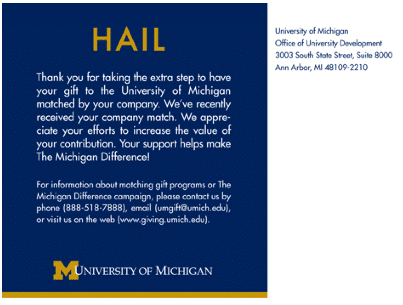
This final example shows that matching gift acknowledgement comes in many forms; what is most important is that you simply express gratitude.
In our increasingly digital age, donors really appreciate something they can actually hold, maybe even put on their fridge. The postcard is put together well and conveys a genuine sense of appreciation for the donor’s effort.
Improving donor retention is a challenge shared by all nonprofits, but studies have shown that most organizations spend less than $5,000 a year on developing and cultivating retention strategies. If you want to see growth, you’ll need to put in the work.
That’s what makes matching gifts such an effective donor retention tool! By taking the extra steps to promote matching gifts, study your donors’ employment information, and target your communication you’ll see the double benefit of boosted revenue and boosted retention.
How to acknowledge matching gifts
Acknowledge both the donor and the funding source, but handle them differently based on corporate preferences.
First, apply the credit allocation rule: the individual donor receives credit only for their original donation amount, while the matching company receives financial credit for the matched amount.
Next, follow standard corporate acknowledgment protocol when thanking the funding source. While you should always thank the individual donor for taking the time to apply for the match, most large corporations explicitly request not to receive a thank-you letter because processing thousands of individual acknowledgments can overwhelm their administrative departments. However, smaller local companies that do not include a restrictive notice may welcome a thank-you note, allowing you to build a stronger relationship with businesses in your immediate community.
Show the impact of matching gifts
Much like you want to communicate the overall amount raised toward a specific fundraising goal, you want to communicate about matched gifts. When donors make matched gifts to your organization, they want to see the impact of their gift.
Be transparent and let them know what that matched gift was able to accomplish.
In the case of a major matching gift campaign, this is even more important! Donors give to a matching gift campaign because their donation goes twice as far and makes twice the difference. Share the overall amount raised and break that figure down. How much did individual donors raise? How much was matched? What did reaching that fundraising goal accomplish? These are all questions you’ll need to answer to show the impact of matching gifts during a matching gift campaign.
Your organization may also want to consider making matching gifts a more common bit of vocabulary in your donor communications. Ask donors to regularly seek matching gifts for their donations. Then, prepare an annual matching gifts report. In the report, share how much the matching gift donations amounted to. Knowing their gifts can go twice as far is a huge motivator for donors. Thus, sharing the impact of matching gifts is key.
Frequently asked questions about matching gifts and donor retention
How do matching gifts improve donor retention?
Matching gifts boost retention by showing donors their personal support goes twice as far. When donors see their immediate, tangible impact amplified without extra personal cost, they feel deeply valued and connected to the cause, making them far more likely to continue giving to the organization year after year.
What is the difference between a corporate match and a matching gift campaign?
Corporate matches are year-round, employer-sponsored benefits triggered individually by employee requests. In contrast, matching gift campaigns are time-limited, high-energy fundraising events where a major donor, board member, or corporate sponsor promises to match community donations up to a set total amount to create urgency.
Who is eligible for a matching gift?
Eligibility depends on company-specific CSR rules. Generally, donations must meet minimum and maximum thresholds (like $25 to $5,000) and go to registered 501(c)(3) nonprofits. Religious organizations are usually excluded unless the funds are explicitly designated for a secular community program, such as a food pantry.
Do I have to thank the matching company for a matching gift?
Usually no. Most large corporations process thousands of matches and explicitly request no thank-you letters to avoid overwhelming their departments. However, you can send an acknowledgment if a small, local business matches a gift without a restrictive notice, as they often appreciate the community relationship.