How to Spot a Lapsing Donor Before They're Gone (In Under Three Minutes)



The math has shifted, whether you've said it out loud yet or not. Foundation grants that used to be dependable for years are now contingent or gone. According to the Center for Effective Philanthropy's State of Nonprofits report published in 2026, 60% of nonprofits say it's been harder to secure foundation grants since January 2025, and 40% report cuts from existing foundation funders. At the same time, 73% of nonprofits report rising demand for services. Fewer dollars in, more mission to deliver.
Your individual donors are filling that gap. That's why retaining the ones you have matters more than it did two years ago. When institutional revenue is contracting, losing a donor costs you more than one gift. It costs you the compounding revenue you were counting on.
Lapse doesn't announce itself. There's no alert when a donor who gave reliably for four years quietly stops opening your emails. By the time they show up on a lapsed report, they've already been gone for months. The relationship has cooled, and the window to reconnect naturally has narrowed.
Most teams catch lapse late for the same reason. The tools they're using tell them what already happened, not what's about to.
What is a lapsed donor?
A lapsed donor is someone who's given before but hasn't made a gift within a defined window, usually 12 to 13 months, based on their typical giving cycles. If someone who gives every year skips a full year, they've lapsed. Monthly donors work differently: when a recurring gift stops, it shows up as a lapse much faster, sometimes within a month or two.
Why does a lapsed donor report arrive too late to save the relationship?
You probably catch lapse the way most fundraising teams do: pull a report filtered by the last gift date. Thirteen or fourteen months since a gift, and the donor is officially lapsed. You work the list, make calls, send reactivation appeals.
That report has its place. But it's backward-looking. It tells you who's already gone, not who's about to leave.
Timing works against you here, and it has nothing to do with how hard you're working. A donor who gave last March and hasn't engaged since has had 12 months to drift. Their connection to your mission has had time to fade, and the ask you're about to make now is harder than the conversation you could have had months earlier.
You're already juggling appeals, stewardship, grant reporting, and event logistics. Fitting in parallel retention check-ins on top of that isn’t something you likely have much time for. To top it off, a lapsed report flags a problem after it happens. It was never built to help you get ahead of one.
What you're missing is a signal that arrives early enough to act on it and this is where predictive donor intelligence can help.
How does Bloomerang's lapse risk score work differently than a lapsed report?
Bloomerang’s intelligent Giving Platform uses predictive donor intelligence to give every donor in your database a lapse risk score, updated weekly. You'll see who's at risk of lapsing this month, when to reach out, and what kind of outreach is most likely to keep them, without running a single report.
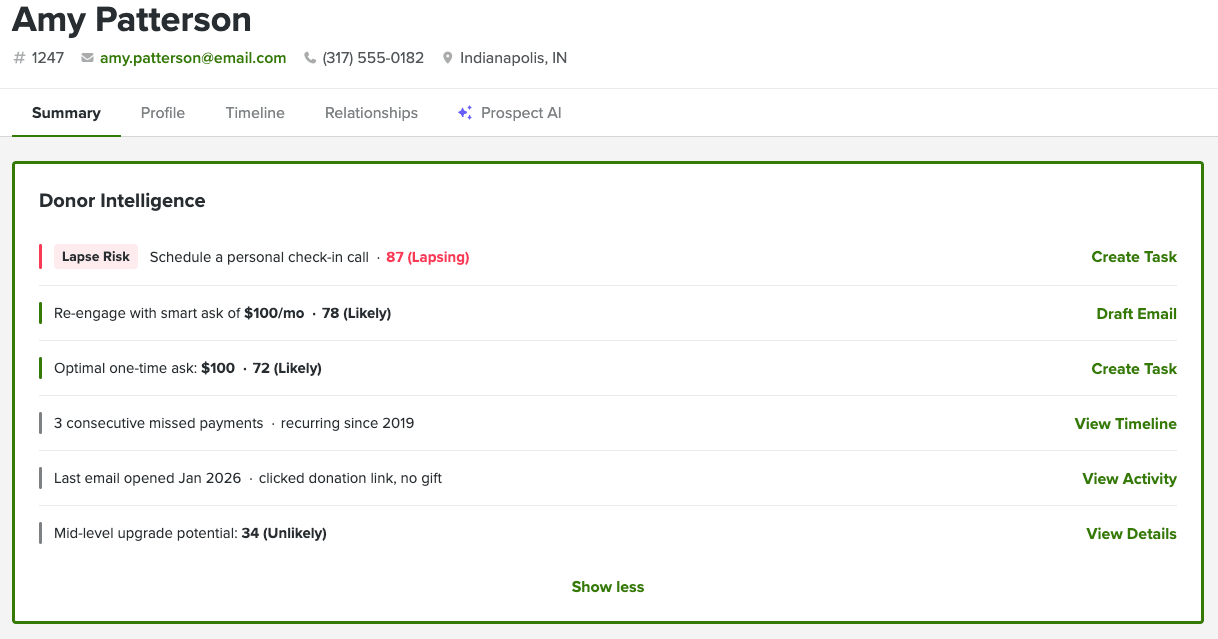
Lapse risk score: a predictive indicator, updated weekly for every donor in your database, that estimates the likelihood of a donor lapsing before they'd show up on a standard lapsed report. It's built from behavioral signals like declining email engagement, changes in giving frequency, and gaps in communication response.
How can you identify and act on a lapsing donor in under three minutes?
Here's what identifying and acting on a donor at risk of lapsing looks like on a normal Tuesday morning, inbox already full.
Daily Actions: a dashboard tile in Bloomerang that surfaces a prioritized list of donors who need your attention today, based on overnight scoring. No report to run, no filters to configure.
- Open your Bloomerang dashboard. The Daily Actions tile loads with donors who need attention today, ranked by urgency.
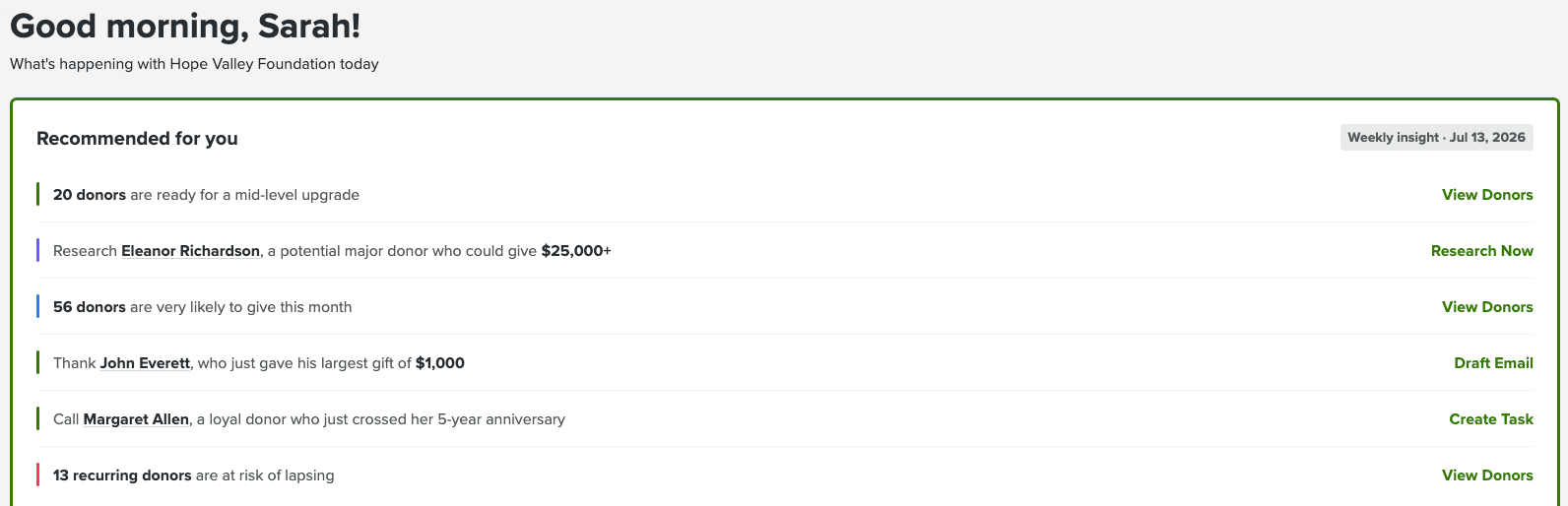
- Review the at-risk list. Each entry shows the donor's name and what triggered the signal: a shift in giving frequency, a streak of unopened emails, a missed event. Scan the list and decide who warrants outreach today.
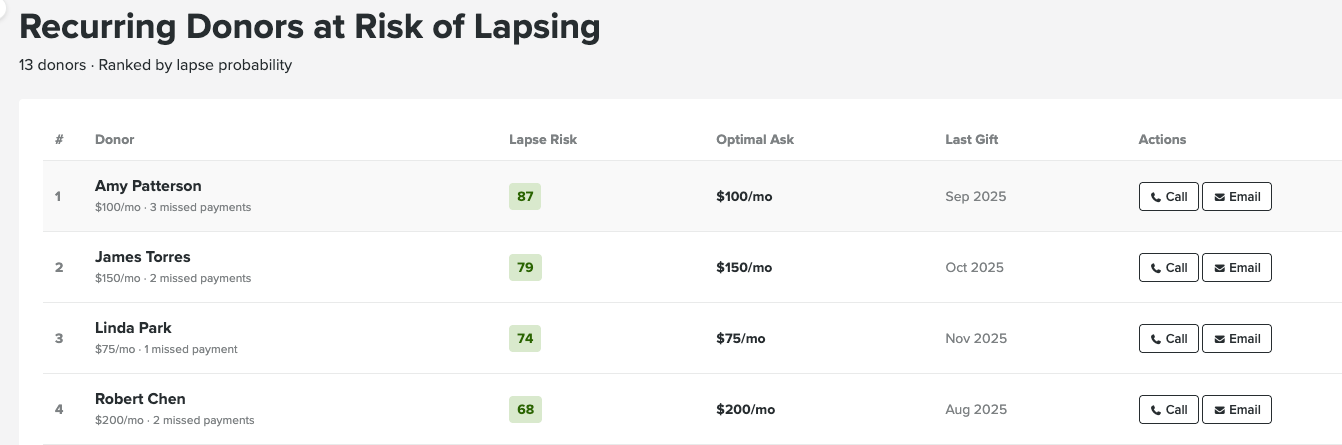
- Click into a donor record. Review their giving history, engagement patterns, and last logged contact. Confirm the signal makes sense for this relationship and look for a natural hook.
- Ask Penny to draft the follow-up. Penny, Bloomerang's AI fundraising partner, explains the donor's predictive signal in plain language, drafts a retention message for your review, and preps a follow-up task, all before you send anything. Adjust the language so it sounds like you, then approve it.
- Make the contact and log it. Call, send the email, or schedule a task. Log the outreach so the next round of scoring reflects what you've already done.
Start to finish, that's about three minutes. The scoring runs in the background. You show up, see who needs you, and move.
Why does reaching a donor before they lapse lead to a better conversation?
Timing is everything here. Reaching a donor while they're still engaged gets you a warmer, more natural conversation than any reactivation call after the silence has already set in.
Your donors will tell you why they give, if you ask. In the Bloomerang Giving Signals Report 2026, 87% of active donors say giving is values-driven, and 92% say it's not primarily transactional. People give because they believe in what you do, and because someone asked in a way that felt genuine.
A reactivation call to a donor who lapsed nine months ago asks them to reconnect with something they've already moved away from. A check-in with a donor who's still technically active, but starting to drift, reinforces a relationship that's still there.
Get to a donor before the silence stretches long enough to feel permanent, and the conversation stays natural. Ask how the program they funded is going. Share a story from that work. Invite them to something without it feeling like a rescue call.
That's what predictive intelligence gets you. Not more calls. Better-timed ones.
How should you prioritize your lapse risk list when outreach time is limited?
An at-risk list is only as useful as what you do with it. Once you can see it, the strategy is simple: prioritize by relationship depth, not just score. A major donor with a strong personal connection and a moderate risk score probably earns a phone call. A mid-level donor with a high score and no recent personal touch might get a warm email first.
A few principles that hold across portfolio sizes:
- Act early. A donor at 60% lapse risk is a much easier conversation than one at 90%. The window is wider, the ask is softer, and the relationship is warmer.
- Personalize the contact. Reference something specific: a gift they made, a program they've funded, a connection they've built with your organization. You have that history in the record. Use it.
- Don't lead with the ask. Retention outreach that opens with a donation request misses the point. Lead with the relationship. Check in. Share impact. The ask comes later, or it comes on its own.
- Log everything. Whether the outreach lands or not, document it. The system learns from what worked and what didn't, which sharpens the next round of scores.
If you manage a recurring giving program, lapse risk scoring matters even more. A recurring donor who cancels is a different kind of loss than a one-time donor who doesn't return, and the patterns that predict a cancellation are detectable before it happens.
Why is donor lapse prevention more financially urgent right now?
Lapse prevention has always paid off. Reactivating a lapsed donor costs more than retaining an active one, and most fundraisers already know it.
That gap is harder to absorb right now. Foundation grants are contracting, and your individual donors are carrying more of the budget than they used to. Retaining an active donor is one of the most financially consequential decisions your team makes when the margin is this thin.
Predictive lapse scoring changes the sequence. Instead of waiting for a donor to cross a threshold and then working to win them back, you can have a natural, relationship-forward conversation while the window is still open. Penny handles the draft. The Daily Actions tile surfaces the list. You make the call.
The donors who would have given again anyway, the ones who just needed you to reach out first, are much easier to find when you're looking at a predictive signal instead of a lapsed report.
Frequently asked questions about lapsed donors
What signals does Bloomerang use to calculate a donor's lapse risk score?
Bloomerang with Dataro analyzes behavioral patterns in your donor data, including giving frequency, recency, email open rates, and communication response gaps. The model compares these signals against broader patterns to estimate the likelihood of a donor lapsing before they cross the standard lapsed threshold. Scores refresh weekly so you're always working from current data.
How often does Bloomerang update lapse risk scores for my donors?
Weekly. Every Monday, your Daily Actions tile reflects the most current signals across your full donor database, including any donor whose risk has spiked since the week before.
Do I need to set up or configure lapse risk scoring myself?
No. Lapse risk scoring is built into the Bloomerang platform through the Dataro integration. You don't need to configure models or set thresholds. Scores appear automatically on each donor record and in the Daily Actions tile, available beginning July 2026.
Does lapse risk scoring work for recurring donors as well as one-time givers?
Yes. Bloomerang with Dataro includes a separate score for monthly donor cancellation risk, built to flag recurring supporters who may be about to pause or cancel their giving. For many teams, catching a recurring donor before they cancel matters even more than retaining a one-time donor, since monthly giving is a long-term revenue stream.
See it in Bloomerang
Bloomerang’s predictive intelligence, including lapse risk scoring and the Daily Actions tile, is available now. If you're still managing retention manually, this is what a different week could look like: fewer surprises, warmer calls, and donors who stick around because you reached them in time.
See how Bloomerang with Dataro surfaces at-risk donors before they're gone. Book a Bloomerang demo!