Automated Email Welcome Series for New Donors: A Guide




An automated email welcome series is one of the most commonly recommended strategies for engaging new donors. When someone makes their first gift, they’re automatically sent a sequence of emails over several weeks—designed to welcome, educate, and eventually ask again.
It’s efficient. It saves staff time. And it ensures no donor slips through the cracks.
But with first-time donor retention rates hovering around 20%, nonprofits have to ask: does an automated email welcome series actually improve retention—or could it unintentionally hurt it?
The following is an excerpt from Robots Make Bad Fundraisers – How Nonprofits Can Maintain the Heart in the Digital Age by Steven Shattuck, published by Bold & Bright Media.
The “email welcome series” is a frequently-recommended tactic for communicating with new donors while saving staff time in the process.
The idea being that when a donor makes their first gift, they’re queued up to receive a series of emails (three, five, etc.) over a period of time (a few weeks, a month, etc.) with each email spaced out appropriately.
But is this really a good idea?
I think that, in general, automation and stewardship are mutually exclusive. Automation is great, but it can’t compete with or replace the personal touch (at least not until the robots are smart enough to wipe us out entirely anyway).
New donors, whose donor retention rates are typically around 20%, are perhaps the worst cohort of constituents to automate any type of communication towards for three reasons:
- Research tells us that personal touch points increase first-time donor retention rates.
- They are the donors you likely know the least about – among your new donors might be very different motivations, interests, etc.
- The series may exceed the “honeymoon period” when an ask for a second gift is ideal.
Unless your organization has a high volume of lower dollar amount first-time donations, a multi-touch email series immediately after the first gift would not be my recommendation, even if it did also include a formal thank you letter in the mail.
3 reasons an automated email welcome series may hurt first-time donor retention
Here is my take:
1. The personal touch reigns supreme
There is a mountain of research that says a personal touch point within 24-48 hours of that gift is the best first touch:
- First-time donors who get a personal thank you within 48 hours are 4x more likely to give a second gift. (McConkey-Johnston International UK)
- A thank-you call from a board member to a newly acquired donor within 24 hours of receiving the gifts will increase their next gift by 39%. (Penelope Burk)
I don’t think an automated email or emails that every new donor gets can be considered a personal thank you. We’re talking a phone call, handwritten note, voicemail and even a 1:1 email.
In today’s digital age, these touch points will stand out among the hundreds of emails we receive daily.
John Lepp from Agents of Good tells recently told me the story of a friend of h is in the donor love department at UNICEF Italy that ran a test on sending a handwritten, heartfelt card within 48 hours of getting a gift (from any donor) and a call on the anniversary of giving or on a birthday.
The results were a 30% yearly increase in retention and a 50% increase in donor lifetime value.
Andrew Olsen, CFRE recently told the story of a hunger relief org he worked with that eliminated paper thank you letters to online donors to save money on print and postage. They lost $300k to lower retention and fewer gifts the next year.
2. Not all new donors are built the same
There’s no better donor to get to know than a first-time donor. Without knowing the motivation for their gift, or what in particular they are interested in with regards to your programs/services, I’m not sure on what basis you would populate the content for an automated welcome series.
You’d either have to make assumptions about all of your new donors, or be forced to cover every single topic all at once and hoping that something sticks.
This is particularly problematic for organizations that have a wide service offering. If you’re an environmental organization, how will your email welcome series account for donors who are interested in wildlife versus those who are interested in the forests? Sure, it’s safe to assume that the donor will care about both, but targeted communications will always win out over a one-size-fits-all approach.
Use the following questions to create and develop insights:
- How did you get their email address?
- Donation
- Blog subscription
- Content download
- Direct contact
- Referral program
- If they donated, how did they donate?
- Online donation page
- Offline, in response to a mailer
- At an event
- Online peer-to-peer campaign
- If they donated, what kind of donor are they?
- One-time
- Yearly
- Recurring
- How did they hear about your organization?
- Google Ad Grant ads
- Social media campaign
- Event sponsorship
- Researching online
- Word of mouth
- What are your list's demographics?
- Location
- Age
- Donation amount
3. The Honeymoon Period
There is no reason to wait an entire year to ask for a second gift. In fact, asking within 90 days of the first gift is a research-based recommendation. However, if a first-time donor is getting automated emails from you that do not ask for a second gift, you run the risk of missing that window of opportunity.
Analytical Ones found that the amount received in a second gift drops the longer you wait to ask for it:
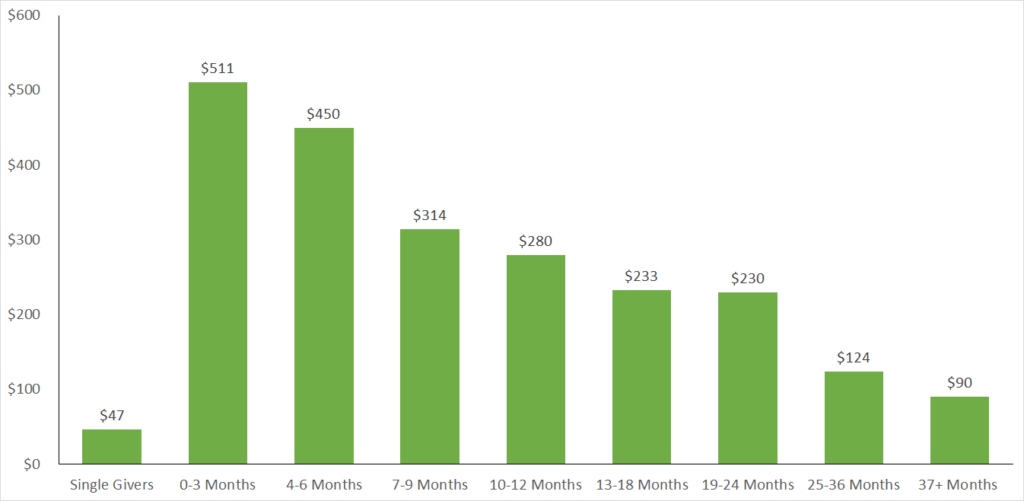
Our own Bloomerang data confirmed as much, specifically in cases when that new donor is called within the first 90 days:

There is definitely a honeymoon period for new donors, but success is incumbent upon doing a good job thanking the donor personally, telling them stories and getting to know them so that you contextualize and personalize that second ask (rather than just automated an appeal on a set schedule that every single new donor gets).
A research-based alternative to an automated welcome email series
So what should you do instead?
Lori Jacobwith has a great first-time donor communication plan that, while hard to automate, does check all of the boxes that research tell us, and sets you up for an effective appeal:
- Board thank you phone call (within 3 days)
- Thank you letter/note in the mail (within 1 week)
- Monthly email newsletter
- Tour invitation (within 6 weeks)
- Appeal for 2nd gift (within 90 days)
- Thank-you letter if second gift received (within 1 week)
- Donor survey (within 6 weeks of second gift)
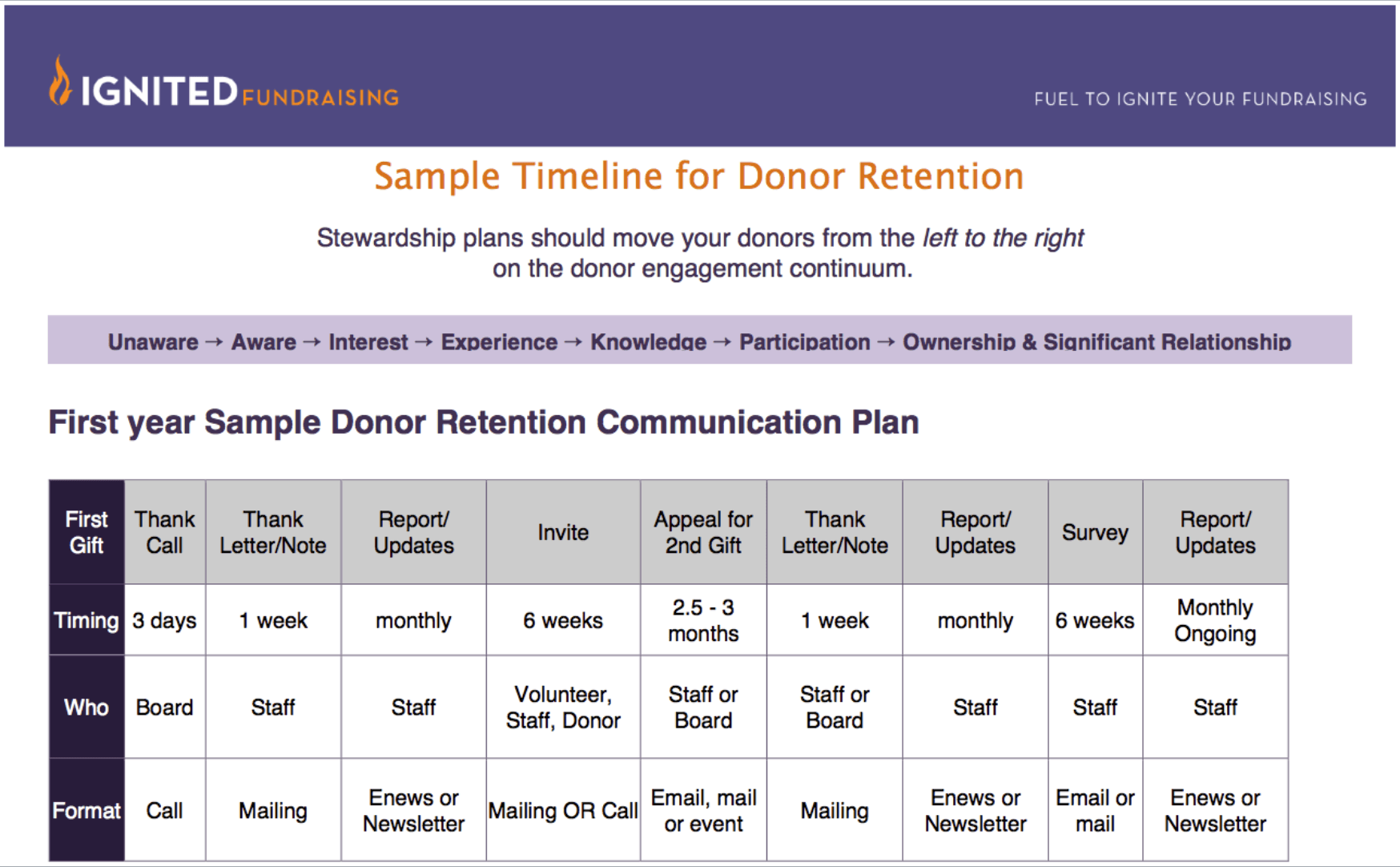
I think this is pretty solid, but you could definitely push a survey sooner. The tour invitation is a great idea if you have a facility or location that can be toured. Not only will they see your mission in action, but you’ll inevitably make small talk and possibly learn about their motivation (replacing the need for a survey).
Thinking again about that “90 day honeymoon period” it might be wise to create a stewardship plan that zooms in on those first three months:
Even though that sounds like a lot of work, it’s worth it. The retention rate on first-time donors is around 20%. So if your cost per acquisition is more than the donation amount from the first gift, you have negative ROI right off that bat. You have to get a second gift to get back above break-even. So spending time here is financially justifiable.
Is automation making things worse?
Not only is the first-time donor retention rate an abysmal 20%, but it’s been on the decline over the last five years:
According to FEP, the first-time donor retention rate is between 19% to 23%, highlighting that while major and repeat donors continue to drive sector growth, acquiring and retaining first-time supporters remains a critical challenge.
Could it be that we’re leaning more on automation to communicate with these new donors?
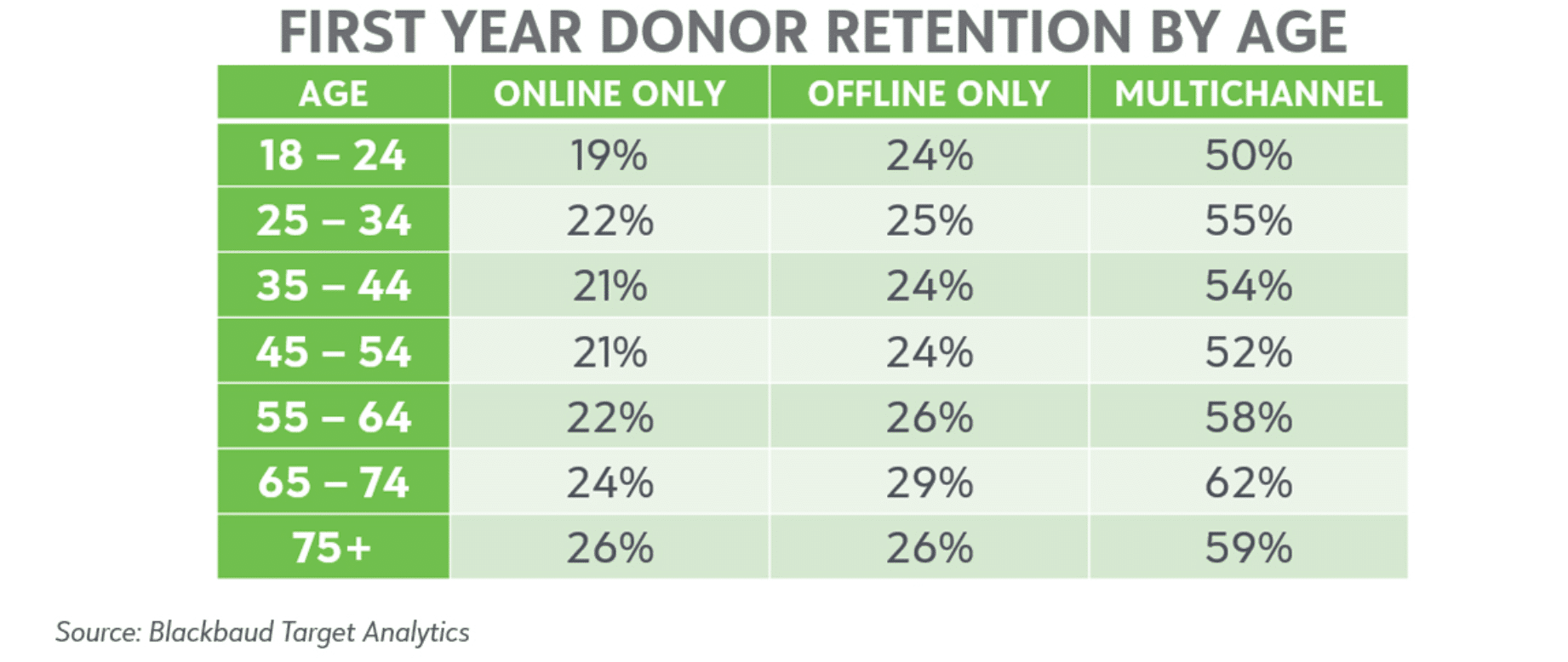
Or is because more first-time gifts are made online, where retention rates are typically lower than gifts made offline?
How to build a donor welcome email series (if you use one)
If your organization chooses to use automation, structure is everything. A successful welcome series strikes a balance between sharing your story and respecting your donor's inbox.
To maximize engagement without overwhelming your audience, follow this proven 4-email framework and cadence guidance.
- Email 1: Introduction to the mission
Move past the generic tax receipt. Use this space to paint a complete picture of your nonprofit’s story, the specific programs you offer, who you help, and the tangible impact your donors make. This is also where you set clear expectations for the communication they will receive next. - Email 2: History & leadership
Bolster your organization's credibility. Share a brief look back at when you were founded and the major milestones you’ve achieved over the years. Introducing the passionate people steering the ship provides social proof that the donor has invested in a trustworthy, sustainably run cause. - Email 3: Getting to know your donors
True donor retention is a two-way conversation. Invite them to get more involved by highlighting non-monetary actions like volunteering or advocacy. Most importantly, include an optional survey to learn about their motivations, helping you customize their donor journey moving forward. - Email 4: Recap & wrap-up
A busy donor might miss an email or two. Use this final touchpoint to provide a "Reader's Digest" summary of the previous emails, formally wrap up the series, and clearly state how often they can expect to hear from you in the future (e.g., your regular monthly newsletter).
How many emails and how often to send
Finding the right cadence for your welcome sequence depends heavily on the first two steps of building any successful automated campaign: clarifying your goals and setting your pacing.
Before deciding on a rigid schedule, you need to understand who your new subscribers are and what you want them to do. A welcome series isn't just about saying hello; it's about nurturing an early relationship.
Keep it tight: 2-4 emails
While there is no single "magic number" for every organization, industry research and experts suggest keeping your introductory welcome series between 2 to 4 emails long.
- Why it works: This range is the sweet spot for keeping your nonprofit front of mind without overwhelming a recipient's inbox.
- The strategy: Avoid the temptation to ask for major commitments or large donations right away. Instead, treat each message as a progressive step toward deeper engagement. Use one email to share your origin story, another to showcase recent community impact, and a third to offer a low-barrier call-to-action (like following your social media channels or joining a volunteer list).
Send the first one immediately
When it comes to timing, there is an absolute consensus across email marketing: you must send your very first email immediately after someone signs up or makes their initial donation.
- Capitalize on momentum: This is the precise moment when your organization is most relevant to them. Their interest is peaking, and a delay can cause that momentum to cool down.
- Make receipts matter: For nonprofits, that immediate email is often an automated donation receipt. Don't waste this space on a boring, sterile PDF. Use it as the official kickoff to your welcome series by embedding a brief impact story, a warm thank-you video, or a personalized note from your director.
Set your pacing based on behavior
Once that initial immediate email triggers, you have more flexibility with the rest of your timeline. A solid baseline is to wait 2 to 4 days between each subsequent message.
As you establish your pacing, keep these two questions in mind:
- Are they on other lists? If these contacts are immediately dropped into your main monthly newsletter, dial back the frequency of your welcome sequence so they aren't bombarded.
- What does your data say? Always track your open and click-through rates. If you notice a massive drop-off between email two and email three, it may be a sign that you need to space them out further or tweak the subject lines to keep them inspired.
Example from a real for-purpose organization
There is no better way to build your own sequence than to look at how fellow practitioners find success. Real-world campaigns from high-performing nonprofits highlight exactly how to move donors from their first gift to long-term alignment.
Check out some advice from Susan Dannemiller, Executive Director for Children’s Day Preschool. After recently setting up a welcome email for her nonprofit, she shared six great tips to help nonprofits get started on their own welcome email series!
- Read as many articles from reputable sources as you can about how to set up the look and feel of the emails, develop content, and specifically, content for welcome emails.
- Form a trusted team to review and help you edit—but make sure they understand the purpose of the emails and can help provide guidance as well as check for grammar and spelling.
- It takes a long time to get the emails where you want them. I may be pickier than most, but it took us several weeks to really develop the look and feel of our email campaign, especially the header! And I had a head start… I send a weekly email to my staff and used that basic design as the base for our agency’s email campaign. But, once you have that set, you can focus on the content.
- Canva is an awesome app/website! We use it for all of our social media, and for these emails, to design our header and some of the graphics we use in our emails.
- We really tried to employ the use of personalized tags and using the word ‘you’ more often than ‘we/us.’ And giving the subscriber reasons to click on things and engage with the email (like the survey in one of their example emails you’ll see later in the article).
- Really try to think of this as a personal conversation you could be having with each individual subscriber. It helps me to imagine who the subscriber is and I’m sending them the email to help them get to know our school/work.
How to get started with donor email automation
Getting started is simple with Bloomerang’s Journey Automation tool. Here’s a quick step-by-step to launch your first automated donor workflow:
- Identify your goal: Choose the type of donor email you want to automate, like a milestone or event reminder.
- Map the journey: Outline the sequence and timing of emails that best support your goa
- Customize your content: Craft messages that reflect your nonprofit’s voice and speak directly to your donors’ interests.
- Set triggers: Use Bloomerang’s automation features to send emails based on donor actions—like a new gift or event registration.
- Launch and monitor: Activate your workflow and track performance to optimize open rates, click-throughs, and donor engagement.
For a deeper dive into email marketing strategies tailored for nonprofits, check out Bloomerang’s comprehensive resource, Email Marketing for Nonprofits: The Ultimate How-To Guide. It’s packed with expert tips to help you craft compelling emails that inspire giving and strengthen supporter relationships.
Ready to save time and boost donor retention? Try Bloomerang’s Marketing & Engagement tools today and turn your email communications into powerful, personalized experiences that grow your mission.
How to improve your automated emails (if you use them)
One way to truly make automation work for you is to make sure that the automated communications online donors receive from you are less transactional and more appreciative.
Pay special attention to:
1. Confirmation page (the page of your website donors are redirected to after donating)
2. Automated receipt email (sent from your donor database/payment processor/online giving provider)
These two things can be optimized to thank the donor warmly, tell a story, preview future impact and maybe even collect information through a survey (“what prompted you gift today?”). These should be generic enough to apply to all donor frequencies (since every online donor will see/get them) but still communicate impact.
All that being said, If I was running a development department and wanted to increase my first-time donor retention rates, I would do the following:
- Make sure the website confirmation page and automated email receipt are engaging and not transactional (one-time fix)
- Create a standing report of new donors this week (or today if gift volume is manageably low)
- View that report daily or weekly (whatever frequency is chosen)
- Have board members ready and available to call those donors within 24 hours
- Equip them with a call list and loose call scripts/guidelines
- If no board member availability, fall back on staff members
- Equip them with a call list and loose call scripts/guidelines
- Get a thank you letter to new donors within a week
- Make sure the letter recognizes them as a new donor with a statement like, “Welcome to the family!”
- Include a handwritten note/signature (just to let them know we spent some time on the letter after printing
- Get them subscribed to the monthly email newsletter
- Send a personal, 1:1 email to the donor inviting them in for a tour
- Again, recognizing them as a new donor that we want to get to know
If you absolutely cannot do this for new donors, then an automated email series might be better than nothing. But you’d still run the risk of sending content that is one-size-fits-all.
Measure and A/B test your welcome series
The true power of an automated welcome sequence isn't just that it runs in the background—it’s that it generates continuous data you can use to optimize your donor relationships. Rather than taking a "set it and forget it" approach, look at your sequence as a living campaign that requires ongoing refinement.
Use your email marketing tool to track your progress. Open rates and click-through rates are a great place to start. But then you can go deeper. You can begin using A|B testing to compare these results against the different emails in your series.
Did email #2 get opened more than #3? Now you have the opportunity to test different subject lines and cadences.
Did email #4 have a higher click-through rate than all the other emails? What type of content do you have in that email? What is the call-to-action at the end? How can you bring those elements into emails #1-3?
Automated series vs. personal stewardship: Which to choose
Nonprofits often treat this as a binary choice: either they build a hands-off, automated email machine, or they rely entirely on manual, high-touch outreach.
In reality, the most successful organizations don't choose between automation and personal stewardship—they segment their donors and match the strategy to the investment.
The table below breaks down how to balance these approaches based on donor tiers, capacity, and average gift sizes.
Will automation win out someday?
Probably, but not yet.
We are already seeing the first major wave of this shift. Instead of generic templates, modern platforms feature purpose-built tools—like Bloomerang’s built-in AI partner, Penny—that analyze real-time donor history, giving behavior, and engagement to tell fundraisers exactly who to prioritize, why, and how to approach them. The gap between data collection and hyper-personalized outreach is closing faster than we think.
Someday soon, our software will deliver fully automated email cadences tailored dynamically to a specific combination of a donor’s gift amount, channel, method, geography, demographics, and real-time motivation. But even as machine learning drafts our first copy versions and builds micro-segments, I’d still put my money on the personal touch. AI should be used to clear the administrative noise so that humans have more time to build authentic, one-on-one relationships.
Have you had success with an automated email welcome series and think I’m wrong? Tell me why in the comments below!
FAQ: Automated email welcome series for nonprofits
Should nonprofits use an automated welcome email series for new donors?
For most organizations, a multi-touch automated series right after the first gift isn’t ideal. Prioritize personal stewardship instead. If you have very high volume, low-dollar gifts or limited capacity, automation may be better than no follow-up.
What’s the best first follow-up to a first donation?
A personal thank-you within 24–48 hours—via phone call, handwritten note, voicemail, or a one-to-one email—outperforms automated emails. Donors thanked personally within 48 hours are significantly more likely to give again.
When is the best time to ask a new donor for a second gift?
Within 90 days of the first gift, during the “honeymoon period.” Waiting longer typically reduces second-gift likelihood and amount.
If we use automation, how can we make it more effective?
Make confirmation pages and receipts warm and appreciative, include a brief impact story, and consider adding a short “what prompted your gift?” survey. Keep messages donor-centered rather than transactional.
What’s a research-based alternative to a welcome series?
A simple plan includes a board thank-you call within 3 days, a mailed note within 1 week, adding donors to your monthly newsletter, inviting them to a tour within 6 weeks, and making a personalized second-gift ask within 90 days.
How long should a donor welcome email series be?
Most nonprofits use 3–5 emails sent over about 30 days. However, personal thank-yous within 24–48 hours tend to have the strongest impact on retention.
Should you ask for a second gift in a welcome series?
Yes. Many organizations recommend asking for a second gift within 90 days of the first donation to take advantage of early engagement momentum.
Is email automation bad for donor stewardship?
Not necessarily. Automation improves consistency and efficiency, but relying only on automated messages without personal outreach may limit donor retention.
Can automation replace personal touches in donor communication?
No. While automation supports timely communication, personal touches such as calls, handwritten notes, or personalized emails remain essential for building strong donor relationships.
How can nonprofits personalize automated welcome emails?
Use donor data such as gift amount, motivation, and interests to segment audiences and tailor content. Surveys and preference centers can help collect additional data for personalization.
What are some best practices for timing automated welcome emails?
Send the first email immediately after the donation to confirm the gift and set expectations. Space follow-up emails over several weeks to maintain engagement without overwhelming donors.
How do I write a welcome email sequence?
- Send the first email immediately: Capitalize on peak momentum by sharing your core mission.
- Keep it concise: Limit the sequence to two to four emails total.
- Space your pacing: Wait two to four days between subsequent messages.
- Use one clear CTA: Dedicate each email to a single, focused next step.
- Nurture before asking: Cultivate the relationship with stories before requesting another gift.
What types of donor emails are smart to automate?
- Donation receipts and acknowledgments: Send timely, compliant receipts that also share impact stories to deepen connection.
- Event invitations and reminders: Automate invites and follow-ups for fundraising events or volunteer opportunities.
- Anniversary and milestone messages: Celebrate donor anniversaries or giving milestones to recognize loyalty.
- Re-engagement campaigns: Reach out to lapsed donors with gentle reminders and updates to rekindle their support.