How to Revise Your Nonprofit Mission Statement: Steps + Tips




Everything you do emanates from the why and what of your existence: your mission! And both the why and what are important, because if folks don't understand why you exist, it's difficult to inspire them with what you are doing.
I always ask a new client what would happen if they ceased to exist. Here are answers you don't want to offer up:
- Not much, really.
- It would be a little bit harder for people to get help.
- Fewer people would get help.
- It might take somewhat longer for people to get help.
- There would be less awareness of the problem.
- I don't know.
The mission statement answers the question: What would happen if your organization disappeared? For example, a food bank's mission might be simply: “To End Hunger in Our Community.” If they ceased to exist, people would be hungry. That would be a very bad thing. You need to have a compelling answer to this existential question. If you don't have something that conveys a sense of urgency about your raison d'être, it's time to reconsider your mission statement!
Can a nonprofit change its mission statement?
Yes, a nonprofit can change its mission statement, provided the revised mission still aligns with the organization's tax-exempt purpose. Making this change typically requires formal board approval.
To officially change your mission statement, you must address several governance and compliance steps:
- Exempt-purpose alignment: Ensure the new wording still qualifies for 501(c)(3) status.
- Board approval: A formal vote by the board of directors is required.
- Bylaws: Review and potentially amend your bylaws if the mission is stated within them.
- Articles of incorporation: Check if your articles need to be amended and filed with your state.
- Form 990/Schedule O: Report the significant change to the IRS on your annual return.
- State requirements: Follow any additional state-specific reporting rules for charitable solicitations.
What does a strong mission statement look like?
The best mission statements are specific, yet succinct. Don't use vague terms like “to help people in Weloveus County live the best lives possible.” Which people? Live the best lives in what regard? Are you talking here about children? Seniors? Right to education? Access to healthcare? Exposure to the arts? Mission statements can't be obtuse.
At the other end of the spectrum are mission statements that appear to have been written by a legal team trying to capture every nuance with a different word (e.g., “We provide therapeutic, healing, and supportive services to children, families, and seniors who are food insecure”). If you can't convey why you exist in a simple, concise manner, people won't clearly understand how to help you.
Write a sentence, not a term paper. You can always amplify your mission statement with descriptive narrative (e.g., on the “About” page on your website, your annual report, your 990, and so forth), but you want something really clear to put on your website homepage, email signature, social profiles, and grant applications. Something easy to remember and, above all, easy to understand.
When should you revise your mission statement?
Missions may evolve over time. Consider whether your mission (i.e., what you do) has significantly expanded or contracted since your founding (or since the last time you visited your mission statement). It is a best practice to review your mission statement every three to five years, or sooner after a strategic plan, merger, major program shift, leadership transition, community crisis, or funding change.
Perhaps you used to serve just preschoolers, and now you serve K–6 as well. Or maybe you used to provide arts education in the public schools and juvenile detention centers, and now your focus has shifted exclusively to incarcerated youth.
For example, the March of Dimes was founded to “eradicate polio in the U.S.” When that battle was won, they could have gone out of business. Instead, they evolved their mission to fight for the health of all moms (healthy pregnancy) and babies (birth defects). Today they're poised “to address some of the biggest health threats to moms and babies with innovations like folic acid, newborn screening, and surfactant therapy.”
How to revise a nonprofit mission statement in 7 steps
Here are the steps in revising your nonprofit mission statement:
1. Decide whether a revision is necessary. Evaluate if your current mission accurately reflects your work.
2. Review your current mission against your current programs and impact. Identify any major shifts or expansions.
3. Gather input from board, staff, volunteers, donors, and the community. (See the brainstorming exercise later on for a deep-dive method on this step.)
4. Draft a clear, specific one-sentence statement. Use the input to forge a focused draft.
5. Test for clarity, brevity, audience, and exempt purpose alignment. Make sure to test your mission for clarity and reading level.
6. Secure board approval and amend governing documents if needed. Take the draft to your board for a vote.
7. Update IRS/state filings, website, donor/grant materials, and internal messaging. Roll out the new mission across all channels.
The legal process for changing a nonprofit mission
If you substantially change your mission, your board must formally amend the mission statement to reflect those changes.
(Disclaimer: The following is general information and not legal advice. Always consult with a nonprofit attorney in your state.)
Board approval and board resolution
The process starts with your board of directors. The board must formally vote to approve the new mission statement, which is recorded in the meeting minutes.
Sample Board Resolution Motion: “I move that the Board of Directors approve the revised mission statement as presented, and authorize the executive director to take all necessary steps to update our governing documents and public materials accordingly.”
Bylaws
Check your bylaws. If your old mission statement is explicitly written into them, the board will need to formally amend the bylaws to replace it with the new wording.
Articles of incorporation
Similarly, review your articles of incorporation. If your specific purpose clause relies on the old mission wording, you may need to file Articles of Amendment with your state's incorporating agency (often the Secretary of State).
Tax-exempt purpose alignment
Will changing your mission affect your 501(c)(3) status? Usually, no—as long as the new mission remains charitable, educational, or otherwise aligned with IRS definitions of a tax-exempt purpose. However, material shifts should always be reviewed by legal counsel.
Form 990 and Schedule O
You must notify the IRS of any significant changes to your organization's purpose. This is done when you file your annual Form 990 by detailing the changes on Schedule O.
State requirements
Ensure you notify the appropriate state agencies (such as the Attorney General's charity registry) when you renew your charitable solicitation registrations.
Mission statement revision checklist
Use this checklist to ensure you’ve covered all the necessary strategic and legal steps when revising your nonprofit's mission statement.
- [ ] Current mission reviewed against programs
- [ ] Stakeholder input gathered
- [ ] Draft aligned with tax-exempt purpose
- [ ] Attorney consulted if purpose changed substantially
- [ ] Board resolution approved
- [ ] Bylaws reviewed/amended
- [ ] Articles of incorporation reviewed/amended
- [ ] Form 990/Schedule O updated
- [ ] State filings checked and updated
- [ ] Public/donor materials updated
Nonprofit mission statement template
When drafting, you can use these reusable formulas to get started:
- "We [action] [audience] by [service] so that [impact]."
- "Our mission is to [action] [problem/cause] for [population/community]."
Before and After Revision Examples:
Seeing a vague mission statement transformed into a strong one can be incredibly helpful.
- Vague: "We help families thrive."
- Revised: "We provide emergency housing and job support to families experiencing homelessness in Central Indiana."
- Vague: "Protecting the environment for everyone."
- Revised: "We restore wetland habitats in the Pacific Northwest to ensure clean water and protect native wildlife."
Great mission statement examples
Here is a mix of both national and international examples so you'll know what to reach for.
charity: water
charity: water is a nonprofit organization bringing clean and safe drinking water to people in developing nations.
It's succinct and specific. They really focus. They describe the kind of water (clean and safe) and their target population (people in developing nations).
San Francisco-Marin Food Bank
Our mission is to end hunger in San Francisco and Marin.
They don't describe their processes or myriad programs. The focus is on the end goal, and it's localized so it seems manageable.
Feeding America
Our mission is to feed America's hungry through a nationwide network of member food banks and engage our country in the fight to end hunger.
You can see how this statement shows how the umbrella organization fulfills its mission through a network of direct service agencies and also engages in advocacy.
Monterey Bay Aquarium
Inspiring conservation of the ocean.
They don't say they do this through a world-class museum and extensive research. Rather, they focus on their end goal. The why of their existence.
First Descents
First Descents provides life-changing outdoor adventures for young adults (ages 18-39) impacted by cancer.
This is super clear. What kind of outdoor adventures? Life-changing. What type of young adults? Ages 18–39 impacted by cancer. Enough—and well—said.
How to brainstorm a revised mission statement
Reviewing your mission statement gives volunteers and staff the opportunity to connect/reconnect with the passion that originally drew them to you. It helps folks better appreciate the why and fully understand the what. The process gets them involved. And once the statement has been affirmed or revised, everyone feels inspired and equipped to communicate it to others. On your website homepage. On your social profiles. In grant applications and donor onboarding. In a fundraising appeal or annual report. Everywhere you justify your existence and seek to inspire others to join you!
Here's an exercise you can do sequentially, first as an individual; then as a team. The team approach is ideal because one of the problems with so-called mission statements is that they were too often written a zillion years ago—and no one has looked at them since. So, were you to go around the table at your board meeting and ask folks to write down your mission on a piece of paper, you could easily end up with more than one different statement. Trust me—I've had this happen more times than I'd like to say!
Do this with a trained, objective facilitator. You don't want to fall into the trap of no one wanting to be honest because they fear their opinion won't matter. Nor do you want folks to defer to a strongly opinionated leader, who may just be at odds with the larger group.
You want a single, agreed-upon mission statement. Not multiple variations you use for different purposes or audiences. And not multiple variations depending on who you ask.
Even though I've called this a brainstorming exercise, it's helpful to do a little pre-planning. Or, at the very least, give folks the opportunity to think for themselves before they become victims of groupthink.
[NOTE: You can do this as a full staff, a department, a board of directors, or as a combination of staff and volunteers. You can also do this in sub-groups, with the plan being to collect the summary responses from each group and then bring them back to a designated 'working group' (perhaps with representation from each of the sub-groups) for further refinement.]
Phase I: Start brainstorming.
1. Answer guiding questions individually, on paper.
You can ask folks to complete a questionnaire before a group meeting, or do it together at the meeting. If the latter allows only 10-15 minutes, let people know they should keep their answers short and focused (i.e., words and phrases, not essays).
- If anything were possible, what would your organization look like? What would its impact be on the world?
- If you could describe what your organization does in a few keyword phrases, what would those be?
- What is/are your most pressing problem(s) as an organization right now?
- If you could wave a magic wand, what would you ask for in order to solve the problem(s) mentioned above?
- What legacy do you want your organization to have?
- Are there partners critical to achieving your goals?
- What does your ideal team, model, or outside partner(s) look like?
2. Once you're done, ask folks to read out their responses to the group.
Do this question by question, while charting the answers on a whiteboard or easel. I prefer using an easel because you can create separate pages for each question, then remove the pages and tape them up around the room.
Group similar responses together by circling, starring, numbering, or color coding with your marker. (e.g., if you are a food bank and six people answer question #1 with “No one will be hungry” and six answer with “No one in our community will be hungry,” you can see at a glance where there is a significant divide that may impact how you rewrite your mission statement— and all your subsequent messaging).
3. Group responses into categories that will serve as building blocks for your mission statement.
Don't judge whether what emerges from the responses you're collecting now seems like the perfect ultimate fit. Right now, you're just trying to get a handle on where you're at today.
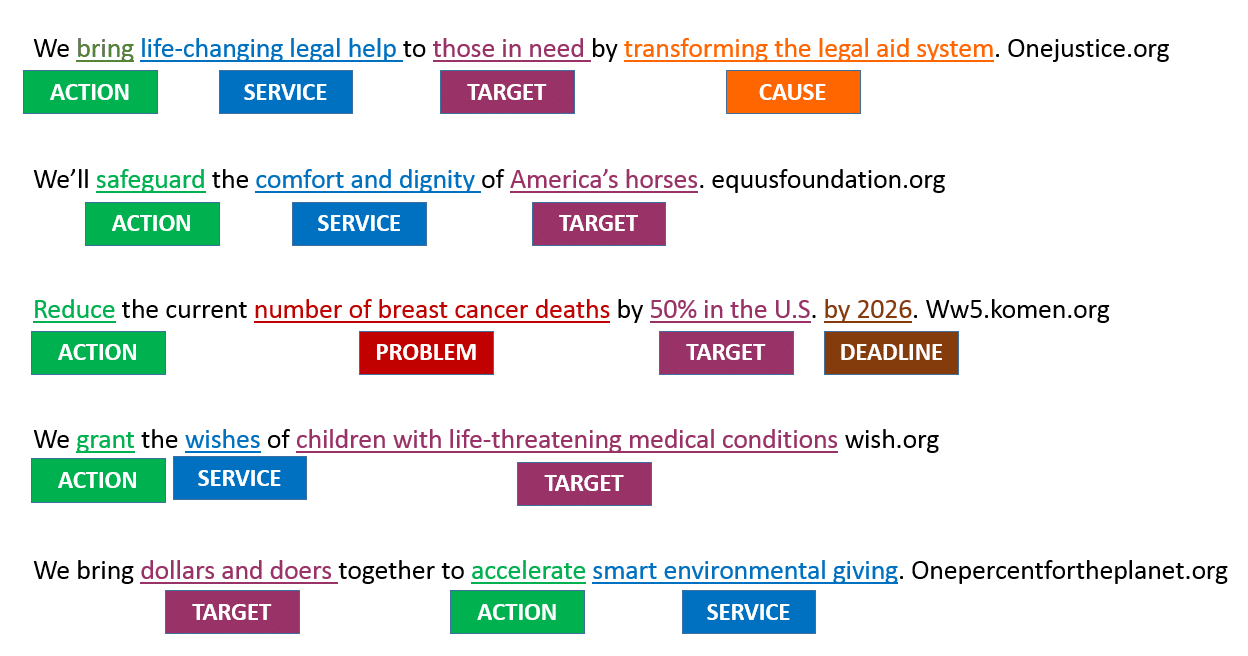
After you complete this grouping, you'll move on to where you'd like to go next. While not all categories may be appropriate or necessary for your organization, general categories include the following:
- ACTION: These are verbs (e.g., to end… to eradicate… to deliver… to build… to teach… to distribute).
- SERVICE: These are generally nouns, sometimes modified by adjectives (e.g. clean water… low-income housing… literacy education… nutritious food… outdoor adventures…).
- TARGET BENEFICIARY: This might be people (specific population(s)), animals (specific), places (local or global), or a cause (e.g., social justice; the environment).
- PROBLEM: This is what your actions and services resolve. They are generally nouns, sometimes modified by adjectives (e.g., local hunger… ovarian cancer… climate change… human trafficking)
- CAUSE: This pertains especially well to umbrella organizations, associations, and networks. It's often an intangible (e.g., injustice… equality… freedom…conservation… spirituality… quality of life).
- DEADLINE: You don't always want a deadline, but sometimes it makes sense. For example, when you want to get to zero carbon emissions by 2030. Or you're committed to getting everyone who lost their shelter due to wildfires, hurricanes, earthquakes, or floods into affordable housing within the next three years.
Take a break.
If you're doing this with a group, by now you'll have a wealth of information collected. While group members have some refreshment, make phone calls, check emails, or whatever, have your facilitator help you get ready for the next phase of this exercise.
- Post your current mission statement on the wall. Not the one you've been processing, but the one you had when you walked into the exercise. You're going to compare it with what you've been brainstorming and evaluating.
- Post your charted answers to the questions you posed to everyone up on the wall for folks to refer to. You're going to go back and review these in Phase II.
- Post your lists of actions, services, target constituencies, problems, causes, and deadlines. You may find you have more than one of some of these, and none of the others. That's okay.
Phase II: Get productive conversations going!
During your discussions, continue taking notes on your whiteboard or flip chart so you create a group memory. This takes the focus off of any one individual's comments. It also assures folks that their comments were heard. Use these conversation facilitation suggestions.
- DISCUSSION A: Are your answers to questions 1, 2, and 5 mentioned in your current mission statement? Elsewhere on your website? If not, why? This discussion highlights the core importance of your mission and helps to uncover gaps that may exist. It also helps you find ancillary programs or services that may not belong in your mission statement as they're not central to your why.
- DISCUSSION B: Did each of your staff/board members have similar answers? If not, you've got work to do! If you don't have clarity internally, how can you expect to clearly convey what you do outside your walls? This is where you can look at groupings of answers. If you have several different ideas competing for prominence, this can be the starting point for discussion. Is the heart of your mission all of these things? Are some of these things merely programs subsumed within your mission?
- DISCUSSION C: Review your responses to question #3. As a team, rank these problems. Combine overlapping ideas. Remove any that are not strategic priorities.
- DISCUSSION D: Review your responses to question #4. Which responses solve more than one of your most pressing problems? What would it take to bring your wishes to reality? What's possible/not possible?
From here, you should be able to develop a plan to succinctly and compellingly reframe your mission, so you attract the resources most needed to bring your goals to fruition and leave a lasting legacy.
Should you revise your vision and values, too?
When you revisit your mission statement, it is a great time to ensure it aligns with your vision and values. As a brief refresher: your mission is what you do and for whom, your vision is the future you hope to create, and your values are the principles that guide your work.
It is highly recommended to align revisions for all three during your broader strategic planning. You can read more about balancing these in our guide on navigating vision vs. mission. To pull it all together for your supporters, you might consider building a nonprofit case statement once you are finished.
Nonprofit mission statement: Frequently asked questions
Can a nonprofit change its mission statement?
Yes. A nonprofit can change its mission statement as long as the new mission still aligns with the organization's tax-exempt purpose. The board must formally approve the change.
How do I change a nonprofit mission statement?
The general legal path involves:
- Board approval via resolution
- Amending bylaws (if applicable)
- Amending articles of incorporation (if applicable)
- Reporting the change to the IRS on Form 990/Schedule O
- Updating state charity registrations
Will changing our mission affect our 501(c)(3) status?
Typically, no, as long as your new mission still falls under the charitable, educational, or other exempt purposes defined by the IRS. Material shifts in your purpose should be reviewed by legal counsel.
How often should a nonprofit review its mission statement?
It is recommended to review your mission statement every three to five years, or after a major strategic plan, merger, program shift, leadership transition, or funding change.
What is a common mistake in nonprofit mission statements?
Common nonprofit mission statement mistakes include making them too vague or using complicated, legalistic jargon. The best mission statements are specific, succinct, and written at a 6th- to 8th-grade reading level.
What are the components of a nonprofit mission statement?
While formats vary, effective mission statements often include an action (verb), a service (what you do), a target beneficiary (who you help), the problem you are solving, and the intended impact.
Do we need to report a mission change to the IRS?
Yes, significant changes to your organization's purpose or mission must be reported to the IRS on your annual Form 990 using Schedule O.
Wrapping up
Revising your nonprofit's mission statement is a powerful opportunity to reconnect your team with your core purpose. A strong mission statement should answer an existential question—what would happen if your organization disappeared?—in a single, specific, and jargon-free sentence. As you refine your wording, take the time to ensure it aligns with your broader vision and values, so that your staff, board, and donors remain fully unified in your goals.