Should Your Nonprofit Accept Stock Donations? How to Get Started




Our Ask An Expert series features real questions answered by Claire Axelrad, J.D., CFRE, also known as Charity Clairity. Today’s question comes from a nonprofit employee who wants advice on setting up stock donations:
The answer is yes — even for small nonprofits, accepting stock is usually worth it because appreciated-securities donors grow contributions faster and setup is simpler than most expect.
Read Claire’s response below:
Dear Taking Stock,
This is VERY important!
A groundbreaking study by Dr. Russell James J.D., Ph.D., CFP®, professor in the Department of Personal Financial Planning at Texas Tech University, found nonprofits that consistently received gifts of appreciated stocks grew their contributions six times faster than those receiving only cash.
The study shows:
- Received only cash gifts = 11% growth.
- Received any kind of non-cash gift = 50% growth. Included gifts of personal and real property and deferred gifts.
- Received securities non-cash gifts = 66% growth. Massive difference from just this one strategy!
But if you don’t promote stock donations, they’ll likely happen very rarely.
Why you should promote stock giving
Aside from the data reported in the Russell James study, gifts of stock offer significant financial advantages for donors:
- Full fair-market-value tax deduction: Donors can generally claim a charitable tax deduction based on the full fair market value of long-term appreciated securities at the time of the transfer.
- Bypassed capital gains taxes: By donating long-term appreciated stock directly to your nonprofit rather than selling it first, donors generally bypass capital gains taxes on the appreciated value. (Note: Tax situations vary, and donors should always consult a qualified tax advisor regarding their specific circumstances.)
- The "step-up" basis strategy: Donors who wish to keep the stock in their portfolio can simply donate their old shares and use the cash they would have contributed to buy new shares of the same stock. This resets their cost basis to the current market price moving forward while eliminating past capital gains liability.
When you proactively share this information with donors, many will be appreciative to discover they can make a significantly larger impact than they thought possible—at a lower out-of-pocket cost.
Donors evaluate gifts using separate mental accounts based on where the money comes from:
- Gifts from income (the small bucket): When a donor evaluates a $1,000 contribution against their monthly budget or checking account, the gift can feel like a substantial percentage of their disposable income.
- Gifts from assets (the big bucket): When that same $1,000 is drawn from non-cash assets (like stock portfolios, mutual funds, or real estate), it represents a tiny fraction of their overall net worth.
Most supporters would love to make a transformational impact if given the opportunity. By educating them on stock giving, you help them unlock their wealth bucket to support your mission.
How to accept stock donations as a nonprofit: 7 steps
Setting up your organization to receive stock gifts is straightforward once you put the right infrastructure and policies in place. Follow this sequential process to get your nonprofit ready to process non-cash stock contributions seamlessly:
1. Confirm eligibility to receive appreciated securities. Ensure your organization is a qualified 501(c)(3) tax-exempt public charity in good standing with the IRS. While most public charities can accept stock directly, private foundations and non-501(c)(3) entities face different tax deduction rules and restrictions.
2. Choose your processing method. Decide how your nonprofit will receive and manage stock transfers:
- Traditional brokerage account: Open an account with a major firm (e.g., Fidelity, Schwab, Vanguard). Best for full control over liquidation.
- Stock donation platform: Use specialized fintech platforms (e.g., FreeWill, Overflow, Infinite Giving) that handle donor intake, transfer processing, and automatic liquidation.
- Donor-advised fund (DAF) sponsor or community foundation: Partner with a local community foundation to facilitate complex stock transfers on your behalf for a small processing fee.
3. Open the account and gather the required documentation. If opening a corporate brokerage account, your financial institution will require specific organizational verification records, such as:
- Your IRS 501(c)(3) determination letter
- Articles of Incorporation and current bylaws
- Tax Identification Number (EIN)
- Board resolution authorizing specific officers to open and trade on the account
4. Create a gift acceptance and investment policy. Establish board-approved guidelines governing non-cash gifts before the first share arrives:
- Hold vs. sell policy: Most mid-sized and small nonprofits enforce an immediate liquidation policy—selling gifts upon arrival to lock in valuation and avoid market volatility.
- Authorized roles: Define who on staff or the board has authorization to initiate sales and transfer proceeds into your primary operational bank account.
5. Draft clear donor transfer instructions. Create a clean, shareable PDF or website page detailing your transfer info so donors can hand it directly to their broker. These instructions should include:
- DTC Number: (Your brokerage firm's 4-digit DTC code)
- Account Name: (Your legal 501(c)(3) organization name)
- Account Number: (Your specific brokerage account number)
- Contact Information: (Name and email/phone of your finance contact)
6. Capture donor details before the transfer occurs. Electronic DTC transfers often arrive at brokerages as anonymous transactions without a donor name attached. Set up an online notification form or instruct donors to email your team before initiating the transfer so you can match incoming shares to the donor.
7. Acknowledge properly and liquidate per policy. Once the stock lands in your account, execute your board’s policy (typically selling immediately). Issue a timely tax receipt acknowledging the gift.
Brokerage account vs. stock donation platform: which is better for a small nonprofit?
Small nonprofits often hesitate to accept stock gifts because they worry about administrative overhead, setting up new accounts, and navigating complex paperwork. However, deciding how to receive stock comes down to a clear tradeoff: staff bandwidth versus processing fees.
Below is a direct comparison of the two primary models to help you choose the best fit for your team:
Do you need a gift acceptance or investment policy?
Yes—absolutely. Accepting stock gifts without clear board-approved policies leaves your nonprofit vulnerable to market risk, compliance issues, and donor misunderstandings.
Before accepting non-cash contributions, your organization needs two core governing policies: a gift acceptance Policy (which determines what gifts you accept) and an investment policy statement (IPS) (which dictates how you handle and liquidate those assets).
Key policy components every nonprofit should establish
1. Hold vs. sell decision (immediate liquidation rule)
The vast majority of small and mid-sized nonprofits enforce an immediate liquidation policy. Under this rule, donated stock is sold immediately upon arrival in the brokerage account.
- Why it matters: Holding onto donated stock turns your nonprofit into an active market speculator. If the stock drops 20% the following week, your program funding drops with it. Immediate sale locks in the cash value and protects your organization from market volatility.
2. Liquidation authority
Your policy must clearly define who has authorization to initiate trades and transfer funds.
- Who decides: Typically, authority is granted to the executive director, director of finance, or board treasurer. Specifying these roles prevents delays on event days or during year-end giving rushes when quick sales are critical.
3. Risk tolerance and prohibited assets
An investment policy statement sets your organization's risk parameters. While publicly traded blue-chip stocks carry a low administrative burden, other asset types carry significant financial or legal liability.
- What to accept: Publicly traded stocks, mutual funds, and exchange-traded funds (ETFs).
- What to flag or decline: Closely held stock (private companies), penny stocks, options, restricted stock, or thinly traded securities. These often require complex valuation appraisals, carry legal restrictions, or prove difficult to liquidate quickly.
4. Board approval requirements
Define clear thresholds for when a non-standard stock gift requires full board or finance committee review.
- Standard practice: Publicly traded stock following the immediate liquidation rule can be processed automatically by staff. However, gifts with donor-imposed restrictions, private company stock, or assets tied to real estate should require formal board approval before acceptance.
5. Minimum gift size thresholds
Establishing a minimum threshold balances donor accessibility with staff administrative overhead.
- Setting limits: Many organizations establish a $500 or $1,000 minimum for stock transfers. For micro-gifts below this threshold, processing fees and broker transaction time can eat up too high a percentage of the contribution.
IRS rules and donor tax documentation
While your nonprofit cannot—and absolutely should not—provide official tax advice, understanding the basic IRS rules surrounding stock donations helps you speak confidently with major donors. Always advise your supporters to consult their personal tax advisor before transferring assets, but keep these core IRS guidelines in mind:
- Holding period determines the deduction: To claim a tax deduction for the full fair market value (FMV) of the stock, the donor must have owned the publicly traded securities for more than one year (classified as long-term capital gain property). If the donor held the stock for one year or less (short-term), their deduction is strictly limited to the lesser of the stock's current FMV or their original cost basis (what they paid for it).
- Valuation is based on the daily average: The legal tax-deductible value of a publicly traded stock donation is not simply the closing price on the day it arrives. The IRS dictates that the value must be calculated using the exact average of the highest and lowest quoted selling prices on the specific date the stock is successfully delivered into your nonprofit's account.
- Form 8283 and the appraisal exemption: If a donor claims more than $500 in total non-cash charitable contributions for the year, they must file IRS Form 8283 with their tax return. However, publicly traded securities come with a massive administrative advantage: they are permanently exempt from the IRS's qualified appraisal rule. While most non-cash gifts over $5,000 (like real estate or crypto) require the donor to hire an expensive appraiser, publicly traded stock of any amount bypasses this requirement entirely.
As mentioned in the setup steps, your nonprofit is only responsible for providing a written acknowledgment stating the ticker symbol, the number of shares, and the exact date you received them. It is the donor's legal responsibility—not yours—to calculate the high/low average and determine the final cash value for their tax return.
Actively promote stock gifts
Donors may never have considered giving from wealth rather than from spare income. Knowing this is not only possible, but easy, gives them freedom to be generous.
Many donors won’t think of this without a prompt from you.
Spell this out for them by keeping it simple. Here’s an example from the San Carlos Education Fund:
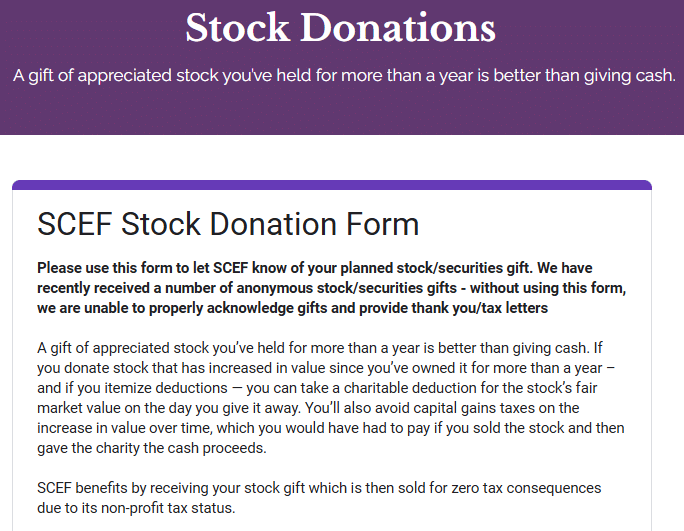
When website visitors click on or hover over your “donate” menu tab, they should see “appreciated securities” as one of the “ways to give” options.
Remember, you’re the one who needs to plant this idea. If donors see this on other charity websites, and not on yours, they’ll assume you don’t accept stock gifts.
Once you’re set up to accept appreciated assets – i.e., take stock – you’re making giving more beneficial for both your organization and your donors – so, toot your horn!
— Charity Clairity (Please use a pseudonym if you prefer to be anonymous when you submit your own question, like “Taking Stock did.)
How does your organization navigate stock donations? Let us know in the comments.
Frequently asked questions about stock donations
Should a nonprofit sell donated stock immediately or hold it?
Nonprofits generally sell donated stock immediately upon receipt. Holding stock exposes the organization to financial risk and market fluctuations; selling right away locks in the gift’s value and ensures funds are immediately available for operations or programs.
Can a nonprofit accept stock without its own brokerage account?
Yes. Nonprofits can accept stock gifts without opening a traditional brokerage account by partnering with third-party stock donation platforms, donor-advised fund (DAF) sponsors, or local community foundations that handle the transfer and remit cash proceeds.
How is the value of a donated stock gift determined?
For tax purposes, the gift value is the mean (average) between the highest and lowest quoted selling prices of the stock on the date it officially lands in the charity's account. The donor, not the nonprofit, calculates this value.
What should a stock donation acknowledgment letter include?
The tax receipt must state the donor's name, the date of receipt, the legal name of the security, and the exact number of shares transferred. Crucially, it must explicitly state that no goods or services were provided in exchange.
Do nonprofits pay taxes when they sell donated stock?
No. Qualified 501(c)(3) tax-exempt charities pay zero capital gains tax when selling donated publicly traded securities. 100% of the sale proceeds go directly toward funding the organization's mission.
What if a donor transfers stock without telling us?
Brokerages often strip donor identification during DTC transfers. If an unidentified stock gift arrives, contact your broker for the sending firm's information, post an unclaimed gifts notice internally, and remind supporters on your website to notify you before making transfers.
Are there state-specific rules for accepting stock donations?
Federal tax laws govern deduction calculations, but state solicitation rules still apply. For instance, organizations in states like California must maintain active charitable solicitation registrations with the state Attorney General and ensure gift policies comply with state-level corporate governance statutes.