

AI is showing up in every corner of the nonprofit sector right now—in your inbox, your donor software, your board meetings. But "AI" isn't one thing. It's a whole vocabulary, and not everyone in the room is starting from the same page.
That's okay. You don't need a computer science degree to use AI well. You just need clear definitions and real examples of what it looks like in practice.
So here's a glossary, written for fundraisers, not engineers. Every term includes a plain-English definition first, then a look at how it shows up inside Bloomerang. No jargon. No hype. Just clarity.
The AI terms
Agent / AI agent
Software that can take actions on its own toward a goal, rather than just answering a question. It plans steps, uses tools, and moves a task forward with limited input from you at each stage.
At Bloomerang, the Data Health Agent flags duplicate records and formatting errors in your database for immediate clean-up so your data stays clean without having to hunt down the mess yourself.
Bias (algorithmic bias)
When an AI system produces skewed or unfair results because of imbalances or blind spots in its training data.
At Bloomerang: It's a core reason human oversight and fairness are built into our approach to AI—a model is only as good as the data and design behind it, and both need ongoing scrutiny.
Automation
Getting a task done by technology instead of by hand, without repeating manual effort every time. Not all automation is AI–some is rule-based logic, like Bloomerang’s Journey Automation, but AI can make automation smarter and more responsive to what's actually happening in your data.
Chatbot / conversational AI
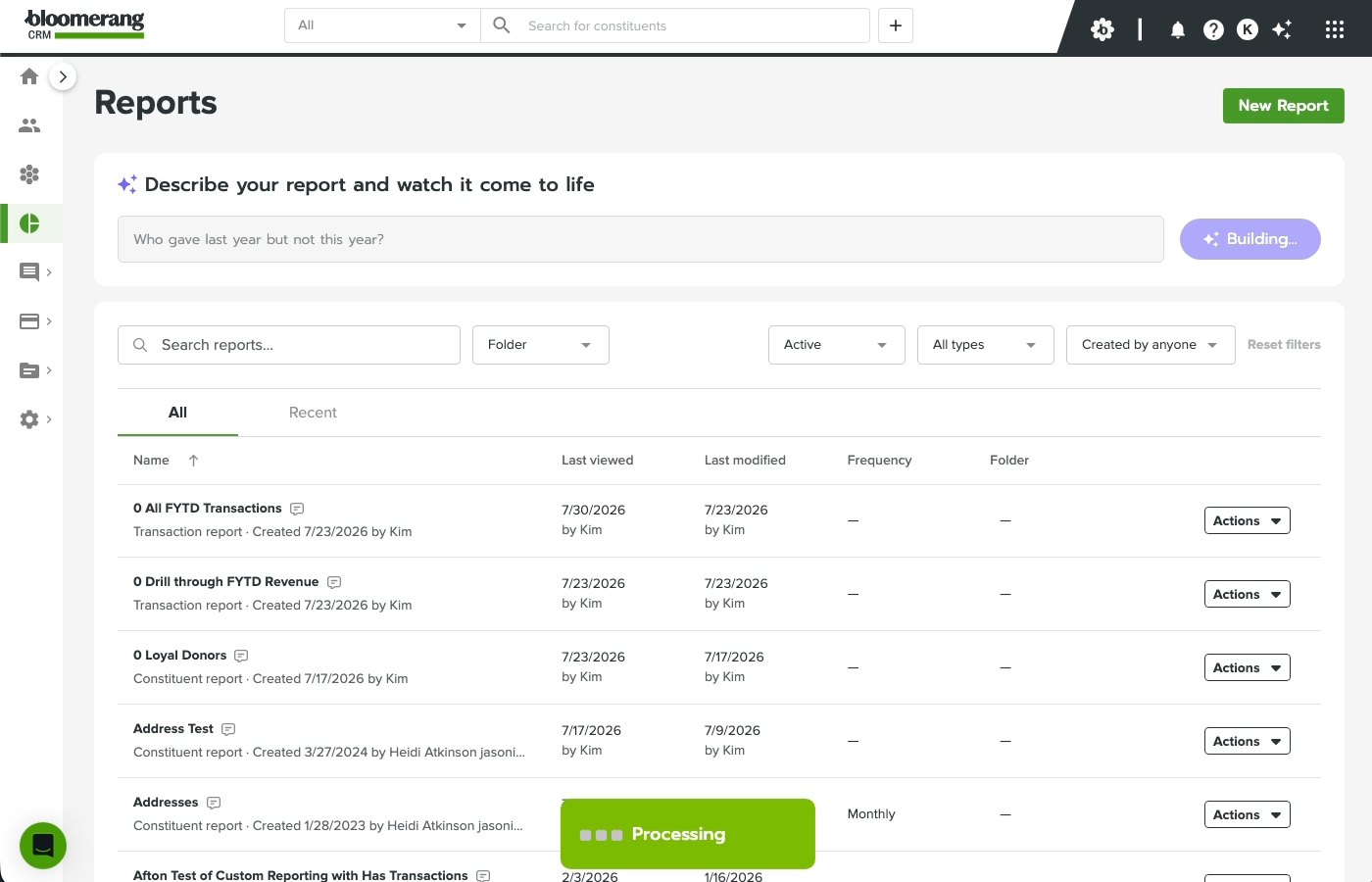
A system built to interact with people through natural conversation, in text or voice, to answer questions or complete tasks.
At Bloomerang, Penny functions this way in day-to-day use—you talk to her the way you'd talk to a teammate. Conversational reporting is the same. Simply describe what you’re looking for and you’ll have a report within minutes—reporting expertise or filters required.
Data-driven insights
Conclusions or recommendations generated by analyzing data, rather than relying on gut instinct alone.
At Bloomerang: Your predictive donor intelligence scores and daily recommended actions are both data-driven insights, built from what your donors have actually done, not assumptions about what they might do.
Hallucination (AI)
When an AI system generates information that sounds plausible but is factually wrong or made up. It's a known limitation of generative AI, not a rare glitch.
At Bloomerang: It's a real limitation of any generative AI, including LLM-powered tools like Penny, so we engineer for it instead of hoping it away. Penny grounds her answers in your organization's own data, hands calculations to purpose-built tools instead of estimating, and every change is tested against scenarios that simulate real fundraisers' questions before it ships. And because no generative AI is immune, Penny's recommendations are meant to be reviewed, not rubber-stamped. She drafts, you decide.
Generative AI
AI that creates new content—text, summaries, ideas—instead of just analyzing what already exists. Large language models are one type of generative AI.
At Bloomerang, when Penny drafts a thank-you note or a campaign summary, that's generative AI at work, giving you a starting point instead of a blank page.
Human-in-the-loop
A design approach where AI drafts or recommends, and a person reviews, edits, and approves before anything is finalized. It keeps AI as an assistant, not a decision-maker.
At Bloomerang: This is a bar we hold ourselves to, not a nice-to-have. Every AI recommendation you get from Bloomerang is built to be reviewed and approved by you—never auto-executed behind your back.
Large language model (LLM)
An AI system trained on massive amounts of text that can understand and generate human-like language. It's the technology behind most modern AI assistants and chatbots.
At Bloomerang: Conversational Reporting runs on an LLM, so you can ask a question in plain language and get a straight answer, no report-building required.
Machine learning (ML)
A method where a system learns patterns from data instead of following rules someone typed in by hand. The more relevant data it sees, the better it gets at predicting or classifying what comes next.
At Bloomerang, machine learning powers the predictive donor intelligence scores that appear on the constituent profile, learning from giving patterns to help you spot your best next move.
Your data is protected throughout—Bloomerang is SOC 2 Type II and PCI DSS Level 1 audited, so the same donor data feeding these insights stays secure. See our full security and compliance overview for details.
Pattern recognition
An AI system's ability to spot recurring trends or relationships in data that would be hard to catch by hand, especially across thousands of records.
At Bloomerang: This is how Prospect AI surfaces prospects you might have missed, by catching giving and engagement patterns publicly available on the internet. Penny is also capable of pattern recognition.
Predictive analytics / predictive insights
Using historical data to forecast what's likely to happen next, like which donors are at risk of lapsing or which prospects are ready for a bigger ask.
At Bloomerang, this is the engine behind your predictive donor intelligence scores, giving you a heads-up before a relationship cools instead of finding out after.
Prompt
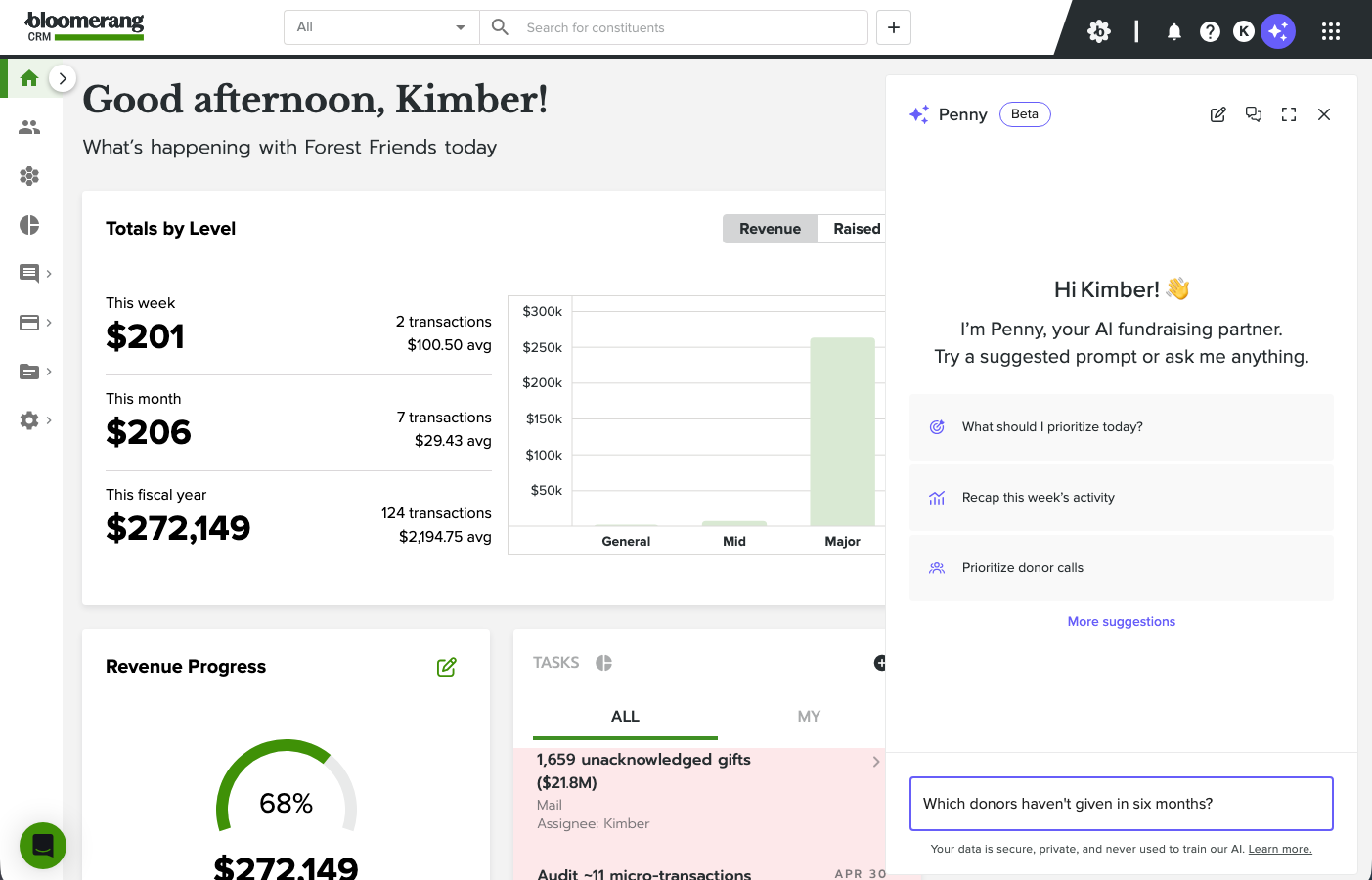
The question or instruction you give an AI system to get a response. Clearer prompts, with more context, tend to get better answers.
At Bloomerang: Ask Penny a specific question, such as “Which donors haven't given in six months?” and you'll get a sharper answer than with a vague question.
Responsible AI / ethical AI
A commitment to building and using AI in ways that are fair, transparent, secure, and accountable to the people it affects.
At Bloomerang: This isn't an afterthought for us. It's a public commitment—read our full AI principles to see the standards we hold ourselves to. We’ve also updated our terms of service to explicitly call out our commitment to data privacy in regards to AI.
Transparency (AI transparency)
Being upfront with people about when AI is involved, how it reaches its recommendations, and what data it draws on, so nothing feels like a black box.
At Bloomerang: You'll always know when things are created or based on AI inside the platform, such as with Penny, Conversational Reporting, ProspectAI reports, or the Data Health Hub.
Where this fits at Bloomerang
None of this is about replacing your judgment. It's about giving you back time and clarity, so more of your day goes toward the relationships that matter, not the busywork around them. That's what AI is built for, and it's why human oversight shows up in nearly every entry above. AI drafts and recommends. You decide.
For example, nonprofit leaders like Jim Jurgensen at The Boaz Project say:
“I talk to my staff a lot around the issue of AI that, in my opinion, it shouldn't be the first thing you start with and it shouldn't be the last thing you use... it can be helpful in the middle, especially with lack of creativity around an operational issue, forms, or policy development." - Jim Jurgensen, Managing Director
Want to see the principles behind how we build all of this? Read our AI principles and explore more AI use cases across Bloomerang’s intelligent Giving Platform.