The Donor Moment 94% of Nonprofits Miss: What a 491-Fundraiser Study Found




Summary: Bloomerang’s July 2026 Pulse Survey of 491 nonprofit professionals found that 94% lack a clear, consistent process for deciding which donors need attention next. Nonprofits struggle, not because they lack donor data, but because they don’t know how to turn the data to a clear next action. Fundraisers say the real cost of unclear focus is missing the moment a donor is ready to give more.
You Can Plan the Ask. You Can’t Schedule Readiness.
You can put every appeal, event, GivingTuesday push, renewal, and year-end campaign on a calendar.
What you can’t schedule is the moment someone becomes ready for more.
A volunteer signs up for a third shift, then makes a first gift. A donor who gives $100 every December suddenly gives $250 in May. A longtime supporter starts showing up in ways they haven’t before.
Those moments don’t wait for your next campaign.
That tension came through clearly in Bloomerang’s July 2026 Pulse Survey of 491 nonprofit professionals.
About this study: Bloomerang surveyed 491 nonprofit fundraising professionals via SurveyMonkey Between July 6-28, 2026, about how their organization prioritizes donor attention.
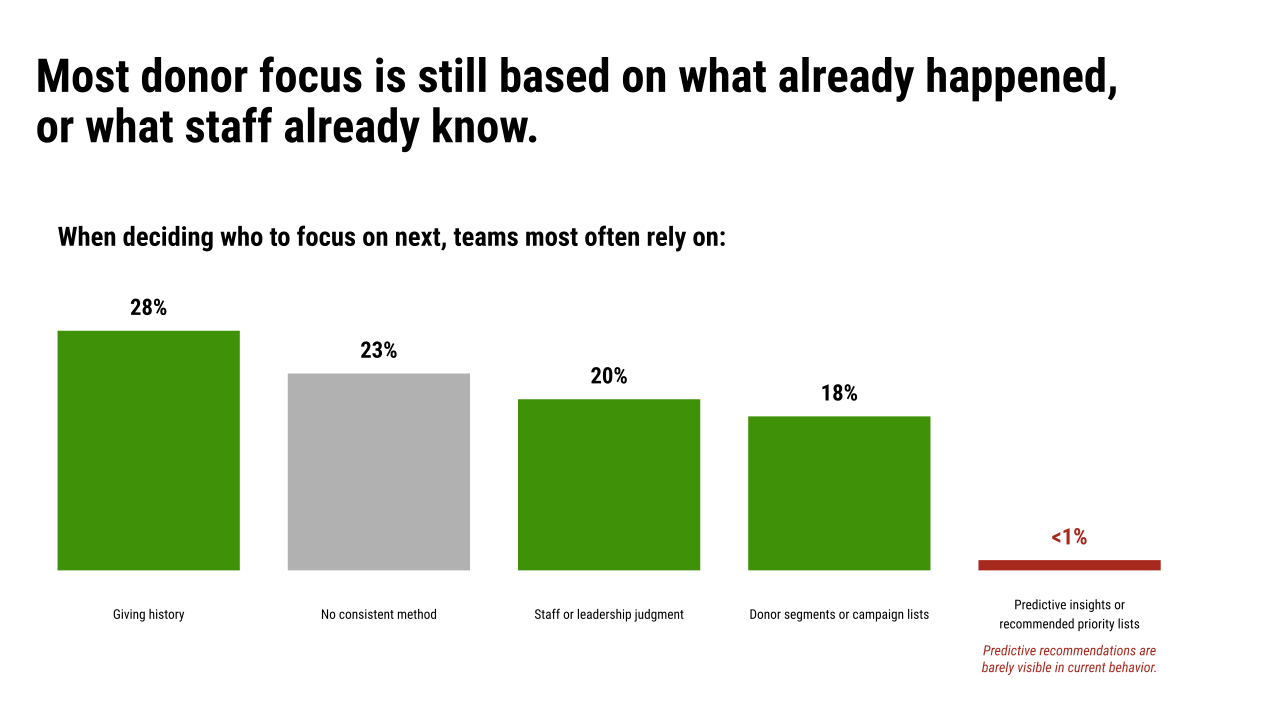
How fundraisers decide who to prioritize today
Fundraisers are split almost evenly between two approaches when deciding which donors to prioritize:
- 49% of fundraisers rely on staff knowledge, relationships, and case-by-case judgment
- 43% of fundraisers rely on manual reports, list-building, or broad campaign segments
The issue isn’t that you don’t have information. You probably have giving history, engagement, reports, conversations, campaign activity… and years of relationship knowledge.
The harder part is turning all of that into one simple answer: What needs my time most today?
Where the process breaks down
The process of deciding which donors to prioritize breaks down, not because they lack donor data, but because 57% of fundraisers lack direction turning donor information into a clear priority, or knowing what to do next.
Within that group, 31% point specifically to building a usable priority list, and 26% point to knowing what action to take once a donor is flagged.
That split shows up in familiar ways: a spreadsheet full of names with no sense of who to call first, or a flagged donor with no clear reason attached to the flag. Either way, the result is the same: good information that hasn’t yet turned into a clear decision.
What’s actually at risk
Here’s where the study’s biggest surprise shows up: when focus is unclear, the risk fundraisers feel most isn’t donor lapse.
- 59% say the biggest risk is missing a larger gift opportunity—a donor ready to upgrade, move to recurring, or give a major gift
- 63% say the hardest thing to catch in time is a donor’s readiness to give more, or knowing the right next ask
Attrition still matters, and it still deserves attention. But the data points to a bigger, quieter cost: gifts that could have grown but didn’t. The mid-level donor who was ready to step up. The loyal supporter who would’ve said yes to a bigger ask, if anyone had thought to make it.
Does organization size change the donor readiness issue?
No, organization size does not change a lack of clear direction as much as you’d expect. Growth readiness—spotting when a donor may be ready to give more, or knowing the right ask—was the hardest thing to catch for:
- 66% or organizations under $100K in revenue
- 63% of organizations between $100K-$999K
- 61% of organizations at $1M+
As organizations grow, the problem of identifying donor readiness doesn’t disappear—it just changes shape. Smaller teams are more likely to be working without much formal structure at all, leaning on relationships and memory because that’s what’s available.
Larger teams typically have more reports, lists, and segments to work with, but a bigger process brings its own risk: the one donor worth noticing can get buried under a dozen who aren’t.
Structure and staffing help. But neither one solves the issue on its own.
Now imagine a different start to your day.
You start your day and see a short list of supporters whose behavior has changed, along with the signals that explain why: One increased a gift and attended an event. Another volunteered, then donated for the first time. Someone else may be showing signs that a different conversation is worth considering.
You still decide whether to call, email, ask, wait. Or do nothing.
What is the solution to donor readiness?
The solution is to see those donor readiness signals as they happen, so the moment doesn’t pass by before anyone notices it. The solution is a shift from piecing things together after the fact to catching the moment while it still counts and acting on those signals.
But now you’re making that decision with more of the picture in front of you.
That’s where technology can be genuinely useful: Doing the background work of connecting signals across hundreds or thousands of relationships, while leaving the human decision where it belongs. With you.
At Bloomerang, that’s the future we’re working toward. Not more scores to check. Not more alerts competing for your attention. Just a clearer way to see which relationships may deserve a closer look, why they’re worth your attention now, and what you might consider doing next. That’s what Predictive Donor Insights is.
Your calendar can’t tell you when someone’s relationship with your mission is changing. But the right donor insights can.
Imagine recognizing those moments, and having the clarity to act on them as they happen.
You can’t schedule readiness. But you can be ready when it shows up.
FAQs about donor readiness
How do you know if a donor is ready to give more?
Watch for a change in behavior, not just a change in gift size: a volunteer who takes on an extra shift, then gives for the first time, or a $100 annual donor who suddenly gives $250 mid-year. Bloomerang's July 2026 Pulse Survey found 63% of fundraisers say this exact moment, spotting readiness to give more, is the hardest thing to catch in time. The signal is usually there. That's the moment worth watching for, and worth acting on.
What's the difference between donor segmentation and donor prioritization?
Segmentation groups donors by shared traits, like giving level or engagement type. Prioritization ranks who needs attention today, based on real-time signals like rising engagement or a sudden change in giving. Bloomerang's July 2026 Pulse Survey found 57% of fundraisers can build lists or segments just fine. What's hard is turning that structure into a clear next move, and that's the shift worth making.
Why do nonprofits miss donor upgrade opportunities?
Not from a lack of data. Bloomerang's July 2026 Pulse Survey of 491 fundraising professionals found 59% see missed upgrades, not donor lapse, as their biggest risk when focus is unclear, and 94% lack a consistent process for deciding who needs attention next. The information is there. Connect it in time, and that missed moment becomes a caught one.