46% of Fundraisers Say Campaigns Drive When They Ask. What About the Donor’s Moment?



September 2026 Pulse Survey | Bloomerang
Campaign calendars help fundraisers plan ahead. But meaningful changes in a supporter relationship can happen between appeals. In Bloomerang’s September 2026 Pulse Survey (n=380, Sept. 9-27, 2026), 46% of respondents said scheduled campaigns have the most influence when their organization asks for a gift, while 7% named recent supporter activity or something the supporter told them. And 51% said they learn about tracked supporter activity within days. The takeaway: Keep the calendar, and make room to respond when a relationship calls for attention.
About the research
Bloomerang conducted its September 2026 Pulse Survey, “Spotting Donor Readiness,” through SurveyMonkey from September 9–27, 2026. Of 440 respondents, 380 (n=380) answered the core questions analyzed here. The survey asked what shapes fundraising outreach, what information is available about supporters, and what happens when someone shows possible interest outside a planned campaign. These findings are directional. They describe respondents’ experiences rather than representing all nonprofits, and they do not measure what donors intend to do or how much they give.
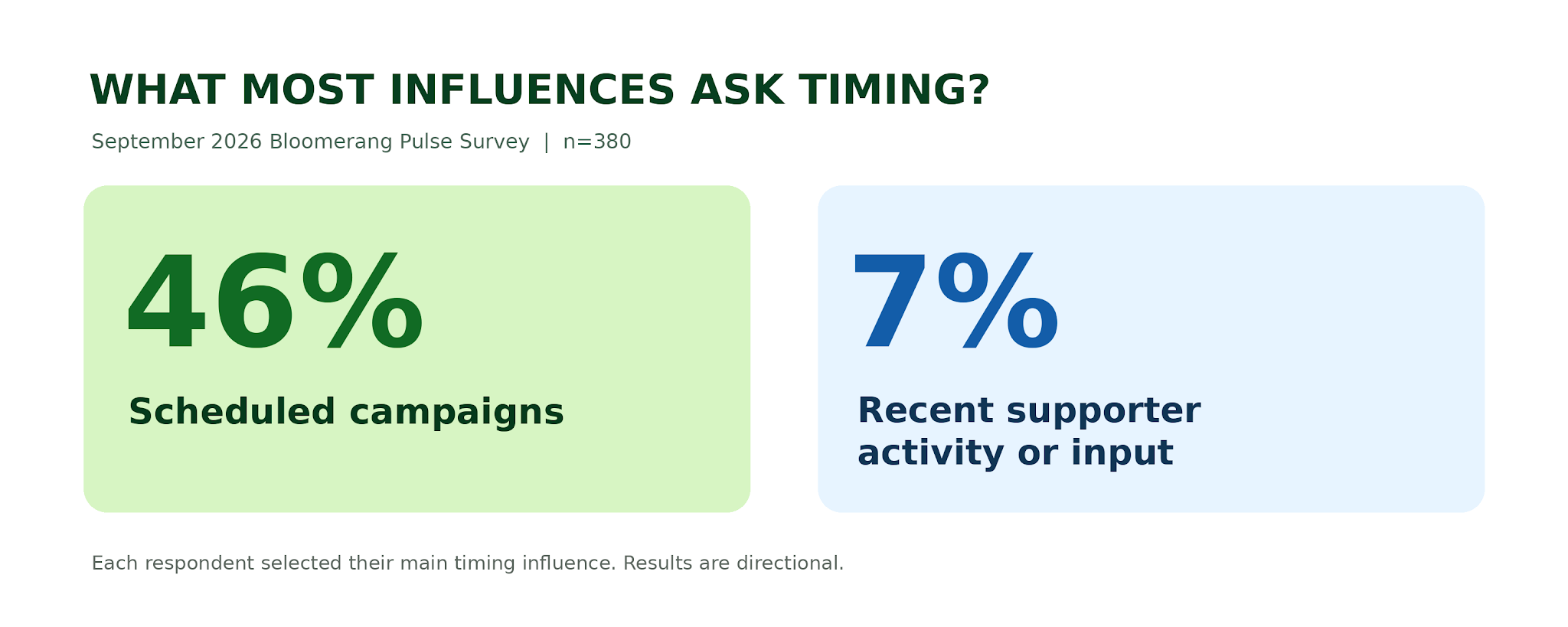
46% say the campaign calendar shapes when they ask
When asked what most influences the timing of an organization’s gift request, 46% selected scheduled campaigns, such as GivingTuesday or year-end. Just 7% selected recent supporter activity or something a supporter had told them. Another 16% chose past giving or an expected renewal date.
A calendar gives fundraising work structure. It helps you plan appeals, manage competing demands, and keep track of what needs your time. But a supporter’s interest in your mission may deepen at any point in the year. Someone might volunteer for the first time, attend a program event, or ask how their past gift made a difference. Each could be a reason to follow up thoughtfully. None, by itself, proves the person is ready to give again.
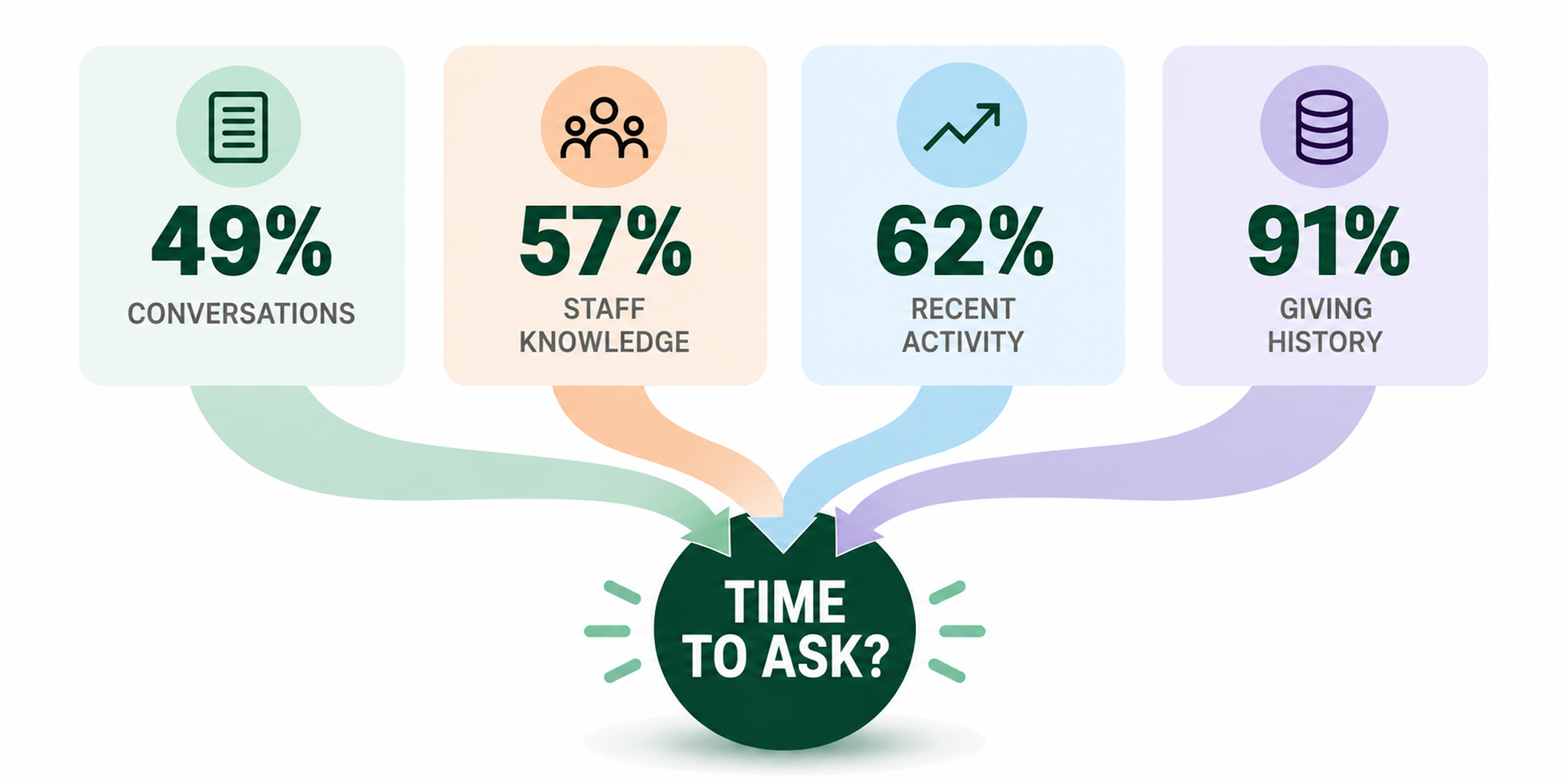
91% of fundraisers have donor giving history. Knowing what to do with it takes judgment.
Most respondents said their organization has access to past giving history (91%). Many also reported having information about recent engagement (62%), knowledge held by staff or board members that isn't recorded in one place (57%), and notes from supporter conversations (49%). Respondents could select more than one source, so these percentages overlap.
That information helps tell the story of a relationship. But one interaction rarely answers, “Is now a good time to ask?” Only 7% said one recent action by itself is usually enough to consider a gift request outside a campaign. Others look at recent activity alongside giving history (24%), wait for someone to express interest directly (16%), or decide case by case (23%).
Opening an email or attending an event can be useful information, but the relationship gives it meaning. Has the supporter shared a new interest? Is there a reason to thank them, share an update, or start a conversation? A gift request is one possible response, not the default.
51% learn about supporter activity within days, but that doesn't clarify the next step
About 51% said fundraisers learn about tracked supporter activity the same day or within a few days. Even within that group, 49% said the calendar most influences ask timing. That number describes how that one subgroup answered; it does not show cause and effect.
Getting information sooner is useful, especially when your time is limited. But an update about supporter activity is only the starting point. You still need enough context to decide whether anything needs your attention today.
65% run into a hurdle that prevents a timely follow-up
When a supporter seems ready to give outside a planned campaign, 48% said someone reaches out first. The other 52% said they review more information, talk through the situation, plan future outreach, or wait until the next campaign. Taking time to understand the situation can be the right choice. The question is whether there's a clear, manageable next step.
Here’s what respondents named as an obstacle for reaching out:
For someone balancing appeals, events, acknowledgments, and donor conversations, even a worthwhile follow-up needs a place in the day.
Keep the calendar. Add the donor’s moment.
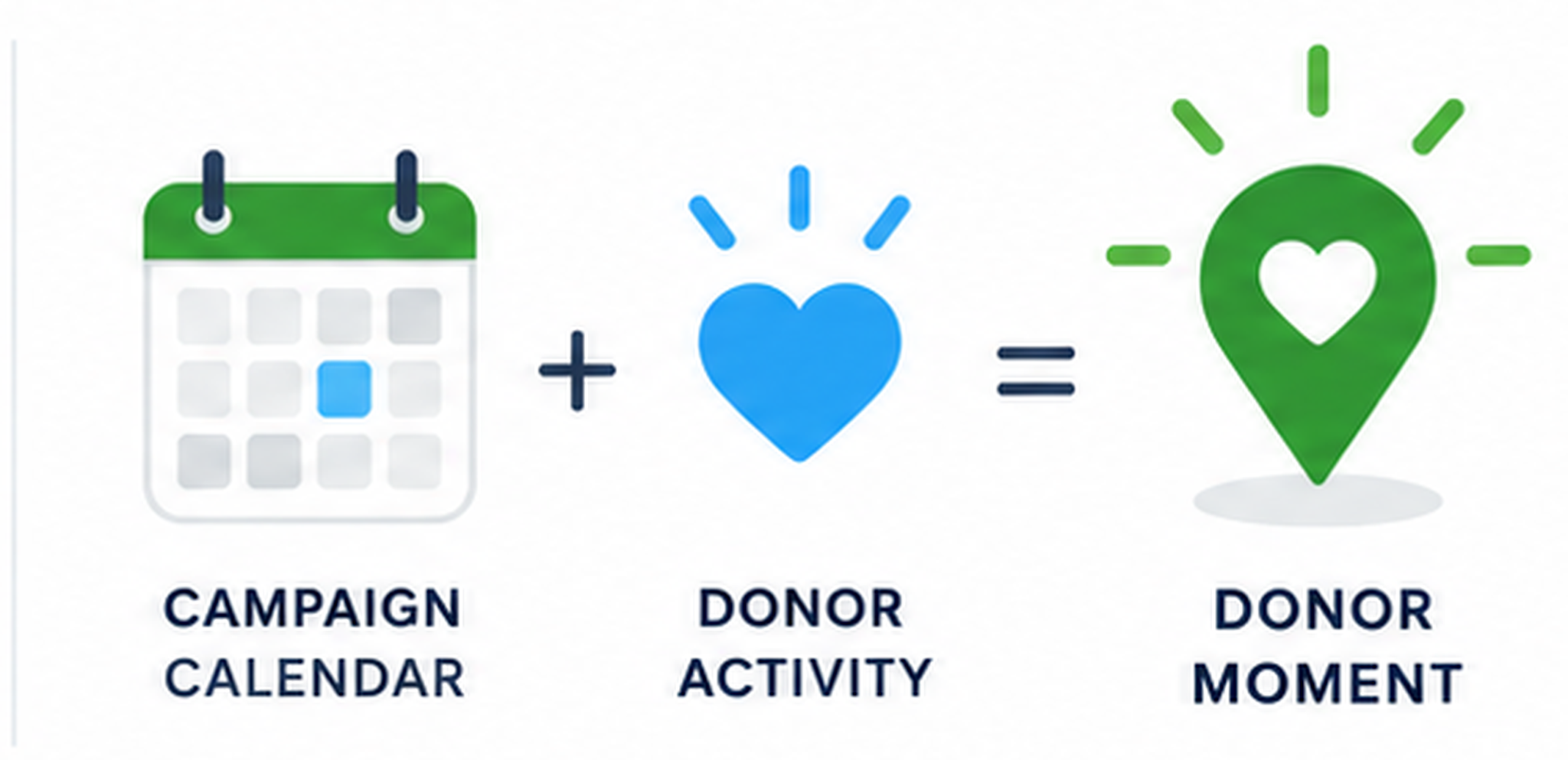
Keep the campaigns you've worked hard to plan. Alongside them, make a little room to notice when something changes in a supporter relationship and consider what response would be helpful. We call this “the donor’s moment.” It's our way of thinking about the research, not a term respondents used or a promise that any signal can tell you exactly when someone is ready to give.
Here's a hypothetical example. A longtime supporter starts volunteering, comes to a program event, and asks how an initiative is going. You might send a personal thank-you or invite them to talk about what interests them. There's no need to turn that engagement into an immediate ask. If someone instead tells you they'd like to help fund a new project, a conversation about giving may be welcome. Let the person and the relationship guide the response.
Three questions to help you decide what deserves your time
1. WHAT CHANGED? Check giving history, event attendance, volunteer participation, and conversations you have access to. Look for meaningful changes, not just more activity.
2. WHAT DOES IT MEAN FOR THIS PERSON? Consider what they care about, what they've told you, and the history of your relationship before deciding whether to reach out.
3. WHAT NEEDS MY TIME NEXT? A thank-you, a check-in, an impact update, a conversation about giving, or no immediate action may all be reasonable. Choose what fits, then make a manageable plan to follow through.
How connected information can make donor stewardship easier
When giving records, engagement history, and volunteer activity are easier to see together, you can spend less time piecing together information and more time thinking about the relationship. Bloomerang's Giving Platform™ connects donor management, fundraising, and volunteer engagement. Its predictive donor intelligence and recommended actions can help identify supporters who may deserve attention. You review the context and decide what, if anything, to do next. Your supporter information should be handled according to your organization's privacy practices and the platform's applicable data protections.
Give donor moments a place in your year-end plan
Before your next appeal goes out, take a few minutes to consider:
- Who has shown new interest?
- What do I know about their relationship with our organization?
- What, if anything, needs my time now?
Even a short weekly check can help you give these relationships thoughtful attention alongside the work already on your calendar. The goal is to respond well, not to turn every interaction into another ask.
Frequently asked questions
What is donor-readiness?
Donor readiness is information that describes whether a supporter would welcome a conversation about giving. Past gifts, recent involvement, and something the person has told you can all provide useful context. None proves that someone intends to give. In Bloomerang's September 2026 Pulse Survey (n=380), only 7% said one recent action alone is usually enough to consider an ask outside a campaign.
How do you know when a donor is ready to give again?
Look at several things together: giving history, recent engagement, volunteer or event activity, and anything the donor has said directly. In the survey, 24% weigh recent activity alongside giving history, 23% decide case by case, and 16% wait for the donor to express interest.
Does opening an email mean someone is ready to give?
No. Opening an email may tell you someone saw a message, but it doesn't tell you whether they want to give. Look at the broader relationship, including giving history and what they've shared with you.
What percentage of nonprofits time asks around campaign calendars?
In Bloomerang's September 2026 Pulse Survey, 46% said scheduled campaigns such as GivingTuesday or year-end most influence when they ask. Another 16% said past giving or an expected renewal date, and 7% said recent supporter activity. The results are directional and don't represent all nonprofits.
Why do nonprofits fail to follow up with donors on time?
65% named a barrier: 37% limited time, unclear ownership, or coordination; 15% unsure the supporter was ready; 13% unsure what to say or do next.
How should nonprofits balance campaign calendars with timely donor outreach?
Keep the calendar and add a short weekly check for meaningful changes in supporter relationships. Ask what changed, what it means for this person, and what needs your time next. A thank-you, a check-in, or no action can all be right.
How fast do fundraisers learn about donor activity?
51% said they learn about tracked supporter activity the same day or within a few days. Faster information doesn't always make the next step clearer, and 49% of that group still said the calendar drives their ask timing.
What information do nonprofits have about donors?
91% have giving history, 62% have recent engagement data, 57% have knowledge held by staff or board members that isn't recorded in one place, and 49% have notes from supporter conversations. Respondents could pick more than one.