Fundraising Appeal Examples: Building Relevancy and Urgency




For every nonprofit, there is something happening in the world right now that directly impacts your work—from shifting legislative decisions to local emergencies. That context is your relevancy.
But you also face immediate, on-the-ground challenges. Your most pressing problem—whether it is a sudden surge in demand for your services or a critical lack of resources—creates your urgency.
The good news? Most people genuinely want to help. They are actively looking for opportunities to make the world a better place; they just aren’t sure where their dollars will make the biggest impact right now. It is your job to make a compelling, immediate case for your mission.
In this guide, we are breaking down two specific, real-world fundraising appeal examples to show you exactly what works (and what doesn't). Read on for a deep dive into these annotated letters, alongside actionable best practices, a proven template, and copywriting tips to help you craft appeals that drive revenue today.
People give emotionally, not rationally
Stories draw people in. Stories compel; data repels. Anything in your appeal that makes folks pause and think too hard is not a good thing.
“Stories sell. Statistics tell.
Stories are for everyone. Statistics are for specialists.
Stories need no translation. Statistics do.” — Tom Ahern, professional fundraising copywriter
Save statistics for your thank you letter, newsletter, and annual report. It’s swell to use numbers to reinforce a donor’s decision after they’ve decided to give to you. It’s a great idea to prevent “buyer’s remorse,” offering proof that their emotional decision was also a rational one. This will help persuade donors to give again.
Make it personal
For the appeal itself, focus on emotion. Stories bring the emotion home in ways no dry recitation of the issues can accomplish. For example:
- 225,000 deaths are impersonal. A story about one person or one family who suffered, especially if they are described in a manner to which the donor can personally relate, can bring a lump to their throat.
- Percentages of people in one racial or ethnic group who are disproportionately affected by a problem are impersonal. A story about one person who was unfairly or cruelly treated, especially if the donor can imagine themselves or someone they know being in that situation, will bring a tear to their eye.
These lump-in-the-throat, tear-inducing emotions will cause donors to reach for their checkbooks.
Be specific
Stories bring the urgency to light in ways vague statements cannot. When a prospective donor is confronted with a black-and-white proposition—help or don’t help—there’s nothing vague about the ask; the donor can clearly visualize the cure. For example, “Now more than ever we must act” is such an overused statement that it goes unnoticed. “Children will go without dinners next month, unless you help,” causes the reader to sit up and take notice.
Real urgency in your fundraising appeal can be visualized. And when donors can see the harm that will result if they fail to act, they are moved to avoid it. Fear of loss weighs more heavily on people than hope of gain. This is important as it causes the donor to think from a perspective of generosity (If I don’t give, children will never be reunited with their parents) rather than greed (If I give, I won’t be able to buy a new painting).
Let’s look at how these rules of emotion, relevancy, and urgency play out in the real world.
A model fundraising appeal opening (template)
If you are struggling to find the right words to build immediate urgency and relevance, start with a single, specific person. Instead of relying on vague statements about the economy or a crisis, ground the problem in a human experience.
Here is a model opening you can adapt for your own organization:
"Diane received devastating news last month when she learned her paid internship was canceled due to sudden company budget cuts. The work experience she needed to land her dream job as a machinist was now out of reach and, worse, she’d no longer receive the paycheck needed to continue living in her studio apartment."
Why this template works:
- It introduces a protagonist: The reader immediately pictures "Diane," not a faceless statistic.
- It establishes relevance: It anchors the story in a real-world obstacle (in this case, budget cuts) that donors understand and can sympathize with.
- It creates urgency: It outlines a specific, escalating timeline of loss—losing an internship, losing a career path, and facing immediate housing insecurity. The donor can visualize exactly what will happen if they do not intervene now.
Fundraising appeal examples by sector
Different types of organizations naturally face different types of urgency. While the hospital and job training examples above cover broad nonprofit sectors, here is how you can apply the principles of relevancy and urgency to other highly searched categories:
For schools and higher education
School appeals often fall into the trap of focusing on institutional prestige or building funds. To create urgency, focus on the immediate student experience or a timely matching opportunity.
- Relevancy: Tie the appeal to the current academic calendar (e.g., "As seniors prepare for their final semester...") or a specific community challenge affecting student life.
- Urgency: Highlight a time-bound gap, such as "If we do not secure funding for the emergency textbook grant by August 15th, 40 incoming freshmen will start the semester without the materials they need to pass their core classes."
For churches and faith-based organizations
Faith-based appeals are great for community-building but can sometimes lack a compelling "why now." Frame your appeal around a specific, immediate outreach need rather than general operational costs.
- Relevancy: Connect the ask to the current season, a local event, or a specific spiritual milestone in the community.
- Urgency: Focus on the human cost of inaction, e.g., "Winter is arriving early this year, and our community pantry is already empty. We need to raise $5,000 by this Sunday to ensure the 50 families who rely on our ministry have hot meals next week."
For animal shelters and rescues
Animal welfare organizations have a natural emotional pull, but appeals can easily become generic if they only ask for general daily care funds. To create urgency, avoid generalities and spotlight a specific, immediate crisis or seasonal influx.
- Relevancy: Connect to seasonal challenges (like the spring "kitten season" or extreme winter weather) or a recent, specific large-scale rescue operation that your community is aware of.
- Urgency: Focus on capacity limits or immediate medical needs, e.g., "We just took in a litter of six puppies found freezing in the snow, and our medical ward is completely at capacity. We need $1,200 by tomorrow morning to cover their emergency veterinary care and ensure they survive the weekend."
For arts and culture organizations
Theaters, museums, and community arts programs often struggle to communicate life-or-death urgency. The key is to pivot away from general operating support and focus on the immediate threat to a specific program or the loss of community access.
- Relevancy: Tie the appeal to an upcoming exhibit, opening night, or recent cuts to local public school arts programs that your organization is trying to offset.
- Urgency: Clearly outline what disappears without immediate support, e.g., "Our free after-school theater program for at-risk teens is slated to be cut next month due to lost grant funding. If we don't raise $8,000 by Friday, 30 students will lose their only safe, creative outlet this semester."
Email vs. direct mail appeals
While the core principles of urgency and relevancy apply to both direct mail and email, your execution must adapt to how donors consume them. Direct mail allows for longer, tactile storytelling where you can control the pacing. Email requires you to be much faster, punchier, and highly scannable.
If you are sending an email appeal, the sense of urgency must begin before the donor even opens the message.
Email subject line strategies
Your subject line is your first (and sometimes only) chance to establish urgency. Avoid generic titles like "Fall Newsletter" or "Update from Our Director." Your subject line should be:
- Urgent and specific: "Diane is facing eviction next week"
- Action-oriented: "Will you step in before our midnight deadline?"
Email body best practices
- Get to the ask faster: Don't wait until the fourth paragraph. Introduce the problem, the specific person affected, and the solution (the donor's gift) within the first 150 words.
- Use bolding strategically: Guide the reader's eye to the most urgent phrases and the specific impact of their gift.
- Make the button clear: Instead of a generic "Donate," use an action-driven button like "Help Diane Keep Her Home Today."
Example fundraising appeals
1. Nonprofit hospital appeal (one page, two-sided)
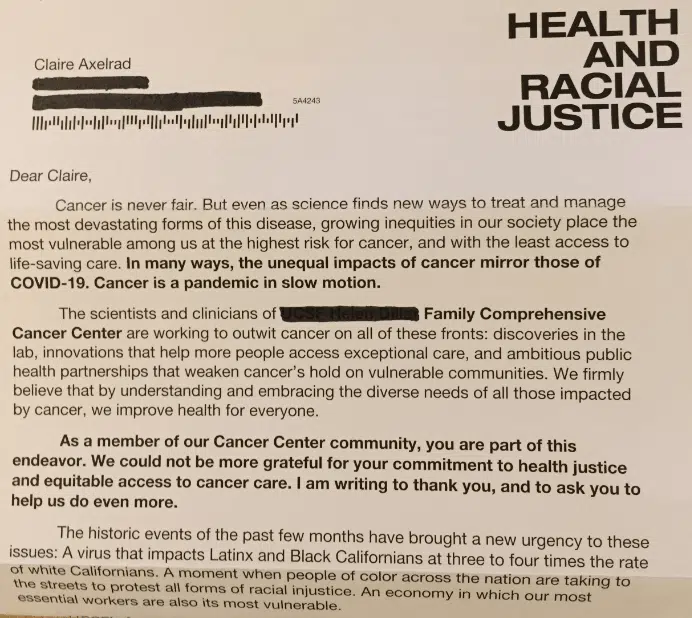
GOOD
- The “Health and Racial Justice” header establishes relevance. We know from eye-tracking studies that one of the first places the reader’s eye goes to is the upper right-hand corner. Especially to big bold headlines and images. This alerted me that the appeal was not just about bread-and-butter cancer prevention or research but also concerned one of today’s hot-button issues.
- The first paragraph, especially the first sentence and concluding text in boldface, continues to establish relevance. “Cancer is never fair.” They know the reader has been thinking a lot about fairness lately, so this is a good hook to get folks to read further. “In many ways, the unequal impacts of cancer mirror those of COVID-19. Cancer is a pandemic in slow motion.” This is pretty brilliant. They’ve got inside my head. I WANT TO DEFEAT PANDEMICS. And COVID-19 isn’t the only battle around. Or the only pandemic with unequal impacts.
- The second paragraph outlines how my gift will be used. This is always an important element of good fundraising appeal examples, and they put it in the context of how these initiatives will also embrace equity and diversity, tying the appeal to top-of-mind issues.
- The third paragraph cements relevance, reminding me I’m a ‘member’ of a community committed to health justice and equitable access. It also introduces an “ask” early in the letter, rather than waiting until the very end to get to the point.
- The fourth paragraph establishes urgency. “The historic events of the past few months have brought a new urgency to these issues…” These are then enumerated.
- The ensuing paragraphs include many more good lines that establish both relevance and urgency. (To save space, and since these fundraising appeal examples are difficult to photograph well, I’ve omitted the visual for the rest of the letter.) Suffice it to note the hospital proposes to:
- “Target the root causes of cancer in underserved neighborhoods”
- “Uncover how racial disparities in physician-patient communication contribute to a much higher mortality rate for African American men with prostate cancer.”
- “Develop a training program to help cancer clinicians serve these patients better.”
- “Do educational outreach to immigrant residents and other vulnerable groups.”
- “Identify new targets for precision cancer therapies in minority patients.”
- “Reduce the financial and cultural barriers that prevent people of color from participating in lifesaving clinical trials.
- The closing two paragraphs of this letter cement both relevance and urgency:
- “As a translational biologist and laboratory researcher, I began my career looking for ways to outmaneuver cancer in the lab. But the longer I work in this field, the more I realize that basic science is just one device in our toolkit.
- We know we still have much work to do. With your support, we will continue to reach out to communities hardest hit by cancer, and amplify their demands for better prevention and screening, and more equitable care. Together, we can make this a place where social justice always guides how we engage in cancer care, research and education.”
- The ask is made in the P.S. (and on the attached remit device, which is not depicted here). It continues to make the case today, relating the Cancer Center’s work to issues currently in the news.
- There is an inserted buck slip describing the hospital’s “ongoing response to COVID-19.” Sometimes inserts can depress response because they distract from the appeal’s urgency. In this case, however, reminding readers we’re not in normal times is a slam dunk for a hospital, since they’re truly on the front lines. Yet not every such institution does a similarly effective job. Here, they go further than simply stating the obvious. They add a URL to find out more about symptoms, prevention, and “practical advice you can use to keep the people you care about healthy and safe.” This is another way they double down on demonstrating relevance (they’re there to take care of you and yours) and urgency (we’re still in the midst of this ongoing crisis).
- Finally, having nothing to do with relevance or urgency, but just with good practice, I confess to a bias toward using all available real estate. In other words, one piece of paper has two sides! Why squeeze all the print onto the front in a too-small font when you can spread it out, make it more readable, include a bit more compelling information, and repeat the ask? This letter appears to me to be in 14-point type, which for me is today’s gold standard (Boomers are the largest cohort of donors, and they have trouble reading teensy type). The paragraphs are indented, which leads the reader into the copy and gives it a bit of oxygen.
NOT SO GOOD
It could have a more specific dollar ask, but I’m not a major donor, so they probably would be guessing. And the remit has a decent range of suggestions from $25 to $500, plus an “other” (which you should always have). This appeal is a home run.
2. Jobs training appeal (one page, one-sided)
GOOD(ish)
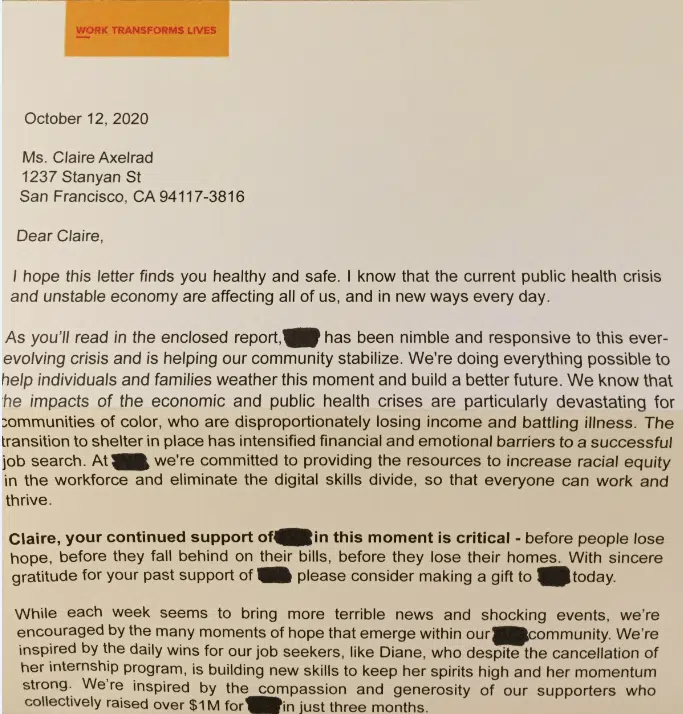
- The opening sentence acknowledges that the reader is concerned about health and safety, and likely worried about uncertainty. This puts the donor in the letter from the get-go, which is always a good idea. Alas, the second sentence is vague. Overall, this opening paragraph isn’t likely to grab anyone’s attention. In fact, if the reader happens to be unwell, it may just stop them dead in their tracks.
What if it had begun more like this instead?
“I’ve never been so inundated with requests from people suffering devastating losses, and hope with all my heart you and yours are healthy and safe.”
- There is an attempt to tell the story of one person impacted by current events. Telling one story is the very best way to help readers visualize the problem you’re asking them to address. Alas, they waited until the fourth paragraph and didn’t provide enough detail for folks to understand or relate to the protagonist.
NOT SO GOOD
- The second paragraph aims to be relevant by highlighting the work they’ve done to help communities disproportionately affected by racial, financial, emotional, and health barriers. However, unlike the hospital letter, the emphasis is on the past more than the future. “As you’ll read in the enclosed report… (This describes all the previous good stuff they’ve done).
- There is too much jargon and imprecision in the language used to be impactful. When you write to a donor, your goal should be to help them visualize both the problem and the solution to which they’re being asked to contribute. Vague bromides won’t cut it. What do you picture with any of the phrases used in this letter?
- “Everything possible.” Specifically?
- “weather the moment” How?
- “build a better future.” What might that look like?
- “impacts of the economic and public health crises.” Can these be named?
- “resources to increase racial equity in the workforce and eliminate the digital skills divide.” Noble and relevant, but… what are these resources and how will they achieve their intended goal?
- The third paragraph makes a well-intentioned stab at urgency, yet there’s a big disconnect. People don’t come to this agency until they’re out of work. So how can my giving now help them “before they lose hope, before they fall behind…?” It’s uncertain, and verges into one of my copywriting pet peeves – the myth that giving people hope will inspire their giving. People cannot visualize hope. It’s why you’ll never see a panhandler with a placard saying “Give me hope.” “Need food for my 2 kids” is more concrete and more inspiring.
- The fourth paragraph again tries for relevance by alluding to “terrible news” and “shocking events,” yet these are too vague to be visualized, internalized or understood in any way that might elicit empathy. Fundamentally, you want your readers to relate to someone specific in a story you’re telling. Someone specific who needs their help right now. Someone specific for whom they can be a hero. The fact that folks who work for this nonprofit are encouraged by “moments of hope” is lovely for them, but this is not donor-centered copywriting.
- The last sentence of the fourth paragraph negates urgency and will depress response. What does this make you think? “We’re inspired by the compassion and generosity of our supporters who collectively raised over $1M for [name of charity] in just three months.” It makes me think they don’t need my money right now!
- At first blush, having nothing to do with relevance or urgency but just with good practice, this letter appears to be suffering from one of the symptoms of CEO-itis. This is the dread disease whereby the person at the head of the organization (sometimes it’s the board president), who is not a development professional, insists that people won’t read a letter longer than one page. This letter appears to be in 11-point type. The paragraphs are not indented, so it gives the eyes no rest.
- One other problem: Though I did not show it in the photo below for privacy reasons, the right-hand side of the letter is completely taken up by a list of the board of directors. Remember the eye-tracking studies showing the upper right-hand side of a letter is one of the prime pieces of real estate? If you must list your board, don’t put it here. Try the left-hand side or the bottom of the letter. While including your board list can be useful if you’re a small community, your board members are well known, and you believe your constituents will be influenced to follow these folks, there are generally more reasons to leave the names off than to put them on:
- First, it’s distracting. It’s a lot of copy (here it’s 25 board members and 24 past presidents), and folks will spend a lot of their time reading the list.
- Second, some folks will put the letter aside if they don’t recognize any of the names.
- Third, it detracts from positioning the donor as the hero; they may seem unnecessary if there are already many other known ‘rich folks’ on board.
Relevant & Urgent Fundraising Appeals: FAQs
What makes a good fundraising appeal?
A good fundraising appeal is built on relevance (why this matters in the current world) and urgency (why the donor must act right now). It centers the donor as the hero of the story, clearly showing them how their individual gift will solve a specific problem.
What should a fundraising appeal letter include?
An effective appeal letter should include a strong hook that establishes relevance, a story about one specific person or situation to build emotional connection, a clear articulation of what will happen if the donor does not help (urgency), and a direct, specific financial ask. It should avoid jargon, dense paragraphs, and confusing statistics.
How do you create urgency in a fundraising appeal?
Create urgency by clearly illustrating the harm that will result if the donor fails to act. People are heavily motivated by the fear of loss. Instead of vague statements like "now more than ever," use concrete timelines and consequences (e.g., "Without your help today, this shelter will turn away 20 families this weekend").
Should appeals use statistics or stories?
Always use stories in your appeals. Stories trigger the emotional responses required to motivate giving, while statistics force the brain into a rational, analytical mode that repels generosity. Save the statistics for thank-you letters, annual reports, and newsletters to validate donors' emotional decisions after they have already made their gifts.
Wrapping up
Donors can handle the truth. They want to help, but need you to describe the current opportunity in compelling terms they can understand. With these tips, you’ll be able to craft a winning appeal that speaks to people’s hearts.