What Donors Are Actually Telling You: Giving Motivations From the 2026 Giving Signals Report
.png)



You've heard the headlines. Donations declining. Trust eroding. Donors pulling back.
But abundance is always out there if you know where to look.
Here's what the data actually says.
Bloomerang surveyed more than 1,000 active donors and 400 fundraising decision-makers for the 2026 Giving Signals Report, and what came back wasn't a crisis. It was a clear signal. Donors are still deeply engaged, still eager to connect, and handing us a remarkably direct map of what earns a joyful "yes!"
Two findings stand out as essential for any for-purpose leader who wants to stop the guesswork and start igniting true connection: understanding exactly why people give and mastering what moves them from caring to acting.
Generosity endures (and it’s not about the pocketbook)
When donors were asked what motivates them to give, their answers had nothing to do with tax write-offs or having extra cash burning a hole in their pockets.
- 97% say simply caring about their communities motivates them.
- 96% say they give because they care about the future.
- 92% view giving as a core part of their personal identity.
Meanwhile, just 68% say "having money to give" is a primary motivator.
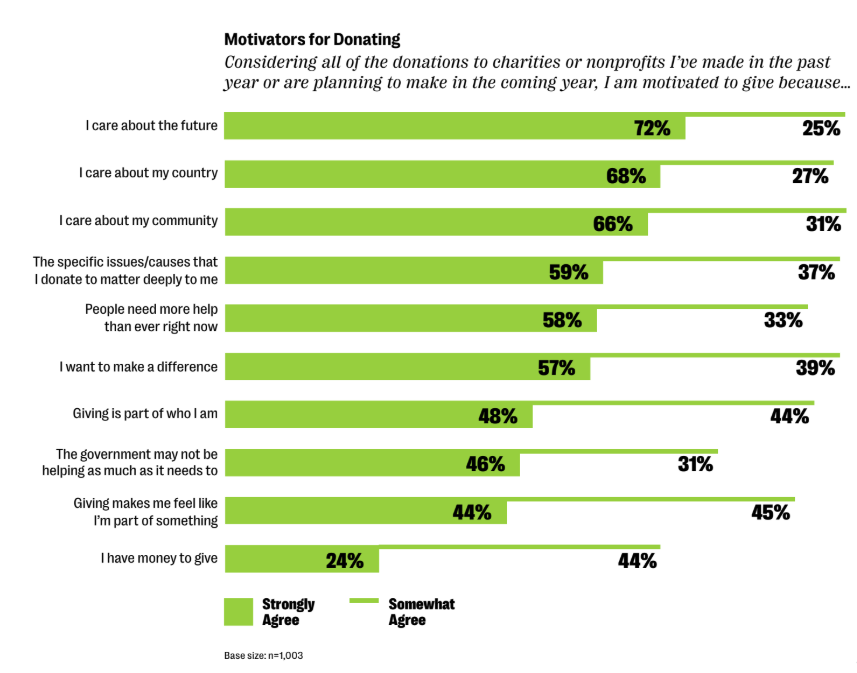
The desire to create change completely outweighs the financial means to do it. That’s a fundamental truth about what generosity actually is. Giving is a values-led act. Donors aren't responding to a line item—they’re giving because supporting your nonprofit says something true about them.
Belonging is a massive piece of that puzzle, too. 87% of donors say they’re motivated by organizations that make them feel like they're part of something. For first-time donors, that desire for belonging ranks among their top three motivators at a rate nearly 20 percentage points higher than for repeat donors. The opportunity to support your mission is an inspiring invitation for donors to support something bigger than themselves.
Nonprofits lead the mission—but donors put purpose in motion
If your appeals lead with organizational need or financial urgency, you might be missing the real heartbeat of your community. Remember, donor identity is strongly connected to why donors give—96% say they are driven to give by a fierce desire to make a difference. Your strongest appeals won't lead with what your organization does. They'll lead with who your donor is when they give.
Most fundraising copy accidentally centers the organization. "We save lives." "We serve families." "We plant trees." That's all important work you do, but it puts your nonprofit at the center of the story. The donor becomes an afterthought.
What moves people is seeing their own values reflected in the mission. Copy that validates their identity hits differently:
Instead of: "Your gift helps us continue our vital mission."
Try this: "You are someone who refuses to look away when a neighbor is in need."
One confirms a transaction—the other celebrates a partnership to purpose.
Caring is the starting point. Clarity is what seals it.
Motivation gets donors to your door. Clarity gets them through it.
Donors are hungry for specificity. While 98% are motivated to give to issues they care about, the ultimate decision relies on knowing exactly what a gift will unlock:
- 94% are motivated when a nonprofit tells them exactly where their money goes.
- 90% say they are driven by a clear explanation of the intended outcome.
Look at how a minor shift in copy completely changes the results.
A typical appeal may say: "Your gift today helps us continue our vital work serving families in need. Every dollar makes a difference."
A more tangible version would be: "$50 buys a week of groceries for a family in our pantry program. $200 keeps the lights on at our family resource center for a day. Where would you like your gift to go?"
Donors preferred the more specific version by a staggering 88 percentage points. That means more vague appeals leave significant funding on the table when supporters are actively looking for concrete details.
The 3-part ask for next-level impact
The data points to a clear framework for what a strong fundraising ask looks like. To take your asks to the next level, treat your appeals like a bridge tied to real-world outcomes. A successful ask seamlessly connects three elements:
- The cause: Aligning with the exact community issues your donor cares about.
- The use of funds: Showing a concrete line of sight between a dollar given and a tangible outcome.
- The proof: Giving them total confidence through transparency, data, and real stories.
When all three are present, the ask becomes a decision. Supporter defense mechanisms drop, and giving feels like a natural, joyful extension of a relationship rather than a chore.
Put insights into action
You don't need a massive team or hundreds of extra hours to apply these changes. Just take a look at your current appeal and ask yourself: Does it speak to who your donors are? Does it give them one specific, tangible outcome to picture?
Rethink your thank-you, too. Instead of thanking donors for a generous gift, thank them for who they are. A helper. A friend. A person who refuses to look away. That's not just a warmer note. It reinforces the identity that moved them to give in the first place.
Donors aren't tuning out. They're sending clear signals. Ready to map out your next campaign with total certainty?
Download the full 2026 Giving Signals Report from Bloomerang today and get the strategic insights you need to know who to ask, when to ask, and how to win more support with every single appeal.