How to Thank Monthly Donors: Best Ways to Show Appreciation




You can never thank monthly donors too much.
Yes, it’s work. But the effort is well worth the investment. Because donors who feel appreciated give more and more often, increasing their lifetime value.
Let’s explore the best ways to show appreciation to monthly donors to encourage long-term commitment and giving upgrades.
Why thanking monthly donors matters (retention + upgrade math)
But, wait. You say monthly donors are already giving more often? True. But… they’re free to stop at any time. They’re also free to make a larger commitment at any time. That’s what you really hope for. Because a $50/month donor ($600/year) can easily become a $60 donor ($720) without batting an eye. If you have 100 donors doing this, you’ll generate an additional $12,000. 1,000 donors? $120,000. That’s so much easier than trying to get one or two major donors to give you this sum.
Research shows the average nonprofit in the U.S. loses 82% of donors after the first gift. Overall donor retention is only 45%. By the time you’ve added a new donor, a majority of your previous donors are out the door.
However, researcher Penelope Burk found that 45% of donors said it was an outstanding thank-you letter that inspired them to give again. 23% said they gave more generously because of the quality of the acknowledgment they received. This data demonstrates that prompt, thoughtful appreciation letters can mean the difference between a lapsed donor and a retained, long-term supporter.
The 3 Ps of donor acknowledgment: Prompt, Personal, Powerful
When Penelope Burk’s groundbreaking Donor-Centered Fundraising research came out, I was bowled over by the primary finding that if nonprofits did just three things, donors would likely give again. Or give more. What was this holy trinity? I call them the “3 ‘P’s”:
- Prompt thank you.
- Personal thank you.
- Powerful demonstration of the gift’s impact.
The more you can incorporate this trinity into your ongoing donor acknowledgment, recognition, and communications program, the greater success you will have in retaining and upgrading donors.
Fundamentally, they’re all about demonstrating gratitude. Not a receipt. But something that demonstrates a grateful feeling, acknowledging the donor did you a favor.
What a gratitude program does for your organization
Don’t say “thank you” once, then ignore a donor until your next appeal. You need to plan communications that engage donors without an ask, express gratitude, and show how they made a difference.
The benefits of gratitude are enormous. It makes you happy. It makes others happy. It makes others like you. It also makes you healthier, boosts your career, strengthens positive emotions, increases optimism, reduces materialism, increases spirituality, and enhances self-esteem. It does all these things for both the gratitude giver and the gratitude recipient.
When it comes to building love and loyalty, a properly executed gratitude program has no downside. It will help you:
- Establish your humanity. As long as you’re not robotic and show some natural human emotion about the impact your donor has made. Be polite, appreciative, grateful, and glowing.
- Show you can be trusted. Trust is the foundation of any lasting relationship. Donors need to know you follow through. “Thank you” shows you got the gift and will put it to work as intended. It’s a simple, and vital, thing.
- Give your donor meaning. Sadly, giving isn’t always its own reward. People need validation. Pats on the back. Reinforcement that they did a good deed. Otherwise, they won’t get the sought-after endorphin rush that brings a warm glow – one where they see themselves reflected in the mirror as the ‘good person’ they hope to be.
- Build the relationship. Research shows that for gratitude to really be effective, it must be repeated. Across multiple channels in multiple ways. This will make your donor feel loved. When we’re loved, we’re likely to return the favor.
6 keys to effectively thank monthly donors
There is a HUGE difference between thank-yous that fulfill the requirement of acknowledging gifts and thank-yous that inspire donor love and devotion. Don’t forget: monthly donors are some of your best bets for legacy gifts. So, keeping them committed and identified with your cause is tremendously important.
1. Flatter your donor.
People respond to compliments; in fact, they crave them. “You are amazing.” “You made this happen.” Flattery is a gift. When you help people feel appreciated and loved, you help them attain the highest goal to which most people aspire in their search for meaning.
2. Lean on impactful visuals.
A picture, indeed, is worth 1,000 words. Close-ups with captions work wonders. Vida Joven sends something brief every month — it doesn’t need to take even an hour of your time.


3. Focus on the outcome.
Put this together with the wonderful qualities the donor possesses (e.g., vision, insight, caring, understanding, generosity, compassion, remembrance). “Jimmy will go to bed with a full tummy tonight – because you cared.” “You remembered – because Gloria couldn’t.”
4. Stand out!
It’s critical that your donor perceives they are being thanked. Don’t add an ask. Don’t go on and on with your organization’s case for support, which can make your communication sound like another pitch. Keep it simple. Heartfelt. Pure gratitude.
5. Close warmly.
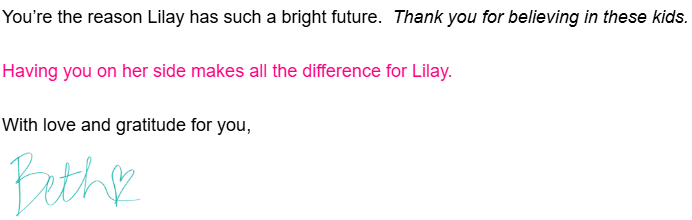
“Sincerely” is a bit formal and does nothing to build a relationship. A thank-you letter is a place to gush a little. Instead, try something heartfelt or mission-related: “In gratitude,” “Warmly,” “With appreciation and admiration,” “For the love of theater,” “In celebration of you,” “From the bottom of my heart,” etc.
6. Add a targeted, personal touch.
For those who give a gift that’s above your average, it’s worth acknowledging this special commitment with an “above average” thank you. After all, you probably thank donors of $1,000 differently than donors who give $100 or less, right? A $100/month ($1,200/year) donor should be treated similarly. Pick up the phone!
Leave a pure gratitude voicemail if you don’t reach them. Send a personalized thank-you text or video. And make sure that when sending a newsletter or meeting in person, you offer opportunities for donors to get involved in ways beyond just giving. Make them feel valued as people, not just wallets, and they’ll value you as well.
Best channels to thank monthly donors
1. Donor recognition wall
Create a long-lasting testament to your appreciation with a donor recognition wall. If you’re thinking of a conventional brass plaque, think again. Modern donor recognition walls (including digital and virtual walls) create a permanent experience that honors your donors while telling the story of your mission.
This is a perfect way to acknowledge loyal supporters while truly expressing the impact and longevity of their support. Plus, a beautifully designed wall will add a branded touch to a high-traffic area of your facility.
TIP: Don’t limit yourself to a traditional or one-size-fits-all approach. Seek a provider that brings a collaborative mindset to the table and focuses on your needs to create a more meaningful final design. Learn more about today’s forward-thinking donor recognition experiences.
2. Mailed letter
The gold standard, and what people expect, is a prompt and personal mailed thank-you letter. Not a canned receipt. Something you took time with, and stopped for a minute to think about your particular donor’s individual contribution. After all, they took time to earn the money they gave to you; it’s the least you can do to return the favor. Next time you think of the old adage “time is money,” think about spending some time to craft a thank you that will be appreciated. That’s how you’ll get more money in the future.
TIP: Add a personal handwritten note. This immediately elevates the thank you from “canned” to special.
3. Email
This is what you send, immediately, when donors give online. But don’t use the canned acknowledgment provided by your CRM or email provider. Donors can tell when something is automated, and they perceive it as “I guess they don’t really care about me.”
TIP: Attach a brief video or photo showing how their gift will be used, and let them know they’ll receive their ‘official’ thank-you in the mail later. Don’t treat online donors as second-class citizens. If offline donors receive a personal note, a welcome package, and maybe a token gift, make sure your online donors receive the same relationship-building touches. Yes, it’s easier and less expensive to forgo the mailed letter in the short run. In the long run, you’ll likely retain more donors if you send both types of acknowledgments. If you’re doubtful, test this.
4. Phone call
This is your secret weapon, perhaps the most underused way to thank donors, and probably the method with the most lasting impact. If you do it, you’ll really stand out. In a good way.
Sending a thank you letter for a gift may sound easier than making a call, but for many donors, it may be well worth it to pick up the phone to say thank you — in addition to sending a letter before or after.
In another study by Penelope Burk, board members who called to thank donors within 24 hours saw an average gift of 39% more than those not called, and 42% more even after 14 months! Calls, it seems, have a real lasting value.
TIP: Make sure you ask donors for their phone numbers on your response devices and donation pages! Bloomerang conducted an experiment to see how 50 randomly selected nonprofits in the Indianapolis-metro area responded to their first-time $5 gifts. Not a single nonprofit of 50 called to thank the new Bloomerang donors. In fact, only 38% asked for a phone number! If you want to communicate easily with your donors, develop strategies for asking for their phone numbers.
5. Video
It used to be expensive to create a video. No more. Today, anyone with a smartphone can create a perfectly serviceable thank-you video – one that is warm and genuine. It can be as simple as you pushing “record” and talking into the phone camera.
TIP: Take photos of staff or program recipients holding thank you signs; then use a simple app to edit them into a quick slideshow. You can even add music. Just make sure your thank you video is brief (probably under 30 seconds).
6. Donation thank-you landing page
Your thank-you landing page is a valuable, too-often-overlooked piece of real estate. Most organizations simply put cursory thank-you language there, and may even use canned language from their email service or CRM provider. This is like having a piece of Monopoly property, but never building a house or hotel on it. It’s fine, but it won’t help you win the game.
TIP: Include a compelling image or brief video that tells a story demonstrating the impact of your donor’s gift. Like any other thank you, this landing page should be considered an opportunity to predispose your donor to make their next gift. But don’t sell; show and tell.
7. Social media
This is a great way to keep gratitude flowing throughout the year, and it’s relatively inexpensive. Simply send high-fives to your donors through the channels they most frequently use (which, of course, you can ascertain by asking them via a survey or response device).
TIP: Sprinkle “because of you” throughout your messaging. Include a link to a video that makes your donor feel good about those being helped because of their support.
8. Text
Some donors, especially younger ones, communicate primarily through text. These folks may actually prefer a text thank-you over an emailed one (which may take them a week to open).
TIP: Consider your audience in crafting your thank-you strategy. Texting may be a viable primary or secondary strategy, especially if you’ll otherwise have difficulty sending a thank-you within 48 hours.
9. E-newsletter or blog
A newsletter provides an easy, regular opportunity to make your donors feel good. Don’t miss an opportunity to sprinkle one or more thank yous and pats on the back to your donors every time you send one out. Donors are the heart of your mission and make your work possible. Give credit where it’s due. Every time.
TIP: In addition to thanking donors in general, consider thanking specific donors. Praise grows in a public setting, and this can be a nice relationship-building touch for those to whom you’re particularly grateful. And don’t just thank major donors this way. Try thanking the kid who saved up all their pennies or held a bake sale. This can get an entire family to hang in with you for the long term, and it also inspires copycats.
10. Annual report
An annual report is a terrible thing to waste. Even if you don’t include a donor honor roll because you’ve decided it’s too resource-intensive, you can still acknowledge that you’d have nothing to report on without donor support.
TIP: Thank donors in the letter from the E.D. or board president, rather than simply talking about how “we did this” and “our organization accomplished that.” Make it about the donors. Also, sprinkle thank-yous throughout your report copy. When you report on a program, conclude with “this was only possible with the support of our corporate partners, foundation friends, and individual supporters.”
11. Event program
An event program is an excellent opportunity for recurring monthly donors, especially since you’ve gathered a crowd in person! Don’t just include donor names in the printed program; recognize donors from the podium or stage!
TIP: Consider adding special recognition touches (e.g., distribute logo pins; hold a donor thank-you reception or after-party; offer free or discounted parking; welcome donors with pinned carnations or glasses of bubbly; invite students to come and sing a special song in tribute to donors; etc.).
Sample monthly donor thank-you message
Here is a quick, highly effective email template you can adapt for your own monthly sustainers to put these principles into practice:
Subject: You made this happen, [Donor Name]! 💛
Dear [Donor Name],
Your steadfast dedication as a monthly sustainer absolutely blows us away. I wanted to pause today and send a heartfelt reminder of how much we appreciate your ongoing generosity and vision.
[Insert a high-quality, close-up photo or a short 30-second video thumbnail of a recipient/client smiling]
Because of your recurring commitment, Leo (pictured above) just finished reading his very first chapter book this week! He was so proud, he couldn’t stop beaming. You didn’t just buy him a book; you gave him the gift of confidence and a lifelong love of reading.
Please know that your constant support is the engine behind these daily victories. We quite literally could not do this without you.
There is no ask in this email—just pure, immense gratitude for the wonderful person you are and the compassionate impact you make every single month.
With admiration and endless appreciation,
[Your Name]
[Your Title]
[Your Contact Information]
How to invite an upgrade within a thank-you
Monthly sustainers exist in a unique ecosystem. Because their giving is automated, the lines between stewardship (thanking) and cultivation (asking) eventually blur, especially around giving milestones.
When done strategically and with the utmost respect, you can weave an upgrade invitation into a message steeped in gratitude. Here are actionable tips to do it right:
- Use the giving anniversary: The absolute best time to invite an upgrade within a thank-you is on the donor’s giving anniversary. Send a dedicated Happy Anniversary message celebrating their past 12 months of impact. Once you have thanked them thoroughly, pivot to the future: “As we look to the year ahead, would you consider increasing your monthly gift to $25 to help us reach even more kids like Leo?”
- Show exactly what the upgrade achieves: Don’t just ask them to give more. Show them what the margin of increase accomplishes. If they currently give $20 a month, invite them to give $30, and explain what that extra $10 does: “By upgrading your gift by just $10 a month, you will provide a full week of meals for a rescue pup every single month.”
- Use the P.S. for a soft invitation: If you are sending a heartfelt, gratitude-focused impact update (not a tax receipt), the P.S. is prime real estate. Keep the body of the message 100% focused on thanking the donor and telling a great story. Then add a subtle upgrade nudge at the bottom: “P.S. If you are ever inspired to increase your monthly impact, you can easily update your giving preferences here [Link].”
- Give them an out to preserve the relationship: Make sure the donor knows their current giving is still deeply valued, even if they can’t upgrade. Use phrases like, “Whether or not you choose to increase your monthly gift today, please know how incredibly grateful we are for your steadfast support.”
- Call them to say thank you (and ask for feedback first): As mentioned earlier, phone calls are powerful. Call your monthly donor simply to say thank you and ask why they choose to support you. If the conversation goes incredibly well and they express deep enthusiasm for your current projects, you can gently transition: “I’m so thrilled to hear how passionate you are about this new initiative. Would you be open to upgrading your monthly gift to help us launch it?”
Frequently asked questions about thanking monthly donors
Is a quarterly thank-you enough for monthly donors?
No, a quarterly thank-you falls short. Because their bank account is charged every month, your gratitude should be just as continuous. While you shouldn’t mail a formal letter monthly, you must actively weave appreciation into regular touchpoints—like emails, social media, and newsletters—between those larger quarterly acknowledgments.
How often should you thank monthly donors?
Thank them at least monthly by varying your methods:
- Month 1: Welcome call and package.
- Months 2–11: Mix impact emails, newsletter shoutouts, texts, or social media tags.
- Month 12: Anniversary card or upgrade invitation.
- Annually: Year-end tax summary with a handwritten note.
Do I need to send a formal tax receipt for every monthly transaction?
No. Sending a monthly tax receipt feels robotic and transactional. Instead, send a warm, impact-focused thank-you message or update each month. Then, send one comprehensive, consolidated annual tax receipt in January summarizing their total yearly contributions for easy tax preparation.
Should we create a branded club for our monthly donors?
Absolutely. Giving your monthly giving program a specific name (like “The Sustainer Circle”) immediately elevates your donors’ status. It fosters a sense of exclusive community and identity, making every thank-you message feel like a specialized VIP perk rather than a standard mass broadcast.
Bottom line: you’ve already done the hard part
One of the best—yet least acknowledged—benefits of a monthly giving program is the ongoing emotional return it provides the donor. Giving frequently in smaller amounts provides them with a recurring monthly dose of accomplishment and goodwill.
It is the perfect opportunity to offer your supporters an even greater, continuous reward for their generosity. Lean into this dynamic! Treat recurring gifts as a deeply reciprocal relationship where they keep giving financial support, and you keep giving gratitude and impact updates.
Your donors are showing up to make a difference every single month. Maybe you should, too?