Donor-Advised Funds for Nonprofits: FAQs and Strategies




The use of Donor-Advised Funds (DAFs) as a means for individuals to make philanthropic gifts continues to rise, and grants from DAFs are becoming a growing source of contribution income for charities of all sizes and shapes. An ever-broader group of Americans is embracing them to approach philanthropy in the thoughtful, strategic way once reserved only for mega-donors who could afford to set up private foundations. These are answers to frequently asked questions about donor-advised funds and should help you understand (1) how they work, and (2) how they may be of benefit to your charity.
DAFs are among the fastest-growing vehicles in modern philanthropy, channeling billions of dollars to charitable causes each year. While they offer donors incredible tax flexibility, navigating the complex IRS rules and frequent donor anonymity can be a unique challenge for development teams. This guide provides actionable strategies and clear answers to help your nonprofit successfully attract, track, and steward more DAF grants.
The growing pot of DAF philanthropy
DAFs have become the fastest-growing philanthropic vehicle, accounting for roughly 10% of all giving per the Chronicle of Philanthropy. Not millions, but billions! The 2024 National Study on Donor-Advised Funds suggests the number of DAFs has increased more than fivefold from 2010 to 2020. If DAFs continue on the trajectory they have been on in recent years, Bridgespan expects grantmaking from DAFs will exceed that of foundations by 2029.
So, it makes a lot of sense to seek out and court these growing numbers of donors who can provide steady funding – even in challenging times.
Jeff Brooks argues on the Moceanic blog: “None of us can afford to ignore DAFs anymore.” According to a recent survey, organizations that actively seek DAF grants raise a lot more money than those that don’t: 2.2 times more revenue. The survey also found that 54% of U.S. nonprofits never solicit DAF donations. That used to be no real problem. But now, if you ignore DAFs, you could be leaving donations on the table!
Top questions nonprofits ask about DAFs
1. What is a DAF?
It’s more or less a personal charitable savings account established by a donor with the sole purpose of supporting charities. It is administered by a charitable sponsor organization that has legal control over the donor-advised fund and is responsible for its operation and maintenance. Charitable sponsors include public charities, community foundations, and charitable funds associated with an investment firm. The donor has (1) made the decision to be philanthropic but (2) not yet decided which charity will be the recipient of their largesse. The DAF acts as a sort of parking lot.
2. Why would someone open a DAF?
There are four principal reasons:
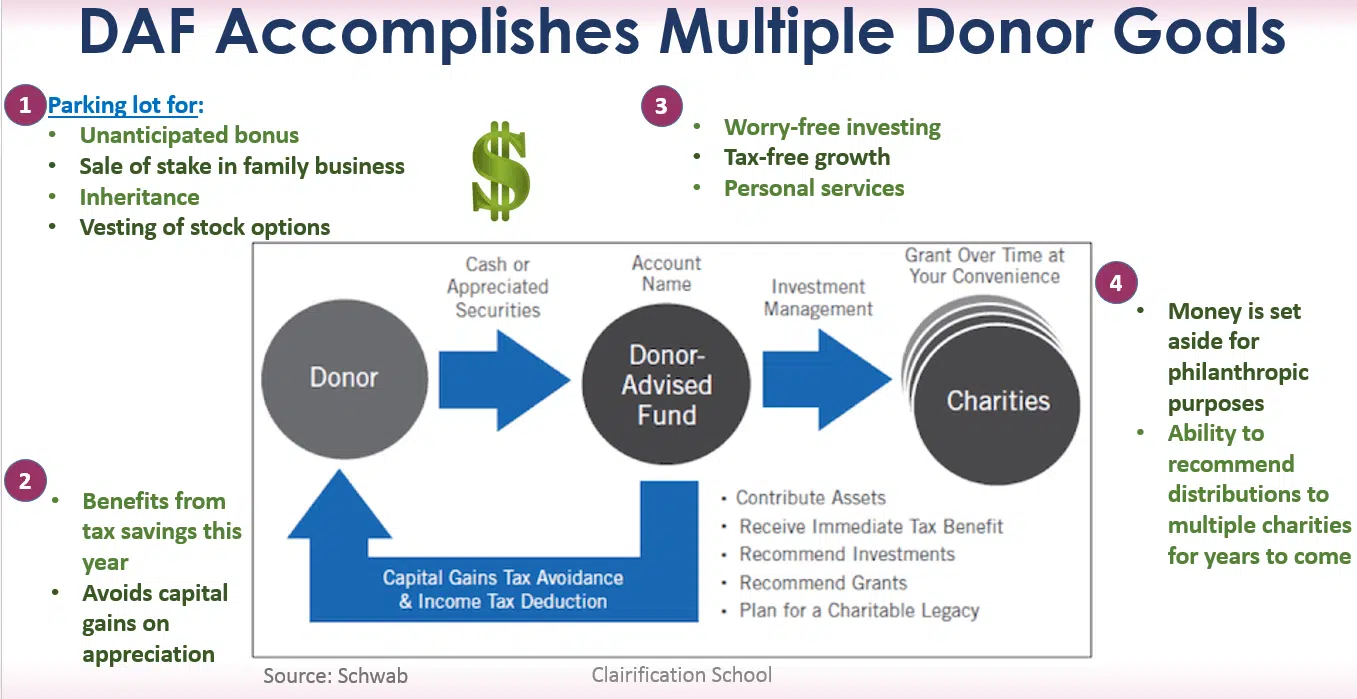
They have a windfall this year
It’s more than they want to give to any single charity right now. They do want to set it aside for charity, however. By ‘parking’ it in a DAF they get their charitable deduction this year and can recommend distributions from their Fund this year and into the future.
They need an income or capital gains tax deduction this year
Regarding income tax, since the passage of the new Tax Act in 2017 fewer donors can itemize deductions unless they reach an amount exceeding the standard deduction. With a windfall (bonus, inheritance, sale of stake in family business, lottery winnings, vesting of stock options) this amount can easily be exceeded. A current DAF strategy is to ‘bunch’ annual charitable deductions by making a gift exceeding the standard deduction to a DAF in one year; then recommending grants over ensuing years when they may make no charitable gifts and simply take the standard deduction.
Regarding capital gains tax, if the donor has an appreciated asset and wants the full benefit of the asset’s fair market value (FMV) when making a charitable gift, they’ll need to donate the asset directly. Were they to sell the asset to get cash for their gift, they’d have to pay capital gains tax on the full amount of the appreciation – thereby diminishing the amount available for philanthropy. Your charity may not accept non-cash assets. All donor-advised funds accept stock gifts, most will accept a range of personal and real property, and some accept cryptocurrency.
They want professional investment and advisory services
Many donors enjoy the freedom that comes from parking their philanthropic money in places where they won’t have to make investment decisions. There’s a benefit to having their money pooled with other DAF investors, and it grows tax-free because it’s all eventually directed to a charitable purpose. This gives them a growing pot of money to grant to charity. DAF administrators also provide useful services:
- They will vet charities
- They will send donors ONE receipt they can use for tax purposes
- They will write all checks to charities
They like the convenience of a centralized, evergreen philanthropic account
In addition to the administrative services offered, donors appreciate being able to recommend distributions for as many years into the future as they wish (until their death or the death of named successors).
3. Who can open a DAF?
Individuals, families, companies, foundations, and other entities can start a donor-advised fund account.
4. Can a nonprofit receive DAF grants?
Yes, a nonprofit organization can absolutely receive grants from a donor-advised fund (DAF).
It is a common misconception that 501(c)(3) public charities “have” or “open” their own free DAF accounts to receive these funds. In reality, a DAF is an investment account managed by a sponsoring organization (like Fidelity Charitable, Schwab Charitable, or a local community foundation).
Here is exactly how the relationship works:
- The donor: Puts cash, stocks, or other assets into a DAF at a sponsoring organization, taking an immediate tax deduction.
- The sponsoring organization: Holds, legally owns, and invests the money.
- The grant: The donor recommends where the money goes, and the sponsoring organization sends a grant check or electronic payment directly to your nonprofit.
Your nonprofit does not need a special account to receive these funds; you simply need to remain an active public charity in good standing with the IRS so sponsoring organizations can legally approve and distribute the grants to you.
5. Why would a donor set up a DAF rather than a private foundation?
There’s a low barrier to entry. Donor-advised funds are easy to establish and donors need not go through the time/expense of setting up a foundation, which tend to (1) require larger investments, (2) have more costly start-up and maintenance costs, and (3) allow a deduction only up to 30% of the donor’s AGI, compared with 60% of AGI for gifts to a ‘public charity’ (which a DAF is).
6. What is the downside of a donor-advised fund for nonprofits?
While donor-advised funds (DAFs) channel billions to charity, they present four distinct hurdles for the nonprofits receiving the grants:
The anonymous donor problem
Donors can choose to remain anonymous when recommending a grant. Your nonprofit receives a check from a sponsoring organization (like Fidelity Charitable) with no donor name or contact information, making it impossible to thank them or build a relationship.
Forbidden benefits (IRS rules)
Because the donor took a tax deduction when funding the DAF, the IRS bans them from receiving any personal benefit from a DAF grant. This means DAF funds cannot be used to buy gala tickets, charity auction items, or legally fulfill a personal binding pledge.
“Parked” capital and delays
Donors get their tax break immediately upon putting money into a DAF, but there is no legal timeline forcing them to distribute it. Billions sit in investment accounts, leaving nonprofits at the mercy of donors’ timelines during urgent campaigns.
Administrative overhead
Tracking DAF gifts requires complex accounting. Gift processors must legally credit the sponsoring organization that cut the check, while simultaneously tracking the individual donor for relationship stewardship—all without accidentally sending them a second tax receipt.
7. How much do people need to open a donor-advised fund account?
To start a donor-advised fund account, a minimum of $5,000 is generally required, though with some administrators you will need to make an initial contribution of $25,000 or more. Once the account is established, subsequent contributions can be smaller — sponsors usually set a minimum gift amount, which may be as low as $50.
8. What is the minimum amount a donor can give the DAF at one time?
This varies by sponsoring organization. I’ve made you a little chart that shows investment amounts at a number of DAF sponsors as of this writing:
9. How much are donors charged?
Fees vary by institution. Typically, the amount will be based on the balance in the account and/or the number of annual transactions. It is usually under 1%.
10. What is the minimum amount a donor can recommend to charity from their DAF?
This varies by sponsoring organization. I’ve made you a little chart that shows minimum recommended gift amounts at a number of DAF sponsors as of this writing:
11. Can a donor-advised fund account be named after someone other than the donor?
Yes. Donors can choose any name for their DAF. They can even call it a Foundation. Most donors choose a name that reflects the main purpose of the account such as “The Clairification Scholarship Fund.” Some donors select a name that helps them remain anonymous, like the “Young Scholars Fund.” Others may name a fund in honor or memory of a loved one, such as “The Lee Axelrad Memorial Fund.”
12. If the donor cannot control the fund (just make recommendations), then who does ultimately control the funds?
The sponsoring organization. Once a donor cedes control of the asset, for which they are entitled to a tax deduction, the gift is irrevocable. They cannot get it back. What they can do is make a recommendation as to how the money should be allocated to other charities. The sponsor isn’t legally required to follow that advice; in practice, most sponsors will abide by donor wishes as long as the recommended beneficiary is a qualifying tax-exempt organization and there are no red flags, such as pending lawsuits against that charity.
13. Are donor-advised funds revocable?
Gifts made to donor-advised funds are irrevocable. Of course, a donor may recommend grants totaling the full amount of their DAF gift(s) and ask the sponsoring organization to close the fund with that sponsor. Sometimes donors will do this if they’re unhappy with fees or services at one sponsor and would prefer to move to another.
14. Are there common characteristics of DAF donors that make them different than other donors?
Most DAF donors are not the same as the stereotypical foundation donor who establishes a multi-million-dollar philanthropic endowment. In fact, because they’re easy to establish, have low overhead, and currently have no strict distribution requirements, a broad spectrum of donors participate. Common characteristics of DAF donors include:
- Don’t give on a whim. They are serious about philanthropy, as evidenced by the fact that they’ve set up a formal charity distribution vehicle.
- Intend to give out their money now. Unlike private foundations, DAFs generally give money away quickly: 38% of DAF contributions are gone within a year; 74% of balances are distributed within five years. Many foundations, on the other hand, give out a bare minimum of 5% of assets each year. Most DAFs are set up not to last beyond two generations, as opposed to the perpetuity more common for private foundations.
- DAF grants tend to be larger than typical contributions. Per Vanguard Charitable, their average DAF gift is nearly $12,000.
- Propensity to make major or planned gifts.
- Often volunteer with grantee organizations through direct service and/or committees, enabling them to hear about needs first-hand and gain perspective on how they can become part of the solution.
- A thoughtful, organized approach to philanthropy. Often interested in collaborating with charitable recipients, and care about demonstrated effectiveness. Reporting back on outcomes is important.
- Propensity to sit down with family to discuss annual philanthropy. Sometimes funds are set up to pass to succeeding generations. Sometimes children who are named successors might give to their parents’ fund in honor of a special anniversary or other occasions.
15. Can a donor-advised fund account have multiple successors, and should we maybe reach out to the donor’s kids when they die?
Yes. Depending on the rules of the DAF administrator, most donor-advised funds allow you to choose at least one successor generation. Sometimes successors share advising responsibilities, and can also name their own successor advisors. This option offers the potential for a DAF to exist in perpetuity. Regardless, it never hurts to reach out to a donor’s family with a condolence note (not an ask) when you learn of a donor’s passing. It’s a human thing to do, and may inspire the family to make a gift in memory of their loved one.
16. Can donors name our charity as a beneficiary of their DAF once they’ve passed?
It depends on the DAF administrator’s rules. If there are no successor advisors, usually donors can designate one or more charitable organizations as account beneficiaries. The DAF sponsor may have a rule allowing the donor to distribute, say, 5% of the account’s balance to the charities that had previously received grants. If a donor had not recommended grants, the entire balance would be transferred to the particular ‘Giving Fund’ or whatever the administrator calls their program. In this case there is generally an advisory panel convened by the DAF sponsor that will pick charities for distributions.
17. Can an IRA name a DAF as the legacy beneficiary?
Yes, donors can designate an existing DAF as a primary or contingent IRA beneficiary. This is done simply by writing the name of the DAF, along with the account number, in the Name or Organization Name of their IRA’s ‘Update Beneficiary Designation’ form. Where donors are asked to indicate the beneficiary’s ‘relationship’ to them, they simply say: “My XYZ Donor Advised Fund.” People can even establish a ‘Testamentary DAF’ they plan to fund with proceeds from their estate. When they fill out the paperwork to establish this fund, they simply indicate they want it to be ‘testamentary.’ This lets the custodian know they aren’t funding it yet, but intend to do so at a future date.
The donor then receives account information and can use the account name and number to designate who will be the beneficiary of their retirement account. Donors can then enter the names and information of the charities they want to support as beneficiaries of the fund and the percentage each should receive of the total account value once the account is funded. Donors can optionally designate contingent directors who decide which charities to recommend for DAF distributions. It’s a way they might honor loved ones without leaving them a personal bequest.
As you may be aware, leaving a traditional IRA to charity is a savvy strategy, as otherwise, these assets can be double-taxed – income taxes never paid during the donor’s lifetime and estate taxes – thereby diminishing the amount received by an individual beneficiary.
18. Can a donor make a required minimum distribution (RMD) gift from their IRA to a personal DAF?
No. As you may be aware, donors older than 73 with traditional or inherited IRAs (not Roth IRAs, which have already been taxed) must take required minimum distributions and pay income taxes on this amount.
Since 2015, the IRS has allowed donors to transfer the amount of their RMD – up to $100,000 directly to a qualified charity. This is known as a “qualified charitable distribution (QCD). The sticking point with donor-advised funds is that donors cannot receive any benefit for making a QCD. Since donors retain the right to recommend distributions of the money in their DAF, this is considered a benefit. At least as of this writing. However, donors can name a DAF account as an IRA beneficiary as part of their estate planning.
19. Can donor-advised funds be used to make a planned gift?
As noted above, donor-advised funds can be used to leave bequests through a testamentary, financial, or insurance vehicle. They cannot be used to fund a split-interest gift (such as a charitable remainder trust or gift annuity) where the donor shares in the benefit through income distributions. Since the gift to the DAF has already received a full tax deduction, the donor is not entitled to additional benefits from this gift.
Donors can, however, couple a DAF with a charitable trust in three other ways. (1) They can name a DAF to be the beneficiary of their charitable trust. This way, the donor need not decide in advance which specific charity will be the ultimate recipient of their planned giving, and their successors named in the DAF agreement can continue to be involved in their charitable legacy. (2) They can fund a DAF through annual income distributions from their charitable trust. (3) They can accelerate their charitable remainder trust, cash out their income interest, and collapse the CRT entirely into a DAF. They will get an offsetting income tax deduction for the value of their income interest.
20. How do you handle gala gifts with DAFs?
Since the DAF donor has already received a tax deduction, they cannot receive anything of value in exchange for their gift. This means they cannot use a recommended distribution from their DAF to purchase a gala ticket, raffle ticket, or auction item.
Note that the IRS used to allow ‘bifurcated’ payments where the donor subtracted the FMV of their ‘purchase + donation’ and recommended a DAF gift for the deductible part. They then wrote a separate check for the non-deductible part. No more. Section 3 of IRS Notice 2017-73 addresses bifurcated gifts (see below). Internal Revenue Code Section 4967 prohibits DAF grants from conferring any benefits that are “more than incidental” to the donor, donor advisor or anyone related to either of them. Mere attendance – even the right to attend — is considered more than ‘incidental value.’ So you simply must tell your donors they cannot use their donor-advised funds for this purpose. If they do, this can result in the assessment of a penalty excise tax of 125% of the grant on any donor/advisor who recommended the grant or who received the benefit.
The Treasury Department and the IRS currently agree that the relief of the Donor/Advisor’s obligation to pay the full price of a ticket to a charity-sponsored event can be considered a direct benefit to the Donor/Advisor that is more than incidental. Therefore, proposed regulations under § 4967 would, if finalized, provide that a distribution from a DAF pursuant to the advice of a Donor/Advisor that subsidizes the Donor/Advisor’s attendance or participation in a charity-sponsored event confers on the Donor/Advisor a more than incidental benefit under § 4967. The Treasury Department and the IRS do not currently agree that, for purposes of § 4967, a distribution made by a sponsoring organization from a DAF to a charity upon advice of a Donor/Advisor should be analyzed the same as a hypothetical, direct contribution by the Donor/Advisor to the charity. A Donor/Advisor who wishes to receive goods or services (such as event tickets) offered by a charity in exchange for a contribution of a specified amount can make the contribution directly, without involving a DAF.
21. How much can we push back when donors try to use their DAF for event sponsorships? I’ve seen people look the other way so as not to anger the donor. So instead they say the organization is choosing to comp the table. I feel uncomfortable with that. Suggestions?
Suggest to whoever is concerned about angering the donor today that the donor may become a lot angrier tomorrow when the IRS disallows their deduction and imposes a penalty excise tax on them. Tell them you didn’t write the laws and are merely following IRS guidelines – for their and the charity’s protection.
22. What is the nonprofit’s responsibility to make sure donors aren’t sending gifts from a DAF to pay auction invoices? If they send a check from the DAF for such a thing, is it our responsibility to return it?
A donor cannot use money for which they’ve already received a 100% tax deduction (i.e., a gift to a donor-advised fund) to pay for something of value to them. Auction items fall into this category unless they are purely for “fund-a-need” items that return no material benefit to the donor. So, yes, you need to let the donor know the gift from the DAF they’ve sent cannot be applied toward their auction item. You can either offer to return it or ask them to send a separate check for the auction item if they still want it.
23. Can a DAF donor purchase an ad and be a sponsor in your event booklet?
No. This would be considered a benefit. It’s a quid pro quo exchange – money for advertising.
24. Can a DAF gift be applied to a membership if the donor waives benefits?
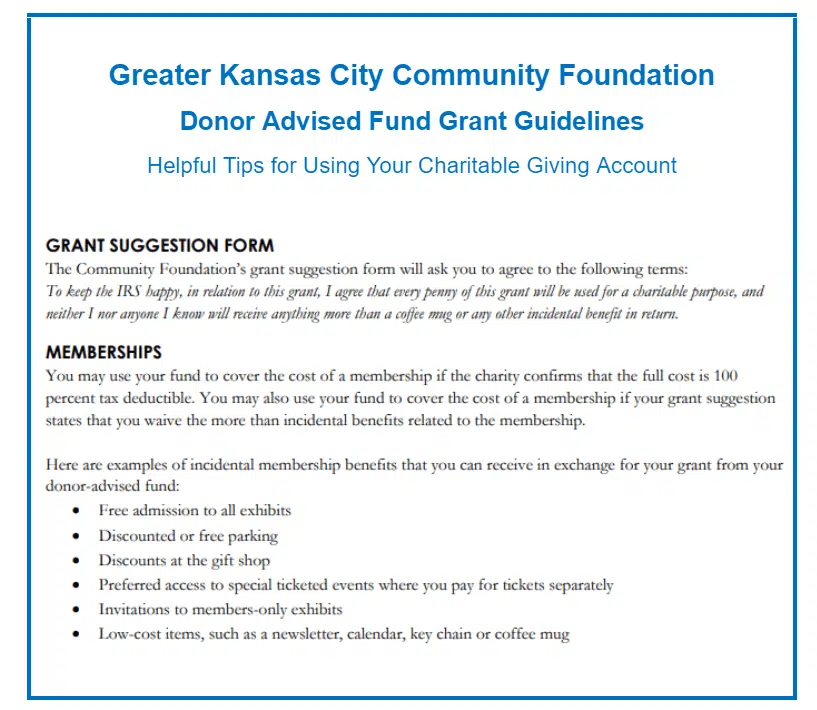
I’ll give you the by-the-book answer: DAF distributions cannot be used to cover transactions that confer ‘incidental benefits’ on the donor. The same logic and penalty that apply to gifts to cover Gala tickets also apply to membership fees that have deductible and non-deductible portions. See Section 3 of IRS Notice 2017-73.
The Treasury Department and the IRS recognize that a similar issue arises if a sponsoring organization makes a distribution from a DAF to a charity to pay, on behalf of a Donor/Advisor, the deductible portion of a membership fee charged by the charity, and the Donor/Advisor separately pays the nondeductible portion of the membership fee. Therefore, the Treasury Department and the IRS anticipate that the same analysis would apply to a case where the Donor/Advisor receives these types of membership benefits, so that the sponsoring organization cannot pay the deductible portion of the membership fee without conferring more than an incidental benefit on the Donor/Advisor.
25. We have a Partners for Life membership group that starts at $1,500. You can choose not to get any benefits, and what that means is your name is just listed as a supporter. Since there is no physical or monetary gift they receive, what are your thought in regards to doing that for DAF supporters?
It’s a bit murky. The IRS seems to be stricter in its definition of incidental benefits for gifts made from donor-advised funds (see above) than for gifts made directly to the charity. For the latter, IRS Publication 1771 notes:
Goods and services are considered to be insubstantial if the payment occurs in the context of a fund-raising campaign in which a charitable organization informs the donor of the amount of the contribution that is a deductible contribution, and:
- The fair market value of the benefits received does not exceed the lesser of 2 percent of the payment or $139, or
- The payment is at least $69.50, the only items provided bear the organization’s name or logo (for example, calendars, mugs, or posters), and the cost of these items is within the limit for “low-cost articles,” which is $13.90.
The dollar amounts are for 2026. Guideline amounts are adjusted annually for inflation. See IRS.gov for annual inflation adjustment information.
So, you might be safe if the value of the benefits you confer on members in your membership group is less than the guideline amounts. But just the ‘incidental benefit of being included’ in your club or gift society – and any status or special treatment that may accrue — may make payment of any part of this membership not okay. In other words, it’s similar to having the ‘right’ to attend a Gala or other fundraising event, even though the donor might ultimately choose not to attend. In general, the IRS has suggested the following for gifts from donor-advised funds:
Examples of non-incidental benefits (not OK):
- Meals
- Certain dues or membership fees
- Goods bought at charitable auctions or tickets for charitable events that entitle the attendees to any material benefit
- Preferential access/seating not available to the general public
- Satisfying a legally binding pledge from a donor-advised fund account
Examples of incidental benefits (generally OK):
- Coffee mugs
- Key chains
- Calendars
- Posters
- Intangible religious benefits
If the donor doesn’t care about the benefits, it’s safest to have them waive more than incidental benefits and to send them an acknowledgment thanking them for their $1,500 gift rather than one welcoming them into your ‘Partners for Life’ society. Note that if an organization has a membership group where they can confirm the gift to become a member is 100% tax-deductible, then this gift would be allowed (this is commonly the case, for example, for museum memberships or dues to religious institutions).
26. Can donors use a DAF to fulfill a pledge?
No, and yes. It’s a gray area. Technically, once the donor has made the gift and received the full benefit of the tax deduction, the donor no longer has ownership or control over the money. They are allowed to make recommendations; there is no legal requirement for the DAF holder to follow these recommendations. Traditionally, pledge fulfillment via a DAF distribution was a complete ‘no-no.’ Section 4 of IRS Notice 2017-73 addressed personal pledges, effectively allowing donor-advised funds to make grants that satisfy pledges so long as the DAF sponsor does not reference the pledge in the grant letter or check.
The reason for this change was that “allowing satisfaction of Donor/Advisors’ charitable pledges facilitates the giving process.” Even though this is a ‘notice’ and not a ‘regulation,’ you can rely on its advice for now. I still recommend erring on the side of caution. Absolutely do not ask a DAF sponsor to send you a letter indicating the gift is intended as pledge fulfillment! Whether the gift fulfills a donor’s commitment is left to you, the charity, and is not considered the business of the DAF sponsor. I would also recommend against sending a thank you to your donor that references the fulfillment of their ‘pledge.’
You can minimize the likelihood of getting your charity or donor into hot water if you never use the word “pledge” and simply substitute “intent to give.” The former is generally legally binding; the latter is not. This is good practice for all your fundraising, not simply gifts from donor-advised funds. ‘Pledges’ must be booked by your accounting office; ‘intent to give’ commitments need not be booked. If a DAF grant gets your donor ‘off the hook’ for a legally enforceable pledge, the IRS may consider this more than an incidental benefit.
27. Since use of a DAF to fulfill a pledge is currently a gray area, do you have any advice as to when you might allow this and when you might not?
I use this question as a guideline for the treatment of gifts as pledges: Would you be willing to see this headline in your local newspaper — “XYZ Charity Sues Donor for Philanthropic Pledge Fulfillment.” If you wouldn’t go to the mat in this way due to all the negative publicity that would accrue, don’t call it a ‘pledge.’ If the gift is for a capital campaign, and maybe it’s even a lead gift upon which your campaign substantially relies, then you might think about this differently. In which case, you’d ask the donor to sign a legally binding pledge agreement. In the case of a legally binding pledge, the donor could not fulfill it with a gift from a DAF.
28. Can donors to donor-advised funds deduct more than donors to private foundations? Or to 501(c)(3) charities?
Donors who give to any qualified 501(c)(3) charity – of which DAFs are included – may deduct up to 60% of their adjusted gross income (AGI). When they give to a private foundation, they can only deduct up to 30% of AGI. This is one of the features of a DAF that makes them popular. You may be aware the 60% limit was temporarily lifted to 100% in 2020 (by the CARES Act), but that applied only to cash gifts. And that increased cap did not apply to gifts to donor-advised funds as I understand the law. See also: How to Let Donors Know New CARES Act Offers Deduction Opportunities.
29. Our community foundation holds donor-advised funds. Are donations to these only deductible at 30%?
When donors set up a DAF with a community foundation or any other sponsor, they are giving to a spin-off 501(c)(3) created by the sponsor. So the percentage limitation for deductions is higher than a straight gift to the foundation.
30. What are the average gift sizes from different donor-advised funds?
It varies. Many nonprofits report that DAF donors make average gifts that are larger than those of non-DAF donors. This is something you can calculate for your own nonprofit. Per Vanguard Charitable, their average DAF gift is $14,808. Yet such averages are heavily skewed by donors with large fund balances. Fidelity Charitable reports that nearly half of its donors have balances of less than $25,000, so thousands of smaller gifts are made. You can find comprehensive annual reporting on DAF contributions, grants, and account balances compiled by National Philanthropic Trust.
31. What percentage of DAFs are permanently endowed and limited to 5% annual payout?
This question is mixing apples and oranges. Foundations have a 5% minimum payout requirement and often do not exceed this. DAFs generally have no payout requirement (though individual sponsoring organizations may set a minimum) and often give out more than 5%. A DAF is not an endowment fund, which is generally designed to keep the principal intact and spend the income. Donors may recommend out the full amount in their DAF every year, as long as they keep whatever balance is required by the sponsoring organization (often as little as $1,000).
32. Can the general public donate to someone’s DAF (as in the case of a memorial gift)?
Generally, no. The reason is if someone other than the donor or someone they’ve specifically authorized to make gifts and/or distribution recommendations as advisors or successor advisors (e.g. family members; partners) gives to the DAF, this individual will get an immediate tax deduction. Yet they’ll simultaneously be receiving a value in return (the value of gifting money for charitable distribution to their honoree). Since donors cannot receive something of value in return for their tax-deductible contribution, this is not allowed.
33. Why would we need to let donors know we accept DAFs? Don’t all nonprofits accept DAFs? Why wouldn’t an organization accept a DAF gift?
No good reason! What you really want to do is get inside the donor mindset. People have a funny way of making assumptions. If you don’t let them know you accept gifts from DAFs or, for that matter, gifts from IRAs or bequests from wills or trusts, folks just won’t think of you when it comes to making these types of philanthropic distributions. For donors who’ve already set up a DAF, having this on your website as a giving option simply serves as a reminder to them that they have a philanthropic pot of money awaiting distribution. If you make it easy for them to give to you from this pot, they may just do so. If you don’t make it easy, they’re less likely to consider this method of giving to you.
34. What is the best way to promote the fact we accept DAF gifts on our website?
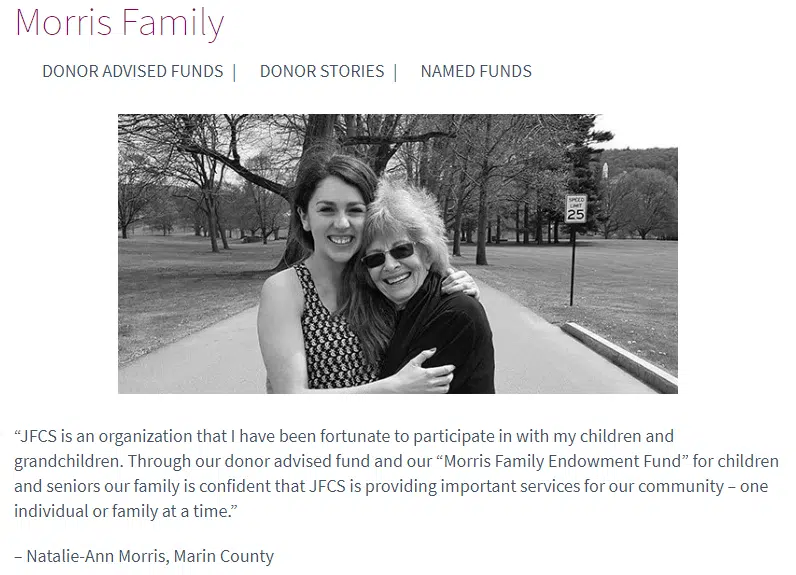
The best and easiest solution is simply to include giving from DAFs as a drop-down option on your ‘donate’ or ‘ways to give’ menu. The International Rescue Committee, Jewish Family and Children’s Services, and the University of Washington all list DAF giving this way.
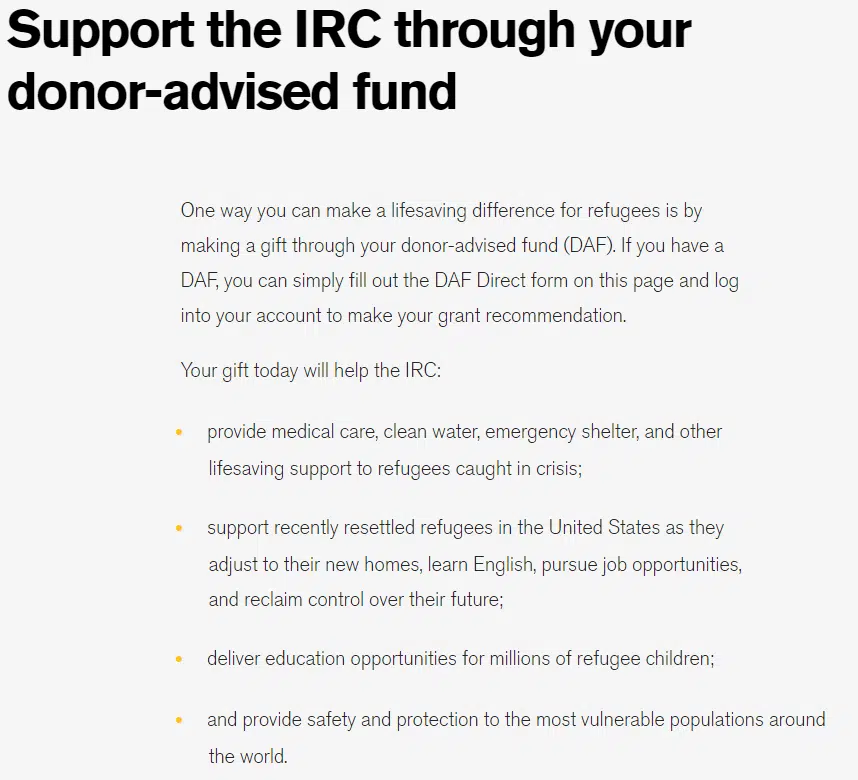
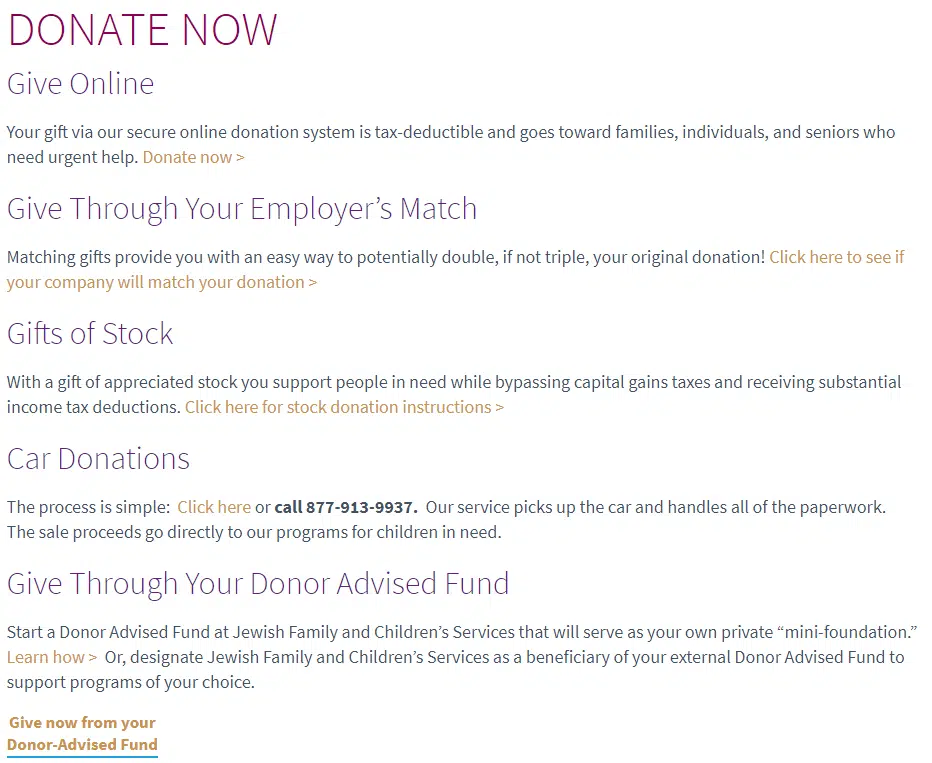
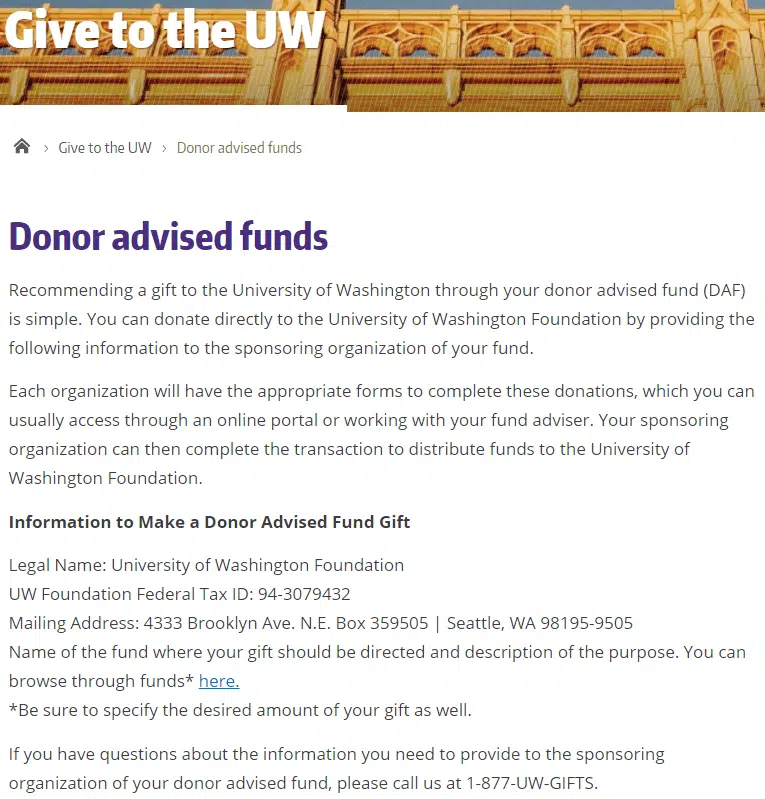
Another strategy is to include testimonials on these pages from other DAF donors to your organization. This acts as ‘social proof’ that your organization is ‘DAF-worthy,’ and may inspire copycat donations. I’ve often had donors call me to say, “If Vera and Hal can do that, so can we!”
35. Is there a way donors can transfer money directly from their DAF to us?
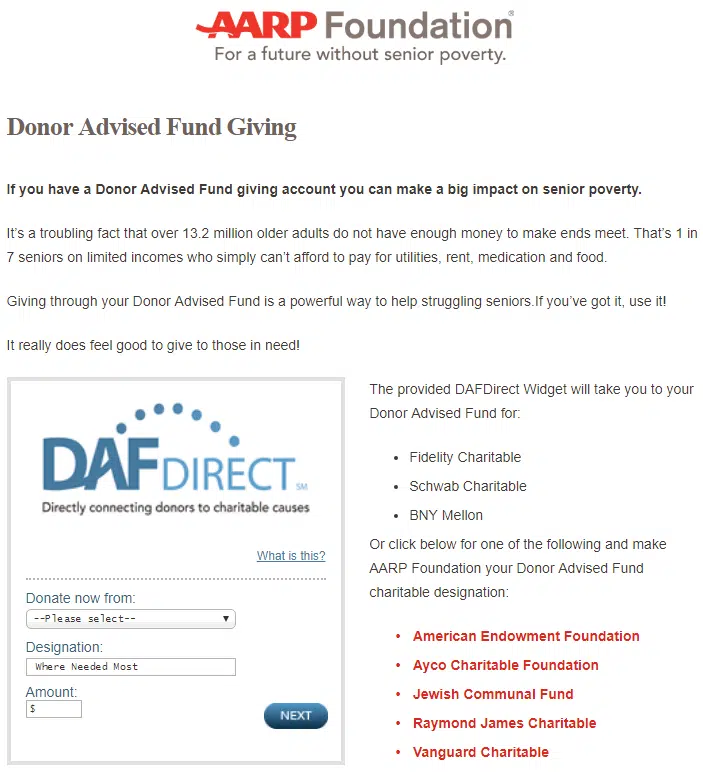
To make giving easy, consider including a widget that enables transfers from DAFs at selected administrators to your charity. I’m most familiar with the DAF Direct widget, which is free. Check it out here. They include a list of nonprofits using the widget, so you can see how other organizations incorporate it into their websites. I’d say its chief limitation is that it only includes a handful of DAF repositories.
I’m unclear if there is a way to customize the widget to add additional DAF sponsors. But… you can add other options alongside the widget. I’ve noticed charities adding their local community foundation, for example. You might need to pay a contractor to add those options, or your own technical staff may be able to accomplish this. AARP, for instance, lists several extra giving options alongside its widget.
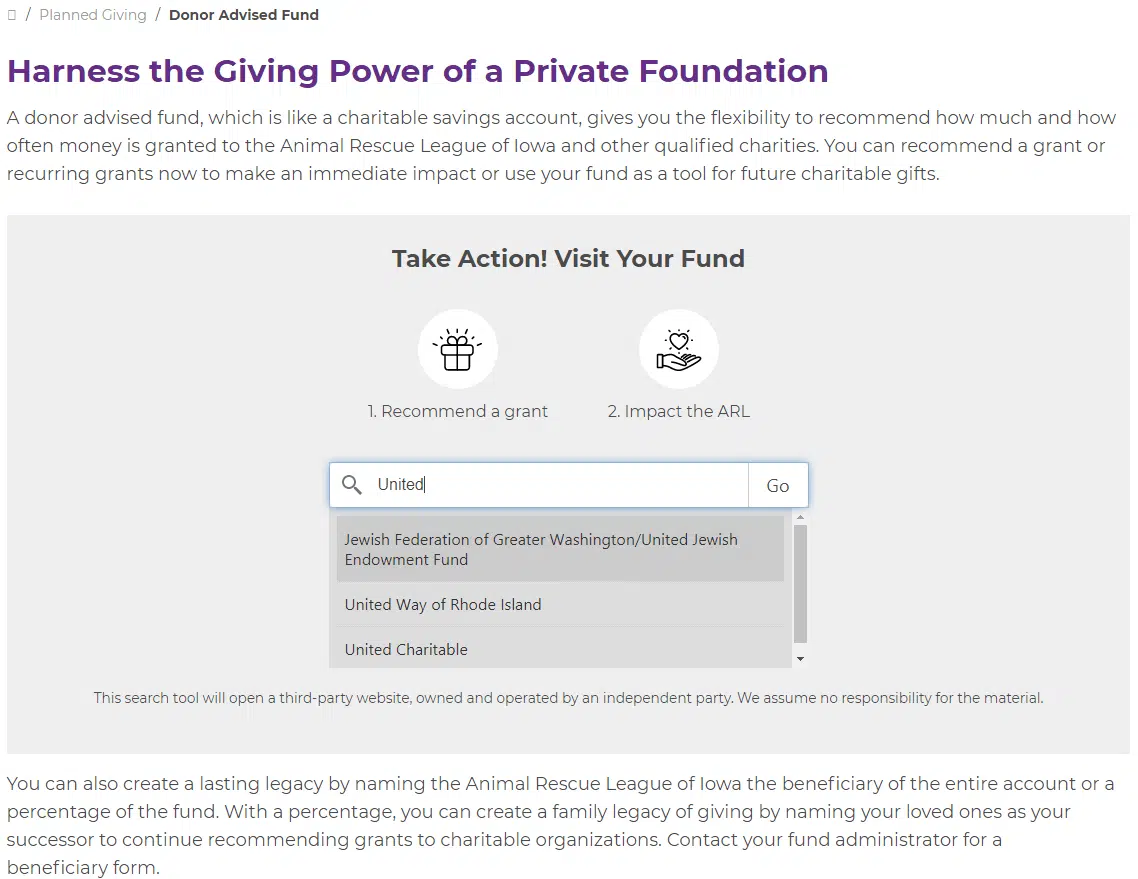
MarketSmart has a widget. The Stelter Company has a promising widget (free now to their clients; available to all) that enables would-be donors to type in the name of their DAF sponsor. If it’s in the system, the would-be DAF donor will get a drop-down with a link that will take them directly to their sponsor’s log-in so they can instantly make their recommendation. If their sponsor of preference is not yet included, the donor will get a prompt, and Stelter will add the link. Contact them if you’re interested. Here’s one example from Animal Rescue League of Iowa — typing in “United” returns a list of matching sponsors to pick from.
36. Are there ways to effect a direct DAF transfer without embedding a widget on your organization’s website?
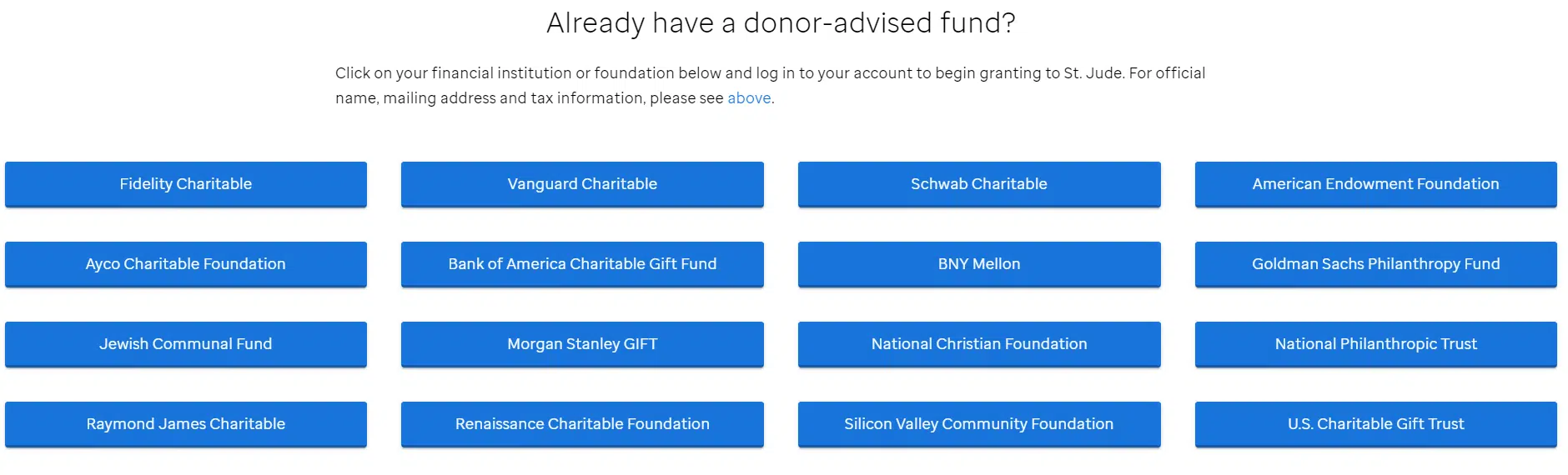
Some organizations that receive (1) significant amounts of DAF recommendations from a wide variety of vendors, or (2) a preponderance of DAF recommendations from DAF administrators not included on currently available widgets, forego the widget entirely and set up their own links to DAF sponsors. St. Jude Children’s Research Hospital does exactly this on its donor-advised funds page.
37. Do community foundations or federations have widgets?
The widgets described above are designed for individual charities so they can make it easy for donors to recommend gifts directly from their DAF. When you put a DAF Direct widget on your website, it will generally take donors to a log-in page with the sponsoring entity. Donor-advised fund sponsors, like community foundations, financial institutions, and charities like Jewish federations, tend to have different software to enable donors to make gift recommendations. Take a look at one example from DAF sponsor Jewish Family and Children’s Services.
38. Is there a way to work with DAF administrators so they steer more DAF gifts our way?
There are several ways to make a positive impression. The easiest, and probably most overlooked, strategy is to claim your Candid/Guidestar online profile. Many DAF sponsors share this nonprofit profile information with their donors. If they don’t share it, they use it themselves to help their clients make informed, strategic decisions. (E.g., Vanguard Charitable advisors, as they research charities to support, make more than 15,000 searches each month via this National Nonprofit Directory.) Even if DAFs do not exist at all, there are tens of millions of donors who search this resource – and you should put your best foot forward. It’s the cheapest advertising around!
Another strategy that works well with local community foundations is simply to reach out to them and ask for a meeting to update them on your work. Often, these advisors are looking for organizations (like yours!) to recommend. You provide an invaluable service by offering on-the-ground insight into root causes of problems and opportunities to make a difference. It’s not unusual for those who’ve established a DAF to see an article about something in the newspaper, then ask the foundation advisor with whom they work if any local nonprofits are addressing the issue. Or they may have a particular area of passion and want to know who is doing good work. Get on these advisors’ radar; build a relationship. These folks influence millions of dollars of philanthropy!
39. What’s the best way to get individual donors to give to us through their donor-advised funds?
Ask them! It’s always a good idea to ask all donors what vehicle they’d like to use to make their gift. This is something you can include as a check-off box on your remit pieces and donation landing pages. If you’re soliciting major donors, this is something you can simply ask them in person: “Do you have a DAF, and might you want to consider recommending a gift here?”
Since the passage of the Tax Act of 2017, fewer donors can itemize deductions unless they reach an amount exceeding the standard deduction. Donors can exceed this limit during a year in which they have some sort of windfall. This is where they might engage in “bunching,” where they make a gift to their DAF, take a BIG deduction this year, and then make no philanthropic contributions the following year – when they simply take the standard deduction. They are then able to recommend distributions from the “bunched money” in their DAF over the ensuing years, when they don’t make a BIG “bunched” gift. See [Major Donor Fundraising: What to Know about the New Tax Law].
You can turn bunching to your favor! These donors now have a DAF filled with charitable money just waiting to be distributed! When you approach them for a gift this year, they may just have forgotten about this little ‘burning pocket.’ It’s a painless way for them to give, and you may end up with a larger gift than you’d otherwise have received — just because you gave them a reminder!
40. Should we advise our DAF donors to consider our organization as a beneficiary upon their death?
Of course! This is something you can add to your thank you letters to donors who recommend DAF distributions to your nonprofit. Just a single line can be effective: “Your support means the world, and we’d be honored if you would consider naming XYZ Charity as a recurring and legacy beneficiary of your Fund.” Most sponsoring organizations will facilitate legacy and/or recurring giving on behalf of your donor.
41. How do we enter DAF gifts in our database?
This is a two-part practice:
- Enter the gift under the record of the donor-advised fund. The gift is legally from the sponsor organization at this point, not the donor. While the individual donor made the recommendation to send this donation to you, the final decision about whether to approve donor recommendations is made by the holder of the donor-advised fund.
- Enter a ‘soft credit’ on the record of the individual who made the recommendation to send the gift. This way, you’re able to track and steward supporters who may not make a gift directly, but who have considerable influence over the decision to make a gift to your organization. Soft crediting is also used for gifts made on behalf of donors by other third parties, such as an employee matching gift or a gift made by one spouse/partner that is credited to the other for purposes of donor recognition.
As with all individual donors you want to engage with DAF donors repeatedly throughout the year to build a relationship that will influence their loyalty. This means whenever you run acknowledgement, recognition, and stewardship reports from your database you want to be sure to add instructions to your query to include soft credits. The same holds true for appeals queries. You’d hate to ask the DAF sponsor for a gift next year and neglect to ask the individual donor! DAF sponsors don’t recommend gifts; individual donors do.
42. When listing DAF donors in an Annual Report, do you list both the donor and the DAF? What if several donors give through the same DAF?
There is no hard and fast rule. What I like to do is to list the donor by their name; then list the sponsoring organization separately – but just one time. For example, if you receive 11 gifts recommended from donor-advised funds established at Vanguard, simply list Vanguard Charitable one time. This means cumulating all the gifts you’ve received from Vanguard Charitable over the course of the year so you recognize them appropriately by giving level. Try to always ask donors how they prefer to be listed. Some may prefer Joe and Mary Goode. Others may prefer The Goode Family Fund.
43. I’ve been told NOT to list value of a DAF gift on the thank you letter but simply say thank you. Will you please expand on this point?
The most important thing is that you not thank donors for their “tax-deductible” gift or in any way convey information that may confuse a donor or their advisor. Since the gift has already received a full tax deduction, I prefer a thank-you letter that says the following:
“Thank you for your $1,500 gift recommended from your Jen Generosity Fund at Vanguard Charitable.”
This reassures the donor you received the full amount they recommended, but also alerts them and their accountant that the gift is not eligible for a deduction at this point.
44. In my experience, it’s the tax advantage that drives DAF creators, not the charitable part. The fact that so many are just giving at the minimum is evidence of this lack of charitable intent.
I would disagree. DAF donors do benefit from a tax deduction, but this means their gift simply costs them less. They’re still parting with their money. Most people want to see an impact from their gift rather than letting it sit unused. In fact, at last reporting, DAFgiving360 (formerly Schwab Charitable) said 80% of its contributions were fully distributed to charity within 10 years. Fidelity said that for $100 contributions, 73% of its contributions were distributed within five years; 89% within 10 years. Sometimes donors just forget the money is there – and that’s where you come in. When you promote DAF giving, you remind donors this option exists. The payout rate from DAFs has actually exceeded 20% every year since 2014.
According to National Philanthropic Trust data, most donors are active, making an average of six to seven gift recommendations annually. Even though donor-advised funds may merit reforms that require more to be distributed, these giving vehicles remain an active source of philanthropy of which you should be cognizant.
45. Our biggest challenge with donor-advised funds is we can’t get any information about the people who are giving via DAFs. How do we figure out who the gift is from?
Some grants from donor-advised funds don’t include the full name and address of the donor. But that doesn’t necessarily mean the donor’s identity is a mystery. In fact, generally, only around 5% of DAF donors choose to remain anonymous. Here are some suggestions for sleuthing out the source of the grant recommendation:
- Always check the paperwork accompanying the check for clues (make sure your finance office doesn’t discard this information before forwarding the gift on to the development office). Often, gifts are from something like the “Jen Generosity Fund at Fidelity Charitable” or the “Lee Axelrad Memorial Fund.” Use those clues to try to find more information about the donor.
- Look at the amount of the gift and take a look at lapsed donors who’ve given a similar amount in the past (look especially hard at donors who’ve given previously through their DAF). This is an opportunity to call these donors and simply ask them if the recommended gift is from them. This is a potential ‘win’ in two ways: (1) It turns out they made the gift, and you’re now able to recognize and steward them appropriately, or (2) It turns out they’d meant to renew their gift, but simply had forgotten; now you’ve reminded them!
46. Any suggestions for making contact with anonymous DAF donors?
Some DAF sponsors will forward on thank-you letters from you to anonymous donors. It’s definitely worth asking them if they will do this on your behalf. It’s more challenging with the large national financial institutions, but I’d definitely recommend trying. You may find a responsive, empathic person answers your call! You’ll definitely have more luck with more local sponsors.
At the very least, when you mail your thank you letter to the funder, send them an extra thank you intended for the donor. These advisors are people too, and many understand how much their donors may appreciate receiving an acknowledgement or impact report from you. This is why it’s a great idea to reach out to donor-advised fund professionals at your local community foundation, United Way and/or Jewish Federation. Let them know what you’re up to, as they often monitor their donors’ interests. If they can make a match between one of their DAF donors and your nonprofit it’s a win for everyone.
47. You recommend thanking the DAF sponsor organization, but just about all of them say in their gift letters to NOT send them acknowledgements or other correspondence. What other avenues are there to communicate with them?
Of course, you should adhere to expressly stated instructions of the granting organization. If this is where the larger donor-advised funds sponsored by financial institutions are moving, then only thank the individual donor.
Yet I imagine it’s NOT the case with DAF gifts coming out of local community foundations, United Ways, Jewish Federations, and gifts from DAFs established at other 501(c)(3) charities. In those cases, I’d suggest it’s still good practice to send a written thank you to the institution. Better still, try to set up a meeting with whoever is responsible for meeting with DAF donors and talk about ways you can work collaboratively in service to their/your donors. Of course, what’s MOST important is cultivating and stewarding the individual donor. So… double up on that!
48. How do we find DAF donors who make recommendations to other charities? Do Fidelity, Schwab, etc., publish annual donor reports?
I recommend scouring annual reports of local and/or social benefit organizations similar to yours. See if you find any hints. For example, do you see a donor listing for the “Jen Generosity Schwab Fund?” The “Jen G. Fund at the San Francisco Foundation?” Or even simply the “Jen Generosity Fund?” If Jen Generosity is one of your donors, yet you’ve never received a gift from her fund, you might reach out to her to see if she’d like to consider making her next gift to you from that Fund. Or just make a note in her donor record so the next time you chat with her about a gift, and she says she can’t make as big a gift right now as she’d like to, you can ask her if she might have non-cash assets from which she might direct her giving. Do this in a helpful way, of course: “Some of our supporters this year are making gifts from their donor-advised funds since that money is already set aside for charitable giving; might you have an established DAF?”
The large financial institutions do not generally list the names of their donors in their annual reports, but I haven’t searched for all of them. You can find more information by searching their financial reports on Candid/Guidestar. You’ll generally find names of grant recipients, not donors.
49. Do DAF administrators other than the large financial institutions publicly list their DAF donors and/or grantees?
Community foundations, United Ways, and Jewish Federations often publish annual reports listing their donor-advised funds. If they don’t list all of them, they may include a sampling of testimonials. You might just get lucky and find someone who would be a good fit for your organization! Here’s a listing with several DAF donor stories from Jewish Family and Children’s Services in San Francisco (where I began their DAF program many moons ago – and it’s going strong!).
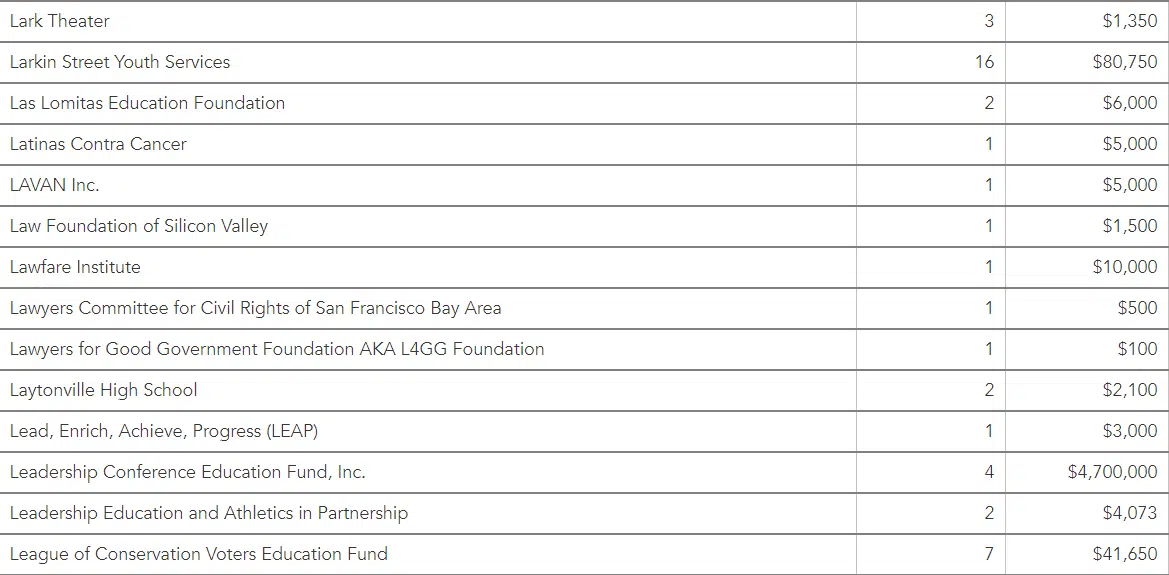
Sometimes you may not be able to find listings of donor names, but you can find grantee listings. My local Jewish Community Federation publishes one on its website, and it showed 16 donors making grants to Larkin Street Youth and seven making grants to the League of Conservation Voters Education Fund. That is useful intelligence if you run a youth services program or an environmental program. Why not reach out to the Federation and see if you can meet with them to let them know what you’re up to?
50. I heard that DAF referrals are a great way to help donors with cryptocurrency make a gift. Is this true?
Donor-advised funds often accept gifts of assets that charities are not equipped to handle. This includes gifts of personal property, real estate, closely-held businesses, and, yes, cryptocurrency. Donating in this manner enables donors to eliminate any capital gains taxes and give the full fair market value to charity. So if a donor wants to give you cryptocurrency, and you don’t accept those types of gifts, you might suggest they consider setting up a DAF, then sending a recommended grant your way.
51. Can a donor put their real estate into a DAF upon their death? Will the DAF institution sell its property for them?
Yes, if the DAF is one that accepts gifts of real property. Generally, it must be marketable and free of debt. And there can be no pre-arranged sale pending. The donor irrevocably transfers the property; when the property sells, the net proceeds will be used to fund the DAF. Most of the larger sponsoring organizations accept such gifts, but they all have their own rules. If you’re speaking with a donor who is considering establishing a DAF for this purpose, you may want to help them, as a donor service, to research the DAF sponsors that accept such gifts. I don’t recommend advising them to set up their fund at any one particular organization, but it is fine to give them a couple of leads to pursue on their own.
52. What is the best way to steward DAF donors?
DAF donors are like any other donor, but perhaps on steroids when it comes to ongoing stewardship. Why? Because they tend to be extremely thoughtful about their philanthropic investments and, therefore, interested in outcomes. They will respond especially well if you send ongoing reports letting them know how their investments are doing.
Whether your donor recommends grants from their DAF of $10,000 or $10 million a year, often they decide based on a larger vision/goal — addressing needs in the local community or making a dent in broader social problems. In fact, the typical Fidelity Giving Account donor has an average portfolio of eight charities. For DAF donors to connect the dots in their giving portfolios wisely, they need feedback from populations they seek to help. This is an opportunity for you to:
- Send warm thank you letters with stories of impact.
- Provide testimonials from folks the donor seeks to help with their gift.
- Ask for DAF donor feedback on strategic priorities.
- Talk to these donors! Listen for insights on areas of need, challenges, and opportunities that resonate with them. Don’t treat them differently because the gift came from a third party.
- If you can’t talk directly to the donor, talk to the donor’s administrator; ask them to share your feedback
IMPORTANT CAVEAT: These answers are offered based on my understanding, to the best of my knowledge, and are not to be relied upon as professional legal or financial advice. As laws and regulations are always changing and open to interpretation, you should always consult with your own professional advisors. A review of IRS “dos and don’ts” will assist with compliance and may save your organization from an expensive and embarrassing violation. See IRS Donor-Advised Funds Guide Sheet Explanation.
Four strategic tips to actively grow DAF revenue
Keep in mind that while donors get an immediate tax deduction for putting money in their DAFs, there are no requirements for how quickly it’s distributed to charity. This makes it essentially a charitable wallet for DAF donors. They can’t do anything else with this money except give it away to charity. Your job, as a philanthropy facilitator, is to help them!
Tip 1: Ask donors to dip into their own DAF piggy bank
Some of your donors may have money parked in their philanthropic piggy bank (aka DAF), and they’ve simply forgotten it’s there. They can’t give it to you simply by clicking the “donate” link in your GivingTuesday or year-end appeal. They have to make a request to the administrator of their DAF. It’s not hard, but a well-placed reminder from you can make a huge difference:
“Do you have a Donor-Advised Fund or private foundation? Thank you for being a proactive “philanthropist” (“lover of humanity”), and for making it a priority to help solve the world’s most pressing problems. If you have undistributed funds just waiting to be put to work, please reach out to your DAF or foundation administrator now to recommend a grant to [your charity] or to the charities of your choice. You will be making a real difference in the lives of those who could use a helping hand (or whatever reason makes sense for your charity).”
I encourage you not to be self-defeating by telling yourself you don’t have the right donors. The demographics of folks who create their own DAF may surprise you. Per Aspire Research Group Millennials opened 13% of DAFs in 2019 compared to only 6% in 2014. So, they’re not just for seniors. They’re also not just for the mega-wealthy. And, they can be opened many places for as little as $5,000.
Tip 2: Ask previous DAF donors to give again
If you have donors who have given via a DAF in the past, but have not done so yet this calendar year, reach out to them individually. The most efficient way is to make a phone call, followed by an email (or a text, if they’ve opted in). Do this NOW; don’t wait for the last two weeks of the year when many folks are traveling or otherwise busy with holidays.
“Last year, you generously made a gift through your Donor-Advised Fund – thank you! We’ve not yet seen a gift from you this year, and are hoping we’re still on your grant list. If you’ve made a recommendation, and we should be on the lookout for it, please let us know so we can thank you properly. If you have not, and I can answer any questions to help you with your decision, please let me know. Even if the answer is “no” this year, it would help us to know your reasons. In fact, that would be a gift to us, too! As always, your support means a lot.”
Tip 3: Steer would-be donors to established DAF repositories
Sometimes a donor wishes to make a significant gift by transferring appreciated real or personal property. If you’re not set up to accept such a gift, this can be an opportunity to suggest they give it to an already-established DAF repository such as Fidelity Charitable, Charles Schwab Charitable, Vanguard Charitable, and National Philanthropic Trust. Or you might steer them to a local community foundation or faith-based organization with which you have a relationship. It never hurts to make your donors their donors too. A rising tide raises all boats, and it’s good for you to establish relationships with your local funders whenever you can.
You might also consider meeting with your local community foundation, Jewish Community Federation, or other DAF repository to see if they have any DAF donors who might consider a gift to your organization. Part of their job is making recommendations to their donors, and they may not be aware of how what you do and what their donors care about are a perfect match!
Tip 4: Make DAF giving easy!
Make sure donors know you accept these gifts, and make the giving process as simple and transparent as possible. If you make giving from credit cards or via check the only “instant” way to respond to your appeals, you’re going to leave money on the table. So, include DAF giving on your donation landing page. Ideally, include a DAF widget with the instructions: “Give from my DAF.” Chariot, a DAF payments company, enables an “express checkout” experience called DAFpay within a nonprofit’s donation forms, akin to Google Pay or Apple Pay. There are others too, including DAF Direct and dafwidget. Here are some pros and cons of each.
Even if you don’t include a widget, publish your tax ID number. Donors may need this to submit to their DAF administrator. Don’t make them search for it!
I hope this advice is quick enough for your purposes, and you now have some good strategies for moving forward to raise more DAF dollars.
— Charity Clairity (Please use a pseudonym if you prefer to be anonymous when you submit your own question, like “Need Quick DAF Advice” did.)
DAF acknowledgement letter template
Because a sponsoring organization (like Fidelity Charitable or a community foundation) technically made the legal donation, you cannot issue a standard tax receipt to the individual donor. Instead, use this template to properly thank them for their stewardship without creating IRS compliance issues.
[Your organization’s letterhead]
[Date]
[Donor name]
[Donor address]
[Donor city, state, zip]
Dear [Donor name],
Thank you so much for recommending a grant of [Grant amount] from the [Name of DAF, e.g., Schwab Charitable Fund] to support [Your organization’s name]. We received this generous gift on [Date received].
Your commitment to [Briefly insert your mission, e.g., providing clean water access or protecting local wildlife] ensures that we can continue our vital work in [Current year]. Because of partners like you, we are able to [Insert a specific, short 1-sentence impact statement].
Please note that because this gift was distributed through a donor-advised fund, no goods or services were provided in exchange for this grant, in legal compliance with IRS regulations.
We are incredibly grateful for your visionary support and your belief in our mission.
With deep gratitude,
[Signature]
[Name]
[Title]
[Your organization’s name]
Important compliance reminder: Do not include text like “This letter serves as your official tax receipt” or “Your contribution is tax-deductible to the extent allowed by law.” The donor already received their tax deduction when they deposited assets into their DAF.
Have you found this information on DAFs useful?
I hope you’ll consider enrolling in “Clairification School” to support my efforts to empower small to medium-sized nonprofits that don’t have large budgets for training and consultation. Consider Clairification your online, year-round fundraising school.
I’ll tell you not just what to do, but why. You’ll get tons of useful content — pretty much for peanuts — because I’m dedicated to giving you the knowledge you need to succeed. Some folks have told me it’s “ridiculously inexpensive” for what you get — and I hope you’ll think so too!
My motto is “If I know it, I want you to know it!”
As others taught me, so do I wish to teach you.