20 Essential Steps to Plan for Successful Year-End Giving




The year-end giving season is your nonprofit’s grand finale: your final, high-energy push to meet and exceed your financial goals before the start of next year. It’s a generous time of year because supporters are motivated by the holiday spirit and want to make a difference. It’s also the last opportunity for donors in the U.S. to submit tax-deductible gifts.
This giving frenzy is reflected in the research. In fact, roughly 30% of annual giving takes place in December.
In this guide, we’ll review the importance of year-end giving and the best strategies to plan a successful campaign. Here’s what to expect:
- Year-end giving FAQs
- Steps to plan a successful year-end giving campaign
- How Bloomerang can help you host the best year-end giving campaign yet
The sooner you can start your year-end campaign planning, the more time your team will have to prepare and align on strategy and timelines.
Year-end giving FAQs
What is year-end giving?
Year-end giving is the powerful stretch of the year—typically October through December—when supporters feel a stronger sense of purpose and increase their donations. During this season, nonprofits experience a natural rise in generosity fueled by holiday spirit, meaningful moments of connection, tax incentives, and hallmark campaigns like GivingTuesday.
For nonprofits, year-end giving is a mission booster. This is when well-planned campaigns help deepen donor relationships, encourage loyal supporters to give again, and attract new donors. With the right strategy, year-end giving can generate the momentum that confidently carries your mission into the year ahead.
When does most year-end giving occur?
Nonprofits often see a spike in giving throughout December, with many final tax-deductible gifts coming in on December 31st.
Furthermore, GivingTuesday, a global fundraising day that occurs every Tuesday after Thanksgiving in the U.S., is typically one of the most successful fundraising days for nonprofits each year. In 2025, nonprofits using Bloomerang collectively raised a record-breaking $76 million in donations.
Why do people give at the end of the year?
People participate in year-end giving for many reasons, including:
- Feeling gratitude and a desire to give back after a fulfilling year
- Qualify for more tax deductions before the tax year cut-off
- Desire to participate in a corporate matching gift program with a year-end deadline
- Feeling influenced by family members and friends who are also giving
Why is year-end giving so important?
Understanding just how important year-end fundraising is for your organization allows you to prioritize it appropriately when planning your fundraising calendar. These statistics illustrate why you should prioritize year-end giving within your overall fundraising strategy:
- December giving made up 26% of all online revenue and 34% of one-time online revenue for nonprofits in 2023. Donations made on December 31, 2023, accounted for 5% of revenue.
- Most nonprofits begin their year-end fundraising planning in November, but 7.7% start as early as September.
- Most nonprofits use various marketing platforms to generate at least two “touches” with supporters during the year-end fundraising season.
- Direct mail is the most popular year-end giving marketing method.
These statistics illuminate the importance of starting your year-end fundraising planning early and creating impactful written appeals to resonate with your supporters.

20- steps to plan a successful year-end giving campaign
You might not have experience creating a formal year-end giving strategy, or you may be looking to update your current strategy. Wherever you’re coming from, here are the key steps to help you make the most of the year-end giving season and reach your goals.
1. Start planning early
Starting early sets your year-end giving campaign up for success. When you plan ahead, you soften the impact of any surprises and give your team the clarity, confidence, and breathing room they need to own their roles.
A good rule of thumb? Kick off your end-of-year giving prep as students head back to school—about three to four months before your campaign begins. This early start keeps your team grounded rather than rushed, and it creates space to build a thoughtful, engaging campaign that inspires generosity when it counts most.
2. Assess past year-end giving results
To move your plan forward successfully, review your past year-end fundraising performance and determine your strengths, weaknesses, and opportunities for improvement. This will help you strategize for your upcoming campaign and improve year-over-year results.
Assess your previous year-end campaign and ask yourself the following questions:
- Did we reach our campaign goal?
- Was the fundraising total higher or lower than we expected?
- Who were our biggest contributors?
- Which marketing platforms received the most engagement?
- What was our average donation size?
- What were the demographics of our year-end donors?
- What aspects of the campaign can we improve this year?
Develop a plan to tackle other aspects of your year-end fundraising campaign that didn’t reach their full potential. For example, if your marketing efforts were misaligned with your audience, conduct more audience research to better understand your supporters. Or, if you fell short of your fundraising goal last year, brainstorm strategies to improve your marketing and stewardship efforts to connect with current and new donors.
3. Set clear fundraising goals
Setting clear, measurable goals gives your year-end fundraising campaign the focus and momentum it needs to truly shine. Use the SMART goal framework to ensure your goals are actionable:
- Specific: Narrow down your goal to something that you can accomplish and make sure you won’t be juggling too many things at once.
- Measurable: Choose metrics that will help you know whether you’ve met your goal or not. Check them often!
- Attainable: Don’t set yourself up for failure by reaching for the impossible. Be realistic about the goal you set for your campaign so you can get there.
- Relevant: Keep your cause at the forefront of your goal-setting. Choose a goal that is congruent with your mission.
- Time-based: Set a clear date or time for when your nonprofit should meet its end-of-year giving goal.
Here are a few examples of SMART goals a nonprofit might set for the end-of-year giving season:
- “By 11:59 PM on December 31, 2026, we will raise the $25,000 needed to equip our animal rescue teams in the new year. We will target our major donors and monitor our CRM to measure donation sizes to stay on track.”
- “By the end of the year, we want to have 300 new donors enrolled in our monthly giving program. To make this happen, we’ll ask each of our current monthly donors to share a post on social media about our monthly giving program. We will offer raffle tickets to everyone who completes the task and watch our social media traffic to see how many people click through to our sign-up form.”
- “We will use this end-of-year giving season to kick off our capital campaign to build a new facility for our nonprofit. By the end of December, we will complete our feasibility study and determine next steps with our fundraising consultant.”
Whatever SMART goal your team lands on, remember it isn’t just for your team to use. You can also share your SMART goal with your supporters to keep them engaged and up to date on your end-of-year efforts. Try giving regular social media updates on Instagram or through a live feed on your website’s homepage.
4. Craft a compelling case for support
A case for support tells donors why you need their help and what their gifts will make possible. Crafting a strong case for support helps donors instantly understand the problems they can help solve, setting the stage for a message that feels both urgent and inspiring.
Build your case for support around meaningful stories and vivid examples of the difference your nonprofit is making. When supporters can see a face, feel a moment, or understand a specific need, empathy grows, and so does their desire to give.
Follow these steps to tell a complete story:
- Select a protagonist. Think about long-time volunteers or someone impacted by your mission. Give your audience information that will help them identify with the individual featured in your story.
- Define the problem. Define the main issue you’re trying to solve with your year-end giving campaign. This could be related to your nonprofit’s overall mission or a specific issue you’re tackling with this year’s fundraising campaign. For example, an animal rescue might target its year-end giving campaign toward renovating its kennel to add more outdoor space for dogs to play.
- Wrap it up with a call to action. Describe how donors’ gifts will enable your nonprofit to help solve the proposed issue. Make the problem as tangible as possible. Show donors how their gift will impact your cause (i.e., meals served, houses built, or animals vaccinated) and how much is needed to reach your goal so they understand the value of supporting your mission.
A strong story, partnered with uniform, professional design, leaves a positive impression on recipients. As a result, they will see your organization as more credible and trustworthy.
5. Increase urgency around year-end giving deadlines
Throughout the year, your nonprofit likely sends urgent appeals sparingly, and for good reason. Too many urgent requests can tire supporters out and cause them to take each one less seriously than the last.
However, the year-end giving season is a great time to roll out urgent appeals, specifically around giving deadlines. For example, you might plan a giving day for your nonprofit with a 24-hour campaign timeline and send several appeals throughout the day to update supporters on your progress and remind them to give.
Also, remind your supporters that donations contributed after December 31st will not be tax-deductible for the year. If donors want to adhere to this deadline, it’s in their best interest to give sooner rather than later, so it doesn’t slip their minds.
6. Brand your year-end appeal
Incorporate your logo, fonts, colors, and tone of voice into all year-end marketing materials to ensure they reflect your organization’s brand.
You might even create a unique brand for your year-end fundraising campaign, with a memorable theme and slogan. For instance, a winter or holiday-themed campaign can build on excitement about upcoming seasonal celebrations.
In your brand messaging, emphasize these key points:
- The campaign is a team effort.
- The donor and your nonprofit are working together.
- Your nonprofit relies on the generosity of its supporters to make a real difference in your cause area.
Creating a unified campaign brand ensures that your year-end fundraising efforts are memorable as a whole and stand out in supporters’ social media feeds, email inboxes, and mailboxes.
7. Segment your donors and personalize messages
While you can send a year-end email appeal to your entire supporter base, many nonprofits see stronger results when they take a more intentional approach by segmenting their donors.
Segmentation simply means grouping supporters based on shared characteristics. For example, you might segment donors by:
- Engagement level
- Recency and frequency of giving
- Preferred communication channel
When you tailor your year-end giving appeals to each segment, you ensure the right message reaches the right people. Instead of sending one broad message to everyone, you deliver more personal, relevant communication—without adding unnecessary work to your plate.
This is where thoughtful messaging matters. For instance, you might celebrate your nonprofit’s recent achievements with new donors, while sending long-time supporters a meaningful year-in-review. Prompt, personalized thank-you messages also play a powerful role in deepening donor relationships and boosting retention over time.
And as you plan, don’t forget to look back. Insights from previous campaigns—what donors responded to, when they gave, and how they engaged—can guide your segmentation and help you refine your strategy for even stronger results.
Finally, make each message feel uniquely crafted for the reader: include donors’ names in subject lines, address them directly, and acknowledge their past involvement. These small touches go a long way in helping supporters feel seen, valued, and inspired to give again.
8. Conduct A/B testing
A/B testing is the process of creating two versions of your year-end appeal and identifying which one inspires more engagement or action. It’s a simple way to understand what resonates most with your supporters and refine your messaging before the final stretch of your campaign.
You can test nearly any element of your year-end appeal: subject lines, body copy, images, calls to action, or even the emotional framing of your message. Successful year-end campaigns frequently experiment with strategies such as matching gift promotions or powerful storytelling, helping them uncover which approaches truly move donors to give.
As you run these tests, change only one element at a time so you can clearly identify what made the difference. For example, take a segment of mid-level donors and split them into two groups. Send each group a version of your year-end appeal with a unique subject line but identical content otherwise, such as:
- [Donor’s First Name], submit your tax-deductible year-end gift today!
- [Donor’s First Name], support our year-end push to get winter coats to community members in need!
Track engagement metrics, like open and click-through rates, to reveal which elements resonate most with your audience. Emotional donor-centered messaging often stands out, helping supporters feel connected to both the need and the impact of their generosity.
By the end of your A/B testing process, you’ll have a polished, high-performing appeal ready to send during the most crucial weeks (or even days) of the year-end giving season, ensuring your message lands with clarity, heart, and purpose.
9. Create an outreach cadence
People tend to get busy at the end of the year. They might notice your outreach messages but forget to give or put it off until later.
An effective communication cadence will help you stand out and maintain your supporters’ attention. Plus, you’ll be able to ensure your nonprofit’s team members, including your staff members, board members, and other volunteers, understand their roles and when they need to complete certain outreach responsibilities.
Develop a communications calendar for October, November, and December for each donor segment, including key dates for each touchpoint. Use these tips to guide you:
- Stagger your communication at least every two weeks until mid-December. Maintain a balance among your most effective communication channels, and don’t place too much emphasis on platforms that receive little interaction. For instance, you might send most of your communications using email and Facebook, while posting only occasionally on your less-popular Instagram account.
- Send more messages during the last two weeks of the year. Most donors know they will make a year-end gift, but some may still be undecided about how much to contribute. Continue to share your case for support and make it easy for them to give at the last moment.
- Send daily digital communications during the last four days of the year. Most of the communication at this point will happen online via emails, social media, and your website. Consider sending the first of your final emails to everyone in your donor file who hasn’t yet given. For the next round, suppress the names of those who opened the previous last-chance email and resend the email.
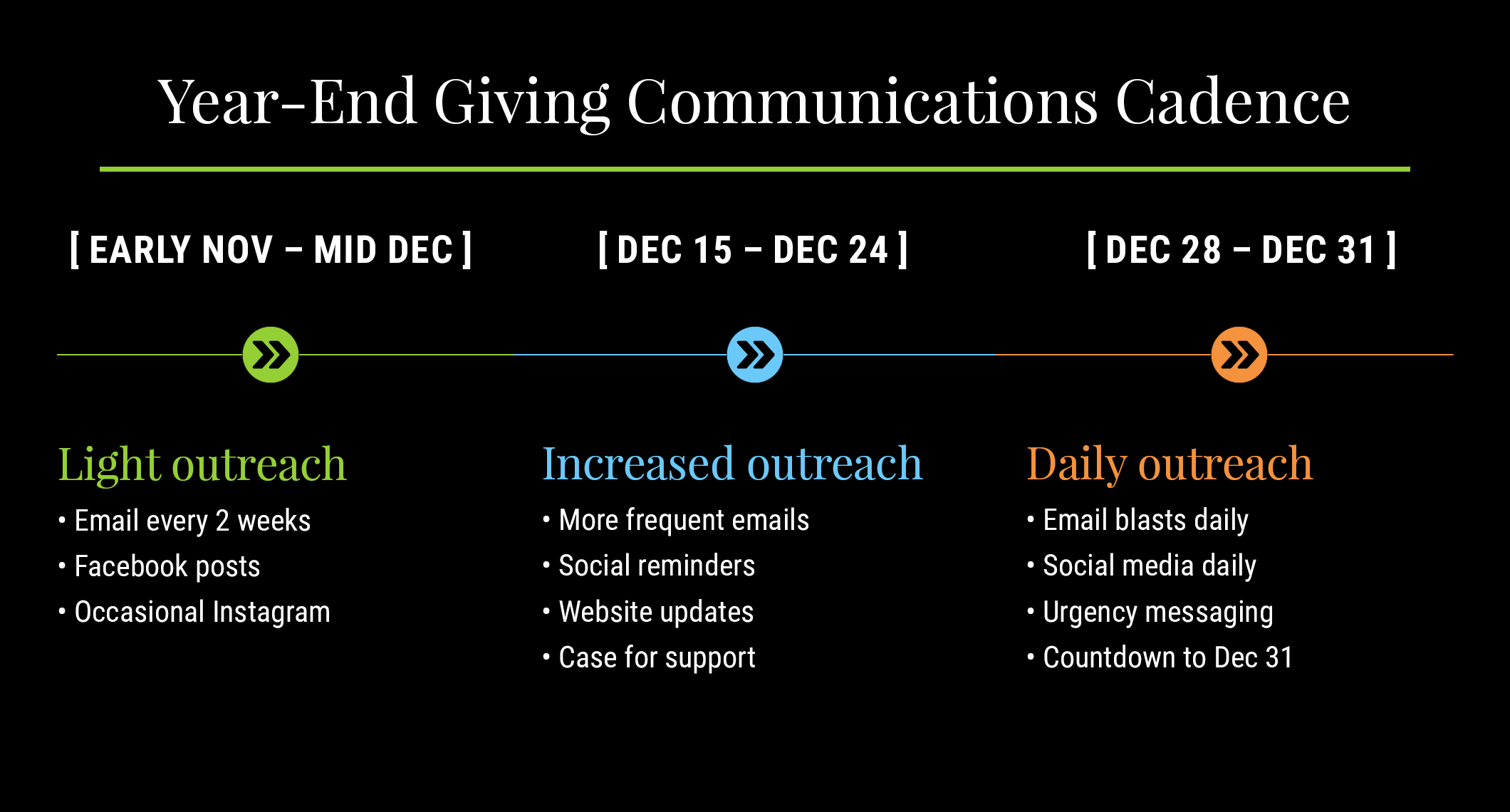
The key to an effective communication cadence is balance. You don’t want to send so many messages that supporters become overwhelmed, but you want to ensure you’re engaging with them so everyone who wants to give has a chance to do so.
Supplement your email and direct mail appeals with social media posts and website updates. Share campaign updates, shorter versions of your case for support, and thank-you messages to those who have already donated.
10. Optimize your website for year-end giving
Make it as easy as possible for donors to find your donation page by including a large donate button on your homepage, along with a variety of call-to-action buttons and links throughout your website that direct visitors to your giving opportunities.
An optimized donation page is clean, mobile-friendly, and features clear calls to action.
Your online donation form itself should be easy to fill out to facilitate ongoing donations through your website. Design your form with the following strategies to make it user-friendly and convenient:
- Only ask for the necessary information, such as donors’ names and payment information.
- Ensure the form is mobile-friendly by reviewing and editing it in the mobile view.
- Embed a matching gift tool so donors can research their matching gift eligibility right from your form, potentially doubling their donation.
- Offer suggested giving amounts to give donors an idea of what types of donations you’re looking for and help them decide on their donation amount.
- Offer donors the option to turn their one-time gift into a recurring monthly donation. Highlight any benefits of your monthly donation program, such as merchandise discounts or VIP access to events.
When your website and online donation form are optimized to support your year-end giving campaign, you can incorporate links into your other outreach channels, such as social media posts and emails.
Also, you can offer a valuable resource that helps both existing and new supporters get to know your organization more deeply and understand the full impact of their donations. They can view your online donation page to get all the information they need to decide whether and how much to give.
11. Write a great year-end appeal
There’s a lot riding on how you ask for donations during the end-of-year giving period. It’s wise to take the time to revisit how to write strong donation appeals. Let’s go over the recipe for a great appeal:
- Focus on the donor first and foremost. Donations, no matter the size, are often a sacrifice for your supporters. They’re choosing to give money to your organization that they could spend elsewhere. Remember that and put your donors first. Recognize their generosity and sacrifice.
- Tell a story. Even a brief story about how your donors have made a difference in your beneficiaries’ lives can strengthen your donation appeal. Try sharing the story of one person to highlight the human element of your cause.
- Use visuals. Pictures and videos bring your cause to life. Don’t be afraid to use them on your donation page or in a social media post to encourage people to give. Visuals often spark our curiosity and get us to dive a little deeper into a webpage or social media post.
- Craft a well-worded call to action. A call to action is simply a statement that asks a donor to complete a specific task. However, some calls to action are better worded than others. For example, “Donate now” is a weak call to action compared to “Give today and help us wipe out cancer for good.”
- Offer multiple ways to give or get involved. Not every supporter is in a position to make a monetary donation during the end-of-year giving period. Offer multiple ways to get involved with your cause, whether that’s through volunteering at your end-of-year event or forwarding campaign information to friends via email.
- Use different channels for delivering your appeals. Pay attention to what different segments of your audience need from you. Some donors will respond better to an appeal on Facebook, for example, while others will prefer to be solicited via direct mail. Don’t forget to adapt your donation to each channel’s unique requirements.
Once you’ve mastered the art of writing end-of-year appeals, you’ll be able to better connect with your supporters and meet your year-end goals.
12. Incorporate text fundraising
Text fundraising is a powerful tool at any time of year, but it is especially useful for attracting last-minute donations in November and December.
Why? Text fundraising is easy for a donor to participate in. That means they don’t have to take too much time away from their holiday celebrations or family get-togethers to give to your cause, making it more likely they’ll follow through with their donations.
Here are some tips for making sure your end-of-year text fundraising will go smoothly:
- Let donors opt in. No one wants to receive messages they didn’t subscribe to. By letting your donors opt in to fundraising text messages from your organization, you’re enabling them to decide if they want to participate in your campaign. This also communicates to donors that you respect what they want and need from your organization, helping build your credibility with them.
- Choose an easy keyword. To opt in to your campaign, donors will need to text a keyword to your organization’s number. From there, you can send them a link to your donation form that they can use to make their donation. This means that your chosen keyword will be critical to the success of your campaign. Keep it short and easy to remember. For example, “ClydeFamilySoupKitchenEndofYear” will be much harder to remember and type than “SOUP.”
- Plan messaging for different segments. Different donors need different messages for your text campaign. For example, new donors will likely need a little more background on your cause and campaign before they’re convinced to give. On the other hand, donors who participate in your monthly giving program will likely appreciate a more straightforward set of messages that acknowledge their current giving, since they’re already invested in your cause!
Try using social media to get the word out about your text fundraising campaign. Share an infographic with instructions for how to opt in and pin it to the top of your social media page until your end-of-year campaign is over.
13. Make the most of GivingTuesday
Many nonprofits use GivingTuesday as the day that launches their end-of-year giving campaigns into full swing.
GivingTuesday 2025 broke records, with over $4.0 billion raised and 38.1 million participants. This momentous giving day is a critical opportunity for your nonprofit during the year-end giving season.
Ensure your organization is ready to make the most of GivingTuesday by planning a campaign. Your campaign could be:
- A 24-hour social media campaign that inspires urgency by having a hard deadline
- A special giving event, such as a 5K or fundraising gala, where supporters can gather and have fun while raising money
- An in-kind donation drive for supporters to contribute valuable items to your nonprofit, such as art supplies, gardening tools, or clothing
Whatever campaign or event type you choose, increase excitement leading up to it by posting event previews on social media and personally inviting your most dedicated supporters to get involved.
14. Start a peer-to-peer fundraiser
Peer-to-peer fundraising is a highly effective form of year-end fundraising because it can expand your nonprofit’s reach to new audiences, driving more revenue for your organization. Using a peer-to-peer fundraising platform (like Bloomerang), you can empower your supporters to create personalized campaign pages that express the campaign’s purpose and their personal connection to your mission.
Then, supporters will share their fundraising pages on social media and email, gathering donations from their family members and friends.
15. Launch a recurring giving campaign
A recurring giving campaign may not bring in as many donations upfront for your year-end campaign, but it will give you a steady and sustainable income you can rely on into the new year.
According to 2025 data from the Fundraising Effectiveness Project (FEP), repeat donor retention is 60%, compared with just 19% for new donors. That means a monthly giving program is well worth investing in!
You can easily incorporate monthly giving into your current donation page as well. Check out how the Learning Resource Center of Polk County included an option on their donation form to multiply impact by turning a one-time donation into a recurring donation:
16. Run a matching gift drive
A matching gifts drive is one of the most compelling ways to create urgency and boost donation sizes during the year-end push. When supporters know their contributions will be doubled (or even tripled), they feel an immediate incentive to give before the December 31 deadline—and are much more likely to increase their gift size to maximize the match.
According to research from Double the Donation, 84% of donors say they are more likely to donate if a match is offered, and 1 in 3 donors indicates they would give a larger gift if matching funds are applied.
There are two effective ways to run a matching gifts drive at year-end:
- Securing a challenge match: Partner with a major donor, board member, or corporate sponsor to create a dedicated matching pool (e.g., “The first $10,000 raised will be matched dollar-for-dollar!”).
- Promoting corporate gift matching: Encourage supporters to use their employers’ matching gift programs.
By embedding an employer-matching gift search tool directly into your Bloomerang donation forms, you make it seamless for donors to check their eligibility and submit match requests—instantly multiplying their impact without requiring extra dollars out of their pockets.
17. Plan a new-donor email welcome series
Creating an email series for new donors can help set you up to retain them into the new year and beyond, especially when you share the impact of their donation, as we mentioned above.
New end-of-year donors are a specific segment of your audience, and you should plan your email series accordingly. Here are some great email ideas to help you kick off their involvement with your organization:
- Introduce your new donors to your mission, the programs you offer, and who you help.
- Share your organization’s history and leadership information.
- Send out a survey to get to know your donors.
- Invite your donors to follow your organization on social media.
- Provide information on gift matching and recurring giving.
- Feature recent blog posts and volunteer opportunities.
When creating your email series for new donors, make sure you work with your team to decide how many emails you’re going to send and how often you will send them. Aim to be consistent in sending your emails, but don’t send so many that they overwhelm your new donors. Each email should be poised to encourage donors to increase their involvement with your organization!
18. Show gratitude
Expressing appreciation for year-end giving donors helps you turn these supporters into ongoing champions of your mission. A thoughtful gratitude strategy lays the foundation for deeper relationships and opens the door to year-round support. Sending heartfelt, personalized acknowledgments within a day or two of each gift strengthens trust and encourages donors to stay engaged long after the season ends.
Follow these steps to build an effective appreciation strategy:
- Ensure your online donation thank-you page or automated donation confirmation includes a thank-you message, reiterates the impact of donor gifts, and allows donors to share their donations on social media.
- Send a longer follow-up thank-you message within 24-48 hours of each donor’s gift to strengthen trust. Reiterate how their contributions will help you achieve the goals you highlighted in your initial appeal, whether that’s collecting funds to support your ongoing programs or supporting a specific project.
- Personalize your thank-you messages by addressing them with donors’ names and referencing their specific donation amount.
Consider hosting an event to wrap up the year-end giving season and thank supporters in person. Events are a great way to reinforce a sense of community within your organization. Year-end giving events can be anything from a gala, grand raffle, auction, seasonal concert, or play. You can also livestream your event to create a hybrid experience, connecting with both in-person and virtual attendees.
19. Analyze your success
After the year-end giving season, assess relevant metrics to determine how well your strategy performed. This analysis lets you know what you should improve or maintain for next year. Round up metrics such as your:
- Fundraising total. Did you reach your goal? Assess whether you exceeded or fell short of your expectations and the possible reasons why.
- Average and median donation sizes. What types of donations were most popular during your giving campaign? These metrics can help you determine which level of donors (smaller, mid-sized, or larger) were most engaged and your suggested giving amounts for next year’s campaign.
- Direct mail response rate. How many donations came through the mail? Your direct mail response rate will help you determine whether you need to adjust your mailing strategy for next year and conduct more A/B testing.
- Online donation total. How many donors used your online donation form, and what was the total donation amount from this platform?
- The number of new donors. How many new donors did you connect with during your campaign? This lets you know the effectiveness of your new donor outreach and marketing strategies.
- The number of repeat donors. How many donors who gave to your most recent year-end fundraising campaign also gave the previous year? This metric will illustrate the effectiveness of your donor stewardship strategies.
Compare these numbers to metrics from previous years to identify trends. This information will let you know the areas you should focus on improving for next year’s campaign.
20. Steward donors after your campaign
Sharing a year-end impact recap reminds donors how much their generosity matters and inspires them to continue supporting your mission.
Follow up with donors again when your campaign concludes to share your year-end giving results and invite donors to engage with your organization in other ways.
For example, you might invite them to:
- Attend an educational event
- Participate in a volunteer opportunity
- Sign up for your email newsletter
- Host a fundraising event
To avoid overwhelming donors, don’t ask for another gift too soon after your year-end campaign. Instead, focus on building genuine, well-rounded relationships in which donors feel truly welcome into your organization’s mission.
How Bloomerang can help you host the best year-end giving campaign yet
Bloomerang is the ultimate hub for year-end giving success. Our unified giving platform empowers nonprofits to raise more, retain donors, and grow year after year.
Exceed your year-end giving goals with purpose-built fundraising features like:
- Unified CRM, fundraising, and volunteer management. Use the best of donor, fundraising, and volunteer management in one system. Get a holistic view of your supporters to identify the best ways to reach them with targeted year-end appeals.
- Built-in donor segmentation. Group donors based on different criteria, such as gift size or frequency, to contact donors with tailored outreach.
- Targeted appeals with an AI Content Assistant. Send more compelling email messages with our AI writing assistant, which you can use to optimize headers, subject lines, content, and calls to action.
- Robust reporting and data analysis. Evaluate your year-end giving performance with comprehensive, customized, user-friendly reporting tools. Drill down into your data with filter-based reporting, scheduled reports, and data segmentation.
Learn about the spectacular results nonprofits using Bloomerang were able to achieve for GivingTuesday 2024:
Wrapping up
The year-end giving season isn’t just a time to reach out to supporters and gather last-minute donations. It’s also a time to reflect on the progress made throughout the entire year and celebrate your organization’s achievements.
By planning early, building a strong case for support, and personalizing your donor outreach, you can reach your year-end giving goals and lay the foundation for stronger supporter relationships next year.
Looking for more information on nonprofit strategic planning and how to improve your fundraising campaigns? Start with these additional resources:
- Nonprofit Strategic Planning: A Complete Guide. Your year-end giving strategy is one component of your overall nonprofit strategic plan. Use this guide to approach strategic planning more effectively.
- 29 Fundraising Platforms for Nonprofits in 2026. You’ll need the support of powerful software solutions, such as a donor management system and an online giving platform, to make your year-end fundraising successful. This guide reviews the top solutions on the market.
- Donor stewardship: key tips to build relationships. Effective donor stewardship is required for every fundraising campaign, including your year-end giving campaign. Use the tips in this guide to improve your stewardship approach.