Should Nonprofits Use an Automated Email Welcome Series for Donors?
Updated: 04/23/2026

Updated: 04/23/2026
An automated email welcome series is one of the most commonly recommended strategies for engaging new donors. When someone makes their first gift, they’re automatically sent a sequence of emails over several weeks—designed to welcome, educate, and eventually ask again.
It’s efficient. It saves staff time. And it ensures no donor slips through the cracks.
But with first-time donor retention rates hovering around 20%, nonprofits have to ask: does an automated email welcome series actually improve retention—or could it unintentionally hurt it?
The following is an excerpt from Robots Make Bad Fundraisers – How Nonprofits Can Maintain the Heart in the Digital Age by Steven Shattuck, published by Bold & Bright Media.
The “email welcome series” is a frequently-recommended tactic for communicating with new donors while saving staff time in the process.
The idea being that when a donor makes their first gift, they’re queued up to receive a series of emails (three, five, etc.) over a period of time (a few weeks, a month, etc.) with each email spaced out appropriately.
But is this really a good idea?
I think that, in general, automation and stewardship are mutually exclusive. Automation is great, but it can’t compete with or replace the personal touch (at least not until the robots are smart enough to wipe us out entirely anyway).
New donors, whose donor retention rates are typically around 20%, are perhaps the worst cohort of constituents to automate any type of communication towards for three reasons:
Unless your organization has a high volume of lower dollar amount first-time donations, a multi-touch email series immediately after the first gift would not be my recommendation, even if it did also include a formal thank you letter in the mail.
Here is my take:
There is a mountain of research that says a personal touch point within 24-48 hours of that gift is the best first touch:
I don’t think an automated email or emails that every new donor gets can be considered a personal thank you. We’re talking a phone call, handwritten note, voicemail and even a 1:1 email.
In today’s digital age, these touch points will stand out among the hundreds of emails we receive daily.
John Lepp from Agents of Good tells recently told me the story of a friend of h is in the donor love department at UNICEF Italy that ran a test on sending a handwritten, heartfelt card within 48 hours of getting a gift (from any donor) and a call on the anniversary of giving or on a birthday.
The results were a 30% yearly increase in retention and a 50% increase in donor lifetime value.
Andrew Olsen, CFRE recently told the story of a hunger relief org he worked with that eliminated paper thank you letters to online donors to save money on print and postage. They lost $300k to lower retention and fewer gifts the next year.
There’s no better donor to get to know than a first-time donor. Without knowing the motivation for their gift, or what in particular they are interested in with regards to your programs/services, I’m not sure on what basis you would populate the content for an automated welcome series.
You’d either have to make assumptions about all of your new donors, or be forced to cover every single topic all at once and hoping that something sticks.
This is particularly problematic for organizations that have a wide service offering. If you’re an environmental organization, how will your email welcome series account for donors who are interested in wildlife versus those who are interested in the forests? Sure, it’s safe to assume that the donor will care about both, but targeted communications will always win out over a one-size-fits-all approach.
Even those with a very targeted mission focus run the risk of missing the mark with a donor.
Two donors who each made their first gift online and each gave $25 can be very, very different types of donors. Consider a donor who gave to you because they had a loved-one die from the disease you’re trying to eradicate, versus a donor who donated because they saw that a college roommate was raising money for you, or gave a memorial gift at a funeral home, or saw a television ad and donated in the moment.
Communicate to these donors the same way at your own peril!
Not only will gleaning and contextualizing donor motivation and gift channels reward you, but donors also like to be asked!
You’ll also see this emphasized in research from DonorVoice (of the top seven reasons cited by loyal donors for why they keep giving, the #4 item was that “the donor receives opportunities to make views known.”
There is no reason to wait an entire year to ask for a second gift. In fact, asking within 90 days of the first gift is a research-based recommendation. However, if a first-time donor is getting automated emails from you that do not ask for a second gift, you run the risk of missing that window of opportunity.
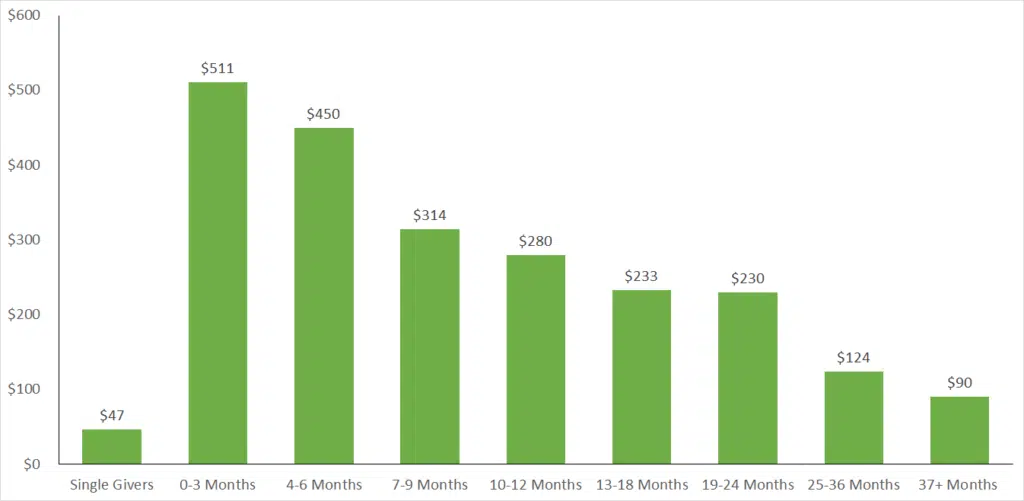
Analytical Ones found that the amount received in a second gift drops the longer you wait to ask for it:
Our own Bloomerang data confirmed as much, specifically in cases when that new donor is called within the first 90 days:
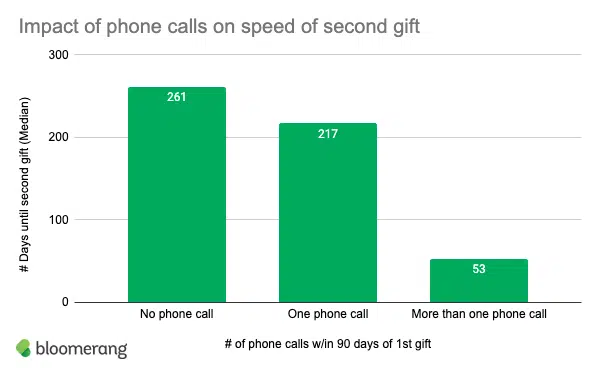
There is definitely a honeymoon period for new donors, but success is incumbent upon doing a good job thanking the donor personally, telling them stories and getting to know them so that you contextualize and personalize that second ask (rather than just automated an appeal on a set schedule that every single new donor gets).
Lori Jacobwith has a great first-time donor communication plan that, while hard to automate, does check all of the boxes that research tell us, and sets you up for an effective appeal:
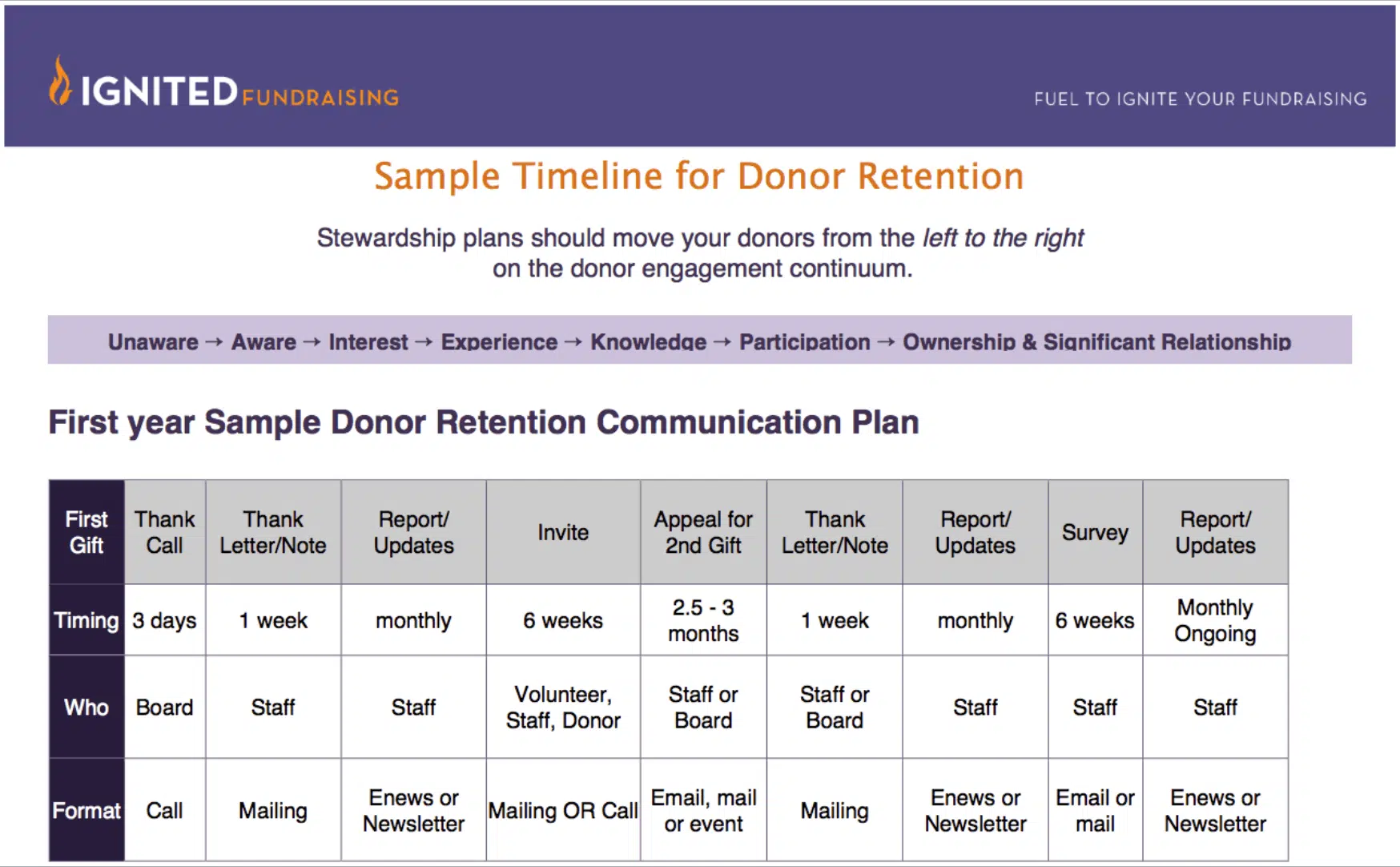
I think this is pretty solid, but you could definitely push a survey sooner. The tour invitation is a great idea if you have a facility or location that can be toured. Not only will they see your mission in action, but you’ll inevitably make small talk and possibly learn about their motivation (replacing the need for a survey).
Thinking again about that “90 day honeymoon period” it might be wise to create a stewardship plan that zooms in on those first three months:
A structured 90-day donor stewardship plan designed to improve retention, build genuine relationships, and maximize second-gift conversion—starting the moment a first gift arrives.
| Timeline | Donor touchpoint | Purpose |
|---|---|---|
| Day 0 | Donation received | Begin the stewardship process immediately. The clock on your new donor relationship starts now. |
| Day 2 | Thank-you phone call | Call within 48 hours to create an immediate personal connection. Research shows this single action meaningfully improves first-year retention. |
| Day 5 | Thank-you note by mail | Send a signed letter from your CEO or Executive Director. A handwritten note adds outsized impact for minimal effort. |
| Day 10 | Donor survey | Gather preferences and motivations to personalize every future touchpoint. Asking donors what they care about signals you’re listening. |
| Day 10–25 | 1st email newsletter | Introduce your mission in action, reinforce the donor’s impact, and begin building familiarity with your organization. |
| Day 25 | Tour invitation | Invite your donor to experience your work firsthand. Seeing your mission in person—and meeting the people behind it—creates lasting emotional connection. |
| Day 25–50 | 2nd email newsletter | Continue your story. Show outcomes tied directly to the donor’s contribution and keep your organization top of mind. |
| Day 50 | Stewardship mail piece | Send a personalized update showing exactly how the donation was used. Include a specific story from your organization—make the impact feel real and human. |
| Day 50–70 | 3rd email newsletter | Reinforce trust, highlight continued impact, and sustain engagement in the window before your next ask. |
| Day 70 | Stewardship phone call | Have a staff member or volunteer call to express genuine appreciation. This isn’t a solicitation—it’s a relationship check-in that sets up the final ask. |
| Day 85 | Second gift appeal | The end of the first 90 days is your best opportunity to secure a second—and often larger—gift. By now your donor knows your organization and trusts your impact. Make the ask confidently. |
Source: Bloomerang — donor retention research and nonprofit fundraising best practices.
Even though that sounds like a lot of work, it’s worth it. The retention rate on first-time donors is around 20%. So if your cost per acquisition is more than the donation amount from the first gift, you have negative ROI right off that bat. You have to get a second gift to get back above break-even. So spending time here is financially justifiable.
Not only is the first-time donor retention rate an abysmal 20%, but it’s been on the decline over the last five years:
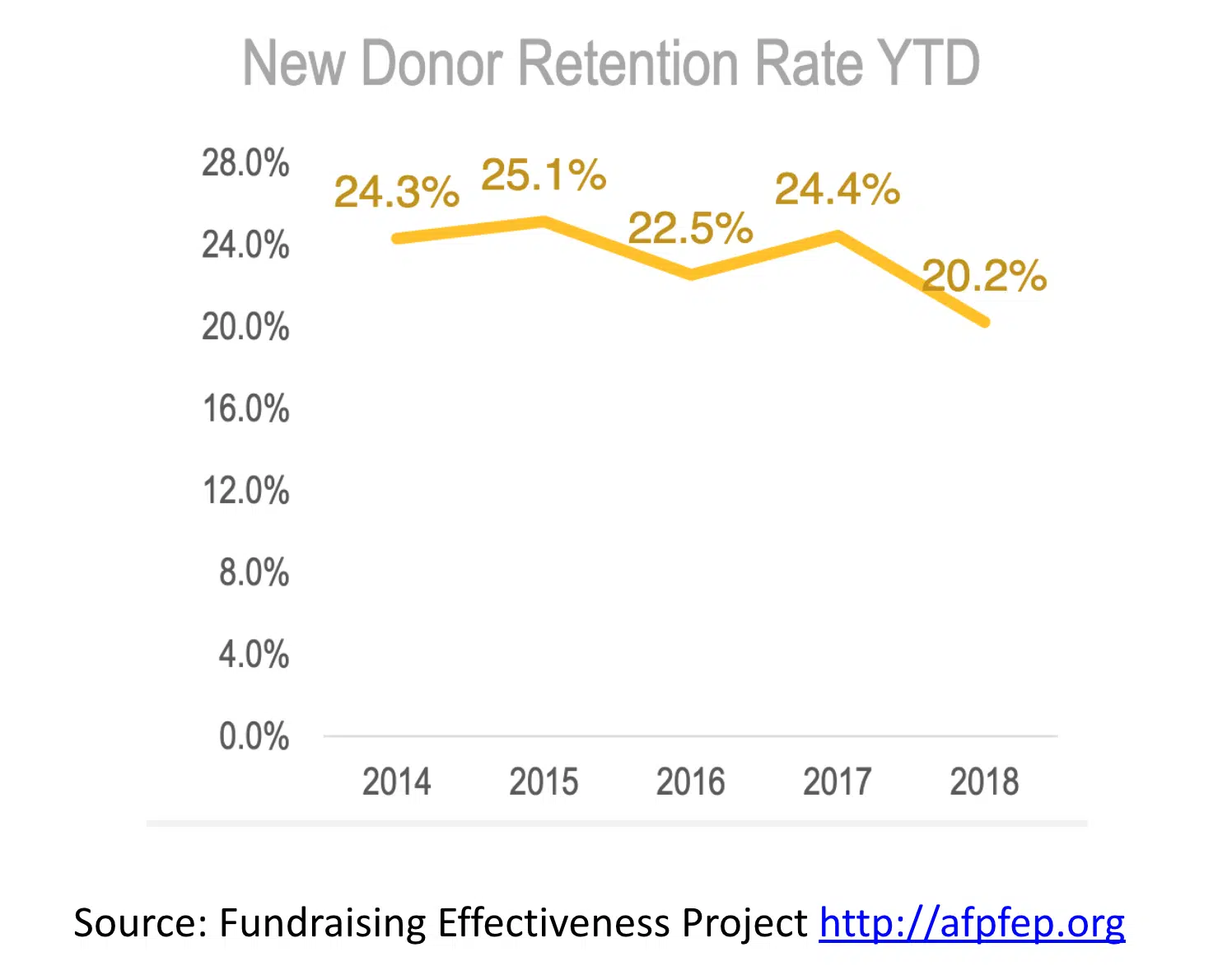
Could it be that we’re leaning more on automation to communicate with these new donors?
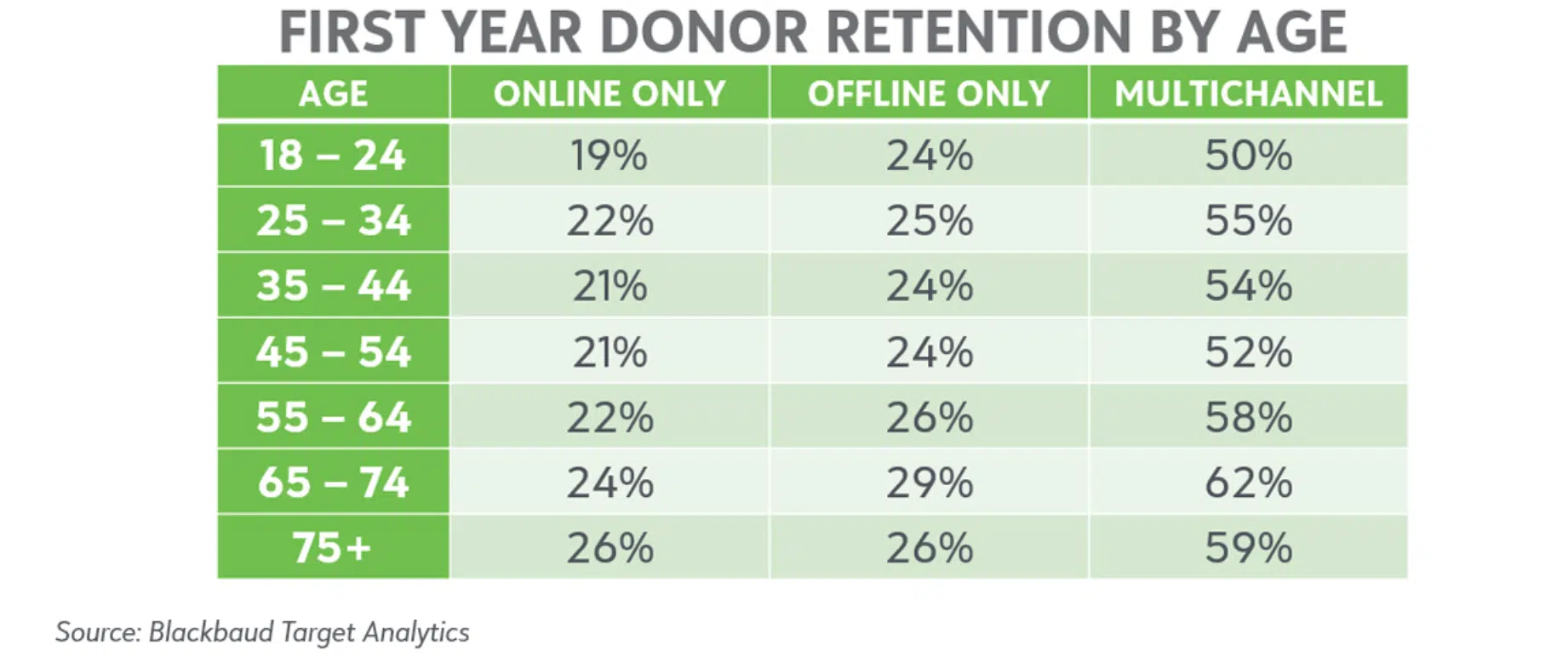
Or is because more first-time gifts are made online, where retention rates are typically lower than gifts made offline?
Automating your donor communications can save precious time and ensure every supporter feels valued—without sacrificing the personal touch that builds lasting relationships. But not all emails should be on autopilot. The key is automating the right messages that keep donors engaged and move them along their giving journey.
Here are some of the most effective donor emails to automate:
Getting started is simple with Bloomerang’s Journey Automation tool. Here’s a quick step-by-step to launch your first automated donor workflow:
For a deeper dive into email marketing strategies tailored for nonprofits, check out Bloomerang’s comprehensive resource, Email Marketing for Nonprofits: The Ultimate How-To Guide. It’s packed with expert tips to help you craft compelling emails that inspire giving and strengthen supporter relationships.
Ready to save time and boost donor retention? Try Bloomerang’s Marketing & Engagement tools today and turn your email communications into powerful, personalized experiences that grow your mission.
One way to truly make automation work for you is to make sure that the automated communications online donors receive from you are less transactional and more appreciative.
Pay special attention to:
1. Confirmation page (the page of your website donors are redirected to after donating)
2. Automated receipt email (sent from your donor database/payment processor/online giving provider)
These two things can be optimized to thank the donor warmly, tell a story, preview future impact and maybe even collect information through a survey (“what prompted you gift today?”). These should be generic enough to apply to all donor frequencies (since every online donor will see/get them) but still communicate impact.
All that being said, If I was running a development department and wanted to increase my first-time donor retention rates, I would do the following:
If you absolutely cannot do this for new donors, then an automated email series might be better than nothing. But you’d still run the risk of sending content that is one-size-fits-all.
Probably, but not yet.
Someday our software will have such sophisticated AI and machine learning that we’ll be able to deliver one of several automated emails cadences based on a specific combination of a donor’s gift amount, gift channel, gift method, geography, demographic and motivation (assuming it can collect or infer that at the time of donating), but until then (and maybe even after) I’d put my money on the personal touch.
Have you had success with an automated email welcome series, and think I’m wrong? Tell me why in the comments below!