AI for Nonprofits: Helpful Prompts & Next-level Tips




If your nonprofit is experimenting with AI, you’re in good company. A recent Twilio study found that 90% of nonprofits, education institutions, and healthcare organizations already use AI in at least one part of their donor engagement or marketing work.
But there’s a world of difference between dabbling with AI and welcoming it into your workflow as a trusted partner—one that helps you reclaim precious hours, uncover new opportunities for generosity, and strengthen the supporter relationships that fuel your mission.
This blog post is here to help you do exactly that. We’re moving past the hype and into real, practical steps for using AI intentionally and ethically, with ready-to-use prompts designed specifically for nonprofits.
AI for nonprofits: FAQs
What is AI for nonprofits (and what isn’t it)?
AI for nonprofits is the set of smart, supportive technologies that help simplify—and amplify—your everyday work. It can brainstorm content, summarize complex information, analyze donor behavior, and help you craft more personalized fundraising strategies.
But here’s the truth of it:
AI isn’t here to replace your people. It’s here to support them.
Think of AI as a partner that takes on the busywork, surfaces insights you might otherwise miss, and helps you make sharper, more confident decisions rooted in real data—not guesswork.
This is exactly how we designed Penny, Bloomerang’s AI fundraising partner. Penny builds on decades of proven fundraising wisdom and your real donor data—so her guidance always connects back to what works, not what’s trending.
What are the three main types of AI?
There are various approaches to AI, each serving different purposes. The three main types of AI you should know about are:
- Generative AI uses your input to create new content, from images to texts to music. One of the most popular generative AI programs is ChatGPT, which aims to provide human-like responses.
- Traditional AI encompasses rule-based programs designed to perform specific tasks. These systems follow predefined instructions and cannot learn from new data.
- Machine Learning (ML) is a branch of AI focused on developing algorithms that enable systems to learn and improve over time. It can automatically recognize patterns, make decisions, and improve performance based on the data it receives.
Which AI tools are most helpful for nonprofits?
Many nonprofits already use AI without realizing it. But the tools that make the biggest difference generally fall into a few key categories:
Donor management
- AI built into your CRM (like Bloomerang + Penny) for revealing opportunities based on reports, personalizing outreach, and strengthening donor stewardship
- Predictive models for identifying donor capacity or likelihood to give
Content & brainstorming partners
- ChatGPT, Gemini, Claude, and Bloomerang’s AI Content Assistant for drafting emails, summarizing research, or repurposing impact stories
Marketing & design
- Canva’s Magic Studio for visuals
- Jasper for marketing copy
Operations & admin
What are some of the best AI use cases for nonprofits?
AI shines brightest when it’s helping you save time or make smarter, more informed decisions. Think of it as a task-doer. Here are a few useful examples:
Fundraising & stewardship
- Draft or summarize grant narratives
- Personalize donor appeals for different segments
- Suggest tailored stewardship touchpoints based on giving history
Marketing & communications
- Create a three-month content calendar
- Turn one story into multiple social posts
- Draft newsletter subject lines and intros
Volunteer management
- Analyze skills, preferences, and availability to match volunteers with the best roles
- Schedule volunteers efficiently and reduce scheduling conflicts
- Automate reminders and information about volunteer activities
Event planning
- Create unique event ideas by analyzing data, trends, and supporter preferences that align with your event’s mission
- Transcribe your event planning meetings into searchable documents
- Streamline social media scheduling, email campaigns, and audience targeting
Grant writing assistance
- Research and match relevant funding opportunities to your organization's mission
- Generate first drafts of proposal narratives, capability statements, and budget justifications
- Proofread submissions against complex funder guidelines and compliance checklists
Data analysis & forecasting
- Recognize patterns and trends within your database
- Predict future trends and potential challenges
- Determine the best times to target appeals to donors
Cybersecurity & fraud prevention
- Monitor and predict behavior patterns to block potential cyberattacks
- Identify anomalies and potential threats before they get a chance to attack your system
- Prevent card testing fraud on donation forms
Operations & admin
- Summarize long meetings with key takeaways
- Draft volunteer recruitment messages
- Create clear, friendly event instructions
Chatbots & virtual assistants
- Provide personalized and detailed responses to supporters’ questions
- Troubleshooting issues and offering solutions
- Propose optimal meeting times and manage appointments
How can nonprofits use AI responsibly?
Many nonprofit professionals feel both excited and cautious about AI. That healthy mix of caution and excitement is exactly what leads to using AI responsibly, and that’s how you build trust. Reassure your team, donors, and volunteer community with these ethical guidelines:
- Protect your data: Never copy and paste donor PII into public tools. Use secure, built-in AI features like Bloomerang’s that work inside your CRM.
- Keep humans in the loop: AI provides a draft. Your team provides the heart.
- Watch for bias: Review outputs for equity, inclusion, and accuracy.
- Be transparent: Communicate how you’re using AI—internally and with supporters.
- Document your standards: Create a simple, sharable AI use policy for your team and the public.
Along the way, remember to proofread, fact-check, and check for plagiarism, as AI can make mistakes.
What is AI prompting—and where do I start?
Prompting is simply telling the AI what role to take, what context it should know, and what you want it to produce.
The easiest way to get started is with the RCGO model:
- Role: Who the AI should be – “Act as an expert nonprofit fundraiser.”
- Context: Audience, tone, constraints – “The audience is donors who have not given in at least two years. The tone should be warm, inviting, and demonstrate that we miss them.”
- Goal: The outcome you want – “Invite these lapsed donors to give to our new ‘Community Garden’ project with a $10,000 goal.”
- Output: The format you need – “Write a three-paragraph email to help us re-engage these donors.”
How can you use the RCGO model? Copy one of the prompts from our prompt library, paste it into your preferred AI tool, and adjust. That’s it.
Why do inputs matter so much in AI prompts?
Better inputs lead to better outcomes. Many AI tools let you feed in brand guidelines, examples, personas, or past campaigns. Others—like Penny—pull from your existing donor data, giving you meaningful guidance without needing to upload anything.
More context = more accurate, trustworthy suggestions.
Can my nonprofit avoid using AI?
You can—but you’re already using it in tools you rely on every day both personally and professionally, like Siri, Google Search, and Amazon Alexa. The real question is:
Will you use AI intentionally to strengthen your mission?
When used with clarity and care, AI saves time, nurtures donor relationships, and helps you do more without asking your team to work more.
AI prompts for nonprofits
We created a nonprofit-focused AI prompt library to help you get the most out of generative AI tools like Penny, Gemini, or ChatGPT.
Here’s a preview of what’s inside:
Campaign planning & strategy prompt
Role: You are a Development Director at a mid-sized nonprofit.
Context: Your audience is current donors who gave in the past two years, and you want to re-engage them with storytelling and impact updates rather than repeated appeals.
Goal: Build a three-month retention-focused campaign.
Output: Include an outline with timeline, messaging themes, communication channels, and three storytelling or impact update ideas.
Social media & email content
Role: You are a digital marketing manager at an animal welfare nonprofit.
Context: You are preparing for National Volunteer Week and want content that highlights volunteer impact, celebrates contributions, and encourages more people to get involved.
Goal: Drive engagement and celebrate volunteers through compelling social media content.
Output: Provide five platform-specific posts (under 100 words) with images + hashtags.
Thank-You Messages
Role: You are a Communications & Development Manager.
Context: The templates you currently use for donor thank-yous feel generic; they need more heartfelt personalization, tailored to each donor’s giving history.
Goal: Write meaningful, personalized thank-you emails to donors.
Output: Provide three thank-you email examples and list best practices for personalizing donor acknowledgements.
Three simple steps for getting started with nonprofit AI
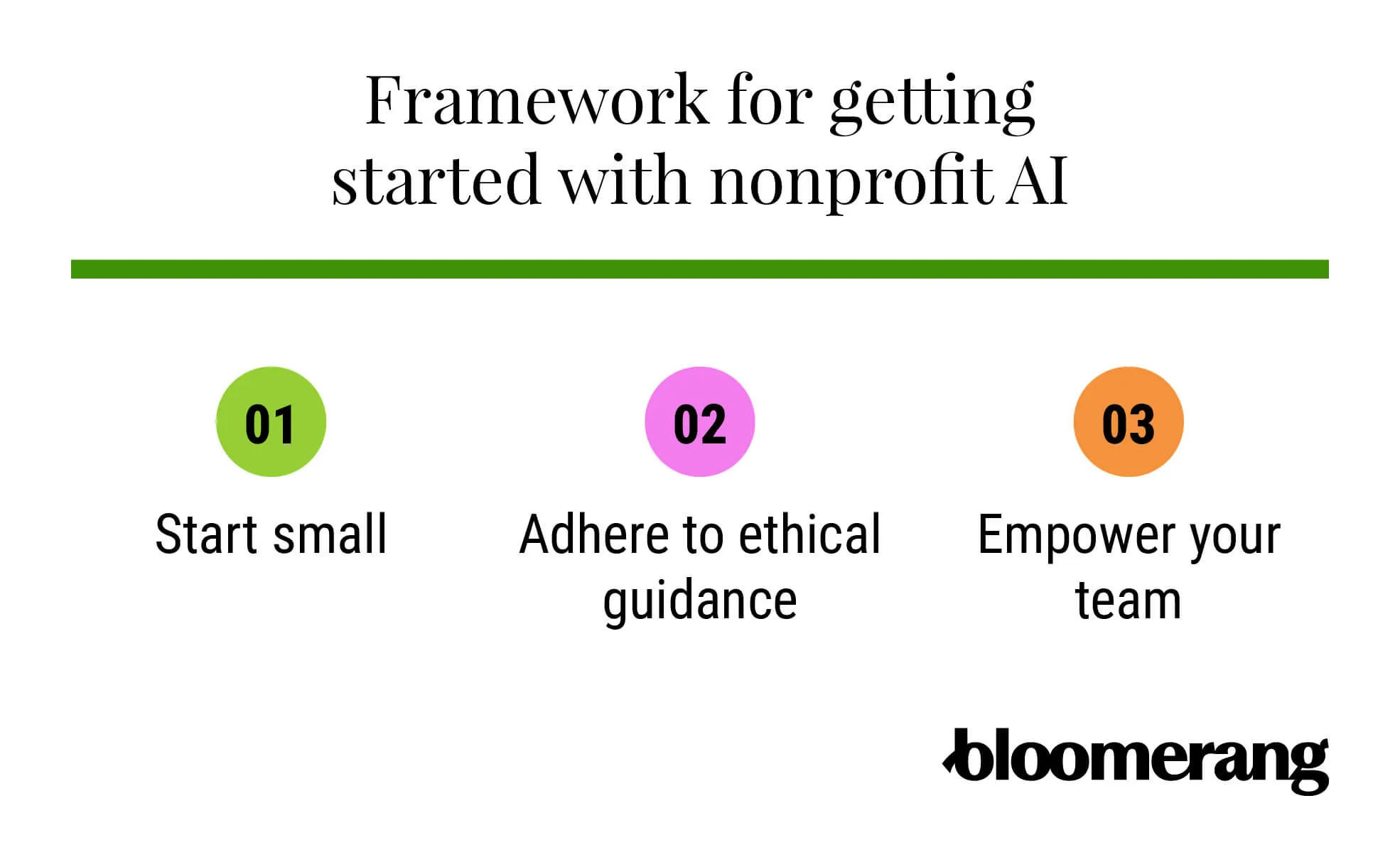
1. Start small.
AI, like most new tech, can be overwhelming at first. Don’t try to do everything at once!
Begin with one task—like drafting an email or summarizing a meeting—and iterate your prompt until it feels just right. Each small win builds your confidence and improves output quality.
2. Follow ethical guidelines.
Develop a simple AI guide for your nonprofit team to follow. Be proactive to prevent security or ethical issues.
A few principles make all the difference:
- Review and refine all AI-generated copy
- Avoid entering sensitive donor information into public tools
- Choose secure, purpose-built AI for data-focused work
- Confirm compliance with regulations like HIPAA or FERPA
3. Empower your team.
Training helps nonprofit staff feel supported, not replaced. Consider hosting a prompting workshop or sharing a short internal guide. Emphasize that:
- AI handles the grunt work
- Humans handle the heart work
- Together, they amplify impact
Encourage your team to experiment, especially with customizable tools like Gems or Custom GPTs. These tools will help you further tailor your prompts and create even higher quality outputs.
Remember: the more comfortable your team feels using AI solutions, the more your nonprofit can raise and achieve next-level impact.
Launch an AI-powered fundraising strategy with Bloomerang
Although it’s possible to tailor AI solutions like ChatGPT or Gemini to your nonprofit’s unique needs, it takes time and effort—time most teams don’t have. And because these tools aren’t built for purpose, they often miss the nuance and heart behind your nonprofit’s mission. Bloomerang is taking a different approach with Penny, an AI fundraising partner grounded in and trained on real nonprofit experiences.
With Penny, our AI fundraising partner, nonprofits get guidance rooted in real fundraising expertise. Penny is trained on decades of hard-earned best practices from Bloomerang’s fundraising consultants and informed by your actual donor data, giving you clarity you can trust.
Penny meets your team where you are—no matter your current level of AI experience—and helps you turn supporter behaviors, donor journeys, and campaign milestones into smart, actionable steps.
With Penny, your organization can:
- Ask questions in clear, conversational terms, such as “Which donors gave last year but not yet this year?” or “Which volunteers are most likely to become donors?” to get immediate answers based on your nonprofit’s supporter data
- Reveal useful donor insights you may not spot on your own, such as lapsed-donor alerts or donor upgrade opportunities
- Streamline tasks like donor segmentation, first-draft content creation, and workflow planning, so you can spend more time cultivating genuine connection
- Take the necessary next steps to roll out new strategies, such as starting a campaign, prioritizing outreach, or assigning key donor follow-up tasks
Penny doesn’t replace your team—she elevates it.
By handling the heavy lifting behind the scenes, Penny frees your staff to show up where they’re needed most: building relationships, deepening generosity, and shaping a future full of impact.
With AI that’s built for purpose—and built for you—your nonprofit can deliver the personalized donor experience supporters crave, without stretching your team thin.

Wrapping up
AI is moving fast—but you don’t need to start sprinting right away. Your first step is simple: open a browser, try one prompt, and see how much time you can reclaim.
Used mindfully and with purpose, AI can help you strengthen donor relationships, raise more, and pour your energy back into your purpose-driven work.
Looking to go deeper? Explore these free nonprofit-focused AI resources:
- AI fundraising explained: boost donor engagement & ROI.
- AI tools for nonprofits: a complete guide in 2025.
- The 12 best donor management software options for 2025.